GDPR Compliance for AI Agents Accessing Data Through MCP Servers
Organizations must embed GDPR controls at the MCP server layer before deployment.
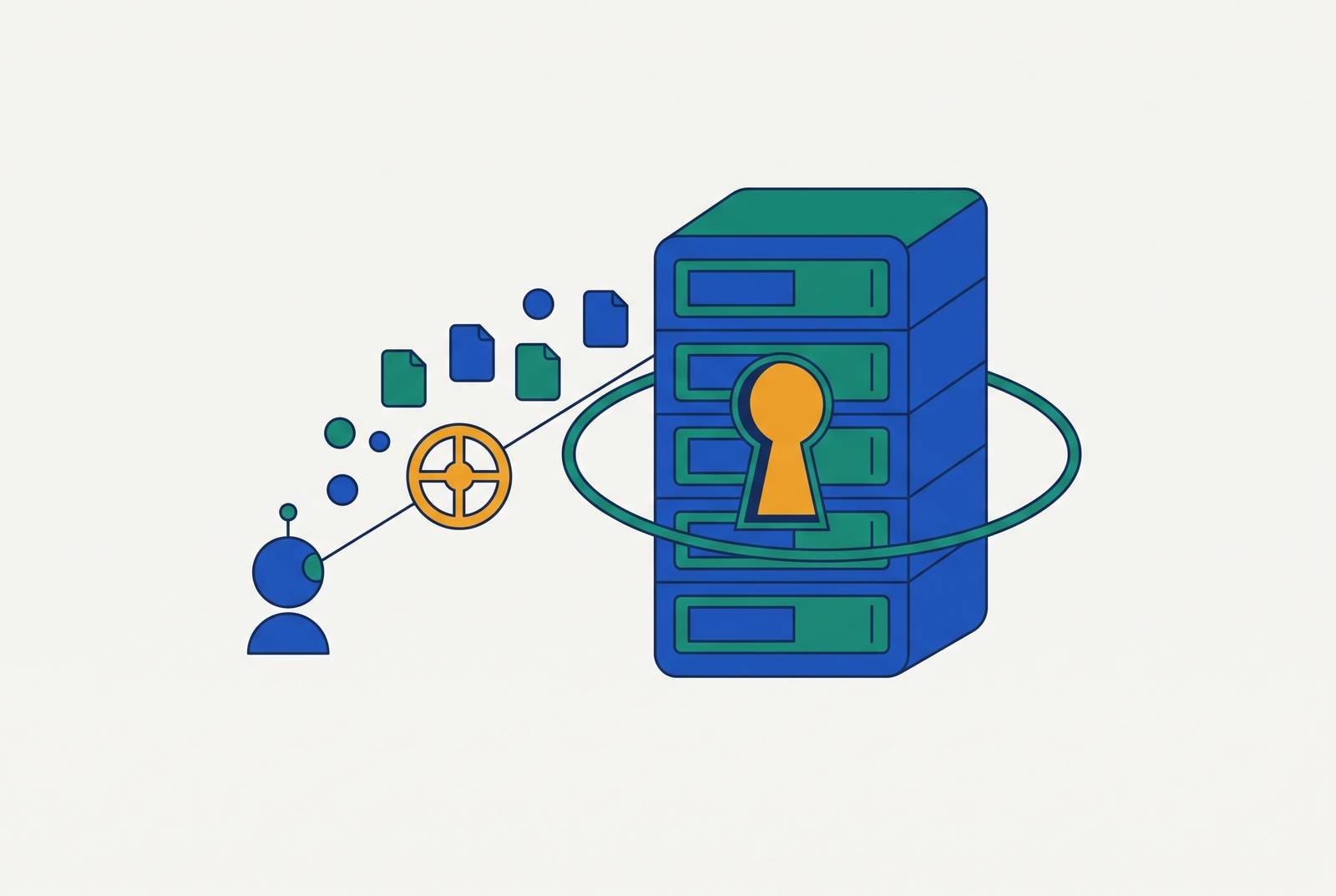
GDPR compliance for AI agents using Model Context Protocol requires controls where personal data enters the workflow, at the MCP server layer. Agents inherit a connection’s access while leaving its data controls behind. The six core obligations, namely lawful basis, data minimization, logging, breach notification, data subject rights and cross-border transfer safeguards, must therefore be built into MCP governance before deployment.
Why MCP agents inherit access but not controls — and why that gap is a GDPR problem
MCP separates a connection into three actors, which are the host, client and server. The host initiates a request, the client routes it and the server executes against a data source. That creates an access layer separate from the controls in the source system. The connection may give an agent permission to reach records without carrying over the limits that made access appropriate in the original application. Whether access is scoped, logged or lawful then depends on how the server was built.
Servers built for capability first can expose personal data without equivalent governance. A server can work exactly as designed, with no breach or technical failure, and still harm a data subject by processing too much data or using it in ways it should not.
The deployment picture makes that distinction important. Most MCP deployments run with full system privileges and direct filesystem access, and many come from unofficial sources whose authors are unknown. Because the MCP server acts as a processor under Article 4(8), every personal-data field it touches falls under the full weight of GDPR from the moment the connection is made.
Why GDPR's existing framework strains against the way MCP agents actually process data
GDPR’s framework assumes that an organization can identify why it processes data, who is responsible and where the data goes. Agentic workflows make each answer less stable. A single session can combine CRM contacts, hiring records and accounting invoices in one prompt. That recombination strains purpose limitation because the agent can assemble a use of data that was not defined for any individual connection.
The same instability affects legal roles. An agent may call a third-party API, retrieve information from an external register and chain a sub-agent within one task. Those who take part may have different roles as a controller or processor. A data processing agreement that labels every participant a processor can therefore describe a simpler chain than the one actually operating. When agents choose tools on their own, they also decide some cross-border data flows at runtime, without a transfer decision made in advance.
The EU AI Act adds rules alongside those in GDPR. MCP servers process personal data and are also parts of AI systems that may be high-risk. Spain’s AEPD guidance published February 2026 makes the accountability boundary clear, stating that autonomous data handling remains legally attributable to the controller that deploys the system and determines its purposes and essential means. More careful role mapping matters, but paperwork alone cannot constrain a runtime decision. Organizations therefore cannot rely on standard processor-agreement templates and must embed controls at the MCP layer itself.
Lawful basis and purpose limitation at the MCP server layer
The first deployment test is concrete. For every tool a server exposes, the deploying organization must be able to produce a written statement of the lawful basis and purpose for its personal-data processing. If it cannot do so now, deployment is already non-compliant. Permission to connect is not a lawful basis, and an agent’s eventual behavior cannot supply a purpose retrospectively.
For enterprise MCP deployments, the Article 6 bases that often apply include contract necessity for customer data and legitimate interest for operational analytics. Legitimate interest requires a documented balancing test. For each connection, the organization must also define the specific fields being processed and the purpose they serve. The resulting scope must govern what the tool can retrieve.
A customer-service server must therefore be technically prevented from accessing HR data. The NSA’s May 2026 advisory found that MCP lacks support for exchanging RBAC permissions at instantiation, leaving enforcement to the governance layer above the protocol. AEPD’s “Rule of 2” offers another boundary for design. Combining any two of uncontrolled input, sensitive information access and autonomous actions demands heightened controls, while combining all three demands architectural separation. An instruction that leaves the final choice to the agent is not an enforceable boundary.
Data minimization in the MCP context window
Once processing has a lawful purpose, the next question is how much data that purpose needs. MCP creates pressure to give the agent more context for better results. But Article 5(1)(c) requires data minimization. Sending an entire API payload when only some fields are needed violates that principle even if the agent never misuses the extra data.
Minimization is therefore a server configuration decision for each tool before deployment. Tool descriptions must spell out which fields go to the model. Personal data should be pseudonymized before it is sent wherever the technology allows. That step must happen at the server, before the data enters the context window, because filtering it later cannot undo what has already been shared.
CIC Hospitality illustrates the distinction in production. It uses EU-hosted data across 50+ data sources, including hotel guest records, POS transactions and accounting data. Passport numbers and special-needs fields are redacted at the column level before an AI agent reads them.
Retention needs a separate boundary. A server that caches a payload also engages Article 5(1)(e), because it keeps data beyond the moment the agent needed it. A pass-through architecture sends live data on without keeping a copy, avoiding the added risk of storing it. Zero-retention configuration must still be verified contractually with both the MCP server vendor and the LLM API provider.
Audit logging as a GDPR obligation, not an operational convenience
After limiting what an agent can touch, the organization must be able to prove what it touched. Article 30 requires records of processing, while Articles 33–34 require organizations to give notice of breaches. Those obligations depend on evidence of the data accessed, the time of access and the tool involved. A permitted connection without a usable record leaves the organization unable to reconstruct the processing.
Default MCP logging does not provide that evidence by itself. Servers do not, by default, produce persistent, audit-grade activity records with the session context needed for reconstruction. The specification also prohibits its own logging channel from carrying personal identifying information such as unique user identifiers. A compliance audit trail therefore cannot be assumed to exist because a server has a logging feature.
The notification deadline makes this an operational requirement. Article 33’s 72-hour window leaves little room to discover what happened after awareness of a breach. Article 34 separately requires notification to affected people without undue delay when the breach poses a high risk to their rights and freedoms. CIC Hospitality’s audit log explicitly supports Article 30 ROPA documentation and 72-hour breach reconstruction. Centralized governance tools, including MCP Manager, provide audit trails and access controls at the MCP layer. The governing criterion is real-time, session-linked evidence, without which a deployment is structurally non-compliant from day one, before any breach occurs.
Authentication and access control as the technical floor for Articles 5 and 32
Logging can record a boundary, but it cannot create one. Without enforced authentication and role-based access control, lawful purpose and field limits have no dependable point of enforcement. Authentication establishes an accountable identity, while RBAC ties that identity to deliberately permitted actions. Together, they make the processing principles in Article 5 and the security requirements in Article 32 enforceable.
The June 2025 MCP specification update (2025-06-18) classifies HTTP-based MCP servers as OAuth Resource Servers and requires OAuth 2.1 authentication. STDIO transports are explicitly excluded from that requirement. Resource Indicators under RFC 8707 are also required to prevent a token issued for one server from being redeemed at another. These protocol requirements do not remove the governance layer’s responsibility for role-based permissions.
The GitHub MCP prompt-injection incident in May 2025 shows what broad permissions can enable. An over-privileged Personal Access Token allowed a compromised agent to exfiltrate private repository contents, internal project details and personal data, including salary details and physical address, into a public pull request. The root cause was broad PAT scopes combined with untrusted content in the LLM context. The organization must decide what access to allow and put that decision in writing, even when the connection has inherited privileges. Otherwise, even an accurate audit log records processing the organization never meaningfully bounded.
Cross-border transfer safeguards when agents autonomously route data
Controlled access answers what an agent may retrieve, but not where the data will travel. When an agent selects a tool that routes personal data outside the EEA, a Chapter V transfer occurs whether or not the organization planned it. An EU-based user’s data passing through a US-hosted MCP server to a US-based LLM is a transfer. Failing to classify it that way does not change the data path.
The agentic gap is the timing of the decision. Tool selection can determine the route at runtime, while transfer safeguards depend on knowing the recipients and conditions in advance. Standard Contractual Clauses alone do not close that gap. The organization must account for each relevant hop, including the MCP server host, any intermediate integration layer, a unified API vendor and the LLM API.
Across the processing chain, the organization needs signed data processing agreements, Standard Contractual Clauses where they apply and Transfer Impact Assessments in writing. The EU-US Data Privacy Framework also provides a valid mechanism for certified US recipients, but certification must be verified for each relevant sub-processor. Major LLM providers disclaim responsibility for retention by third-party services beyond the inference call. Under that disclaimer, the deploying controller remains liable and responsible for closing the documentation gap around every service that can read, store or replay the personal data.
Data subject rights enforcement across an MCP access layer
A source system’s rights-management process is incomplete if it stops before the AI workflow. Article 15 access requests require lineage from the source through any warehouse cache to the agent’s processing. The organization must be able to identify what data about the person was accessed, in which session and through which tool.
Article 17 erasure covers both the original record and any copies that have been kept. Deletion must propagate to the warehouse, any MCP server cache, log exports and derivative outputs produced by the agent. Article 18 restriction requires a different mechanism. Server configuration must enforce a flag for each data subject that keeps that person out of AI processing without deleting their data.
Article 22 adds the need for human-in-the-loop gates on agent writeback where automated decisions affect the data subject. Approval of the original task does not itself provide human review of a later decision inferred by the agent. Each right therefore tests a distinct part of the architecture, including lineage, deletion propagation, exclusion and review. The one-month response window does not pause while an organization discovers that these capabilities are missing. Rights enforcement must reach the MCP layer before deployment rather than being built in response to the first request.
Embedding the six obligations in MCP governance before deployment
These obligations meet at the point where a server is registered and approved. A centralized registry makes the rest of governance possible because an organization cannot apply policy to servers it cannot enumerate. Registry coverage supports access control, records of processing and accurate breach reconstruction. An unregistered server is an identity the organization cannot account for.
Buying decisions must therefore take account of more than the number of connectors. The relevant criteria include purpose enforcement, field-level scoping, audit evidence, rights-request support and transfer documentation. Buying connectivity first and discovering these gaps during a complaint or regulatory inquiry reverses the necessary order.
MCP Manager is one option for this control layer, providing a gateway, access controls, real-time observability, audit trails, RBAC enforcement and registry coverage. Usercentrics acquired MCP Manager, bringing data governance expertise to that architecture. Those capabilities support compliance work but do not replace the organization’s decisions about lawful purpose or its contractual obligations.
A governed route to the tools employees want also reduces the pressure for shadow deployments that a blanket ban can create. Clear boundaries let teams approve production use rather than postpone governance until something goes wrong. The organizations that treat AI governance as a competitive advantage will be the ones that earn the trust of regulators and users in the agentic era.