MCP vs API Fundamental Differences

There is a phrase I keep hearing in engineering meetings, usually from someone who has just skimmed a blog post about AI agents: "It's just another API." I understand the instinct. From a certain altitude, everything that lets two systems exchange data looks like an API. But that framing flattens a structural distinction that actually matters, and if you're building AI systems, or governing them, or securing them, the flattened version will eventually cost you something.
Let me try to show you what I mean.
The Scaling Problem That Made a New Protocol Necessary
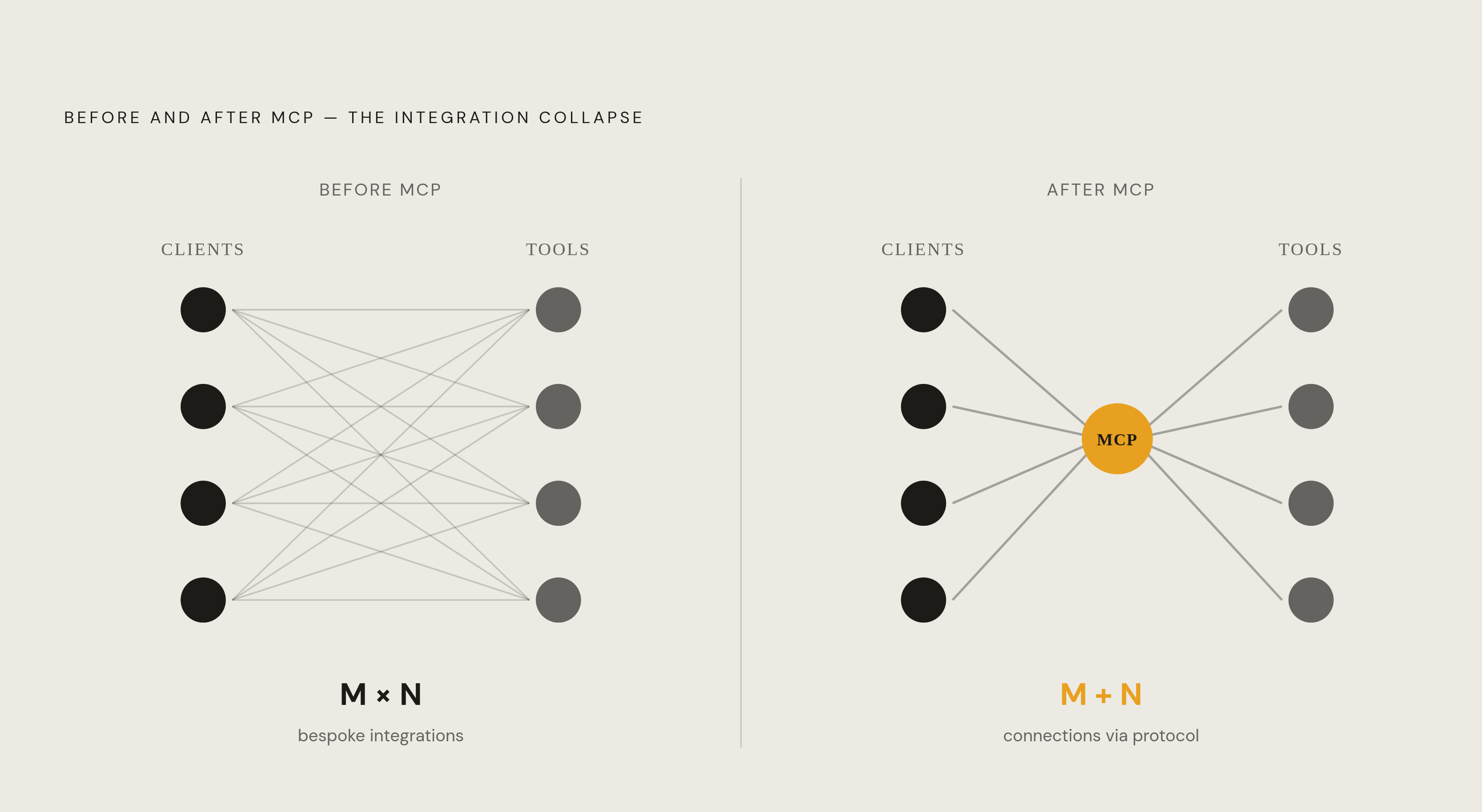
Before MCP existed, connecting an AI application to external tools meant writing custom integration code. Every time. For every pair of tools and AI clients.
Think about that combinatorially. If you have some number of AI clients and some number of tools those clients need to reach, the total number of bespoke integrations you have to build and maintain is the product of those two sets, not the sum. Engineers who have tried to connect large language models to real enterprise systems at scale know this wall intimately. It's not a theoretical concern; it's the point at which ambitious architectures become maintenance nightmares.
The origin of MCP is instructively mundane. David Soria Parra and Justin Spahr-Summers, engineers at Anthropic, built the protocol out of practical frustration. Soria Parra was tired of copying code between Claude Desktop and his IDE. That's it. That's the inciting problem. The kind of friction that seems minor until you're doing it constantly, at which point it starts to feel like a structural failure.
Their structural answer: require each client and each server to implement the protocol once. A single MCP server can then serve any MCP-compatible AI client. A single AI client can connect to any MCP-compatible server. The integration count collapses from a product to a sum. Each new tool added to the ecosystem serves the entire pool of compatible clients automatically.
Anthropic introduced MCP as an open standard in November 2024, and the "open" part is not incidental. Because the protocol doesn't belong to any one vendor, there's no competitive reason for rivals to avoid it, and every reason to adopt it. That's a network-effects argument. The value of the standard increases with every server and client that joins, which is why, when major competing platforms added support, the story was architectural, not just commercial.
What MCP Actually Is, Technically, and Why Calling It "Just Another API" Misses the Point
Here is where I need to be precise, because the technically accurate description can be misleading.
Yes, an MCP server is a form of API. Fine. But so is every protocol that lets two systems communicate. The meaningful comparison is with REST APIs as developers actually use them, and that comparison reveals something substantive.
MCP uses JSON-RPC 2.0 as its message format: structured method calls, like "tools/call" with parameters, rather than the resource-oriented HTTP endpoints REST developers are accustomed to. But the message format isn't the interesting part. The interesting part is what MCP exposes and how it exposes it.
MCP defines three primary capability types. Tools are executable functions the model can invoke. Resources are structured data sources the model can read. Prompts are reusable interaction templates. These aren't endpoints in the REST sense; they're capability primitives, and that distinction matters for how an AI agent interacts with them.
The architecture has three components. The host is the AI application the user actually talks to, something like Claude Desktop or an IDE. The client lives inside the host and maintains a stateful session with a server. The server is external, exposing its tools, resources, and prompts to whatever client connects.
What makes this architecturally flexible is the transport layer. MCP supports stdio for local communication with no network overhead, WebSocket for persistent bidirectional remote connections, and HTTP with Server-Sent Events for serverless or firewall-restricted environments. That flexibility means MCP can operate across local, cloud, and hybrid deployments where traditional HTTP APIs would require additional scaffolding for each context.
None of that, taken individually, sounds revolutionary. But the combination, stateful sessions, machine-readable capability descriptions, a consistent protocol structure across tools, creates a different kind of interaction model. And that difference is what changes how AI systems behave.
The Four Structural Differences That Change How AI Systems Behave
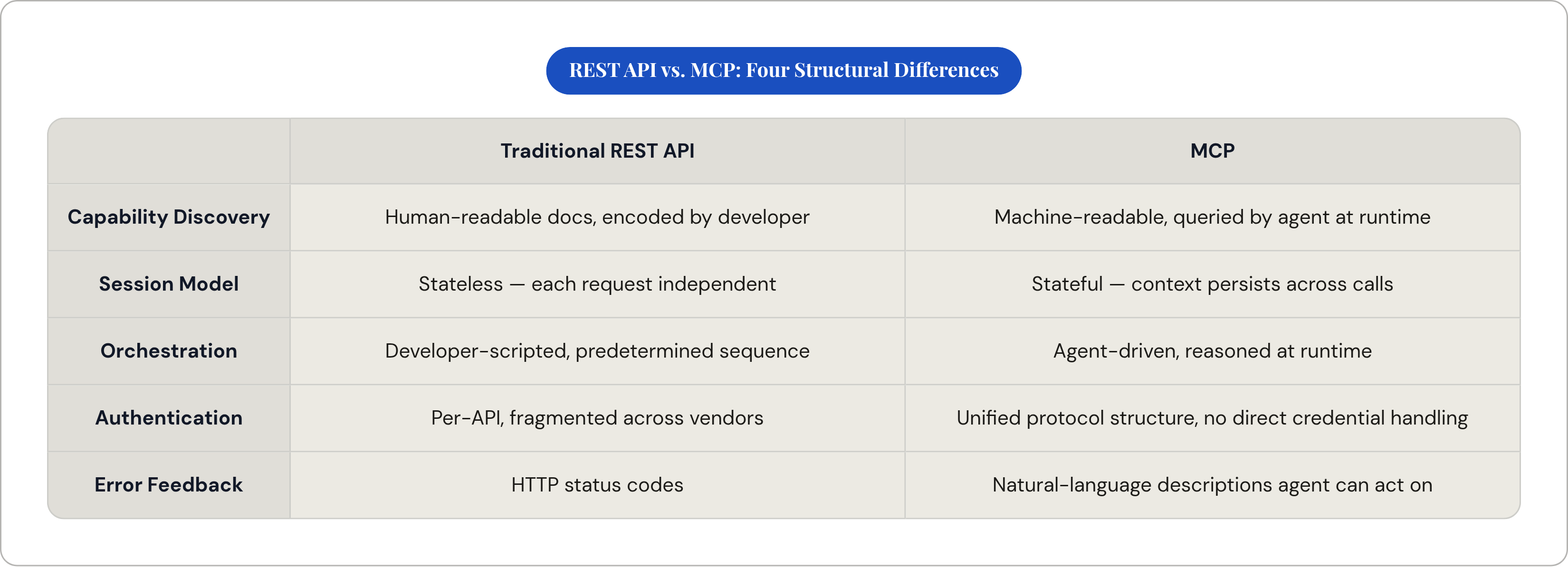
Static documentation versus dynamic capability discovery. A REST API does not describe itself to callers. The knowledge of what an API can do lives in human-readable documentation, written by humans for humans. A developer who built the integration had to read that documentation, understand it, and encode that understanding into the integration logic.
An AI agent operating through MCP can query a server directly: what tools do you offer? The server responds with a machine-readable list: function names, parameter types, expected outputs. The agent doesn't need documentation because it receives capability descriptions it can actually process. Behaviorally, this means an agent can adapt to new tools at runtime without the developer having pre-programmed each integration.
Stateless request-response versus stateful session. Every REST API call is independent. The server holds no memory of prior calls. If you need the server to understand that your current request is part of a larger workflow, you have to re-send all the relevant context every time. That's fine when the caller is a deterministic program following a script. It's awkward when the caller is an AI agent reasoning through a multi-step task.
MCP maintains a stateful session across an interaction. The server understands that multiple calls are part of the same task. A workflow that requires research, then synthesis, then revision is coherent, because the session carries context forward rather than requiring the agent to reconstruct it from scratch at each step.
Caller-driven orchestration versus agent-driven orchestration. In a traditional REST integration, a developer writes explicit step-by-step logic. The sequence is predetermined in code before the integration runs. The orchestration intelligence lives in the codebase.
In MCP, developers define tool boundaries and expose capabilities. The AI decides when and how to invoke them based on the goal it's pursuing. The orchestration intelligence moves from the codebase into the model. This is the shift that makes agents genuinely agentic, because they can reason about which tools to chain and in what order, rather than executing a predetermined sequence.
Per-API authentication fragmentation versus unified protocol structure. Every REST API has its own authentication scheme: OAuth implementations that vary by vendor, API key formats that differ across services, custom token patterns that require bespoke handling. Every integration has to manage these separately.
MCP provides a consistent protocol structure across all connected tools. The model interacts with one standard regardless of what's behind the server. The agent never directly handles credentials. Practically, this means extending an agent to a new tool doesn't require rebuilding authentication logic from scratch, and the reduction in per-integration configuration friction is real.
One additional detail worth noting: MCP provides semantic, natural-language error feedback rather than cryptic HTTP status codes. When something goes wrong, the agent receives a description it can reason about, which means it can attempt correction autonomously rather than failing silently or requiring developer intervention.
How MCP Layers Over APIs Rather Than Replacing Them
I want to be clear about something that often gets muddled in conversations about this.
MCP does not replace REST APIs. The most common real-world pattern is an MCP server wrapping one or more traditional REST APIs, providing an AI-native interface while the underlying APIs remain entirely unchanged. The division of labor is straightforward: APIs handle execution, the actual data retrieval, the database write, the service call. MCP handles understanding and orchestration, which tools to call, in what sequence, with what context.
Gartner's projections, as cited in the brief, suggest that the majority of API-gateway and integration platform vendors will have MCP features by 2026. That's the industry treating MCP as an addition to existing API infrastructure, not a departure from it.
For engineering teams, the practical question isn't "MCP or REST?" That's a false choice. The real question is: which of our existing APIs should we expose through MCP servers, and for which agent use cases does that exposure create value?
What MCP does not do is also worth stating directly. It doesn't manage the underlying API's rate limits, data schemas, or business logic. Those remain the REST layer's responsibility. The separation of concerns is by design, and understanding where that boundary sits is important for anyone building or governing these systems.
Where MCP's Architectural Advantages Create New Security Exposure
Here is where the story gets more complicated, and where I think the industry is still catching up to its own enthusiasm.
Traditional API security is built around a specific assumption: a trusted application is making predetermined requests. The developer defined the integration. The security posture is configured at development time for a known caller making known calls.
MCP changes that assumption. The caller is now an autonomous agent making context-driven decisions the developer didn't fully script. And the very features that make MCP powerful are the same features that create new attack surface.
Dynamic tool discovery means a malicious or misconfigured server can present tools the agent will invoke without human review. Stateful sessions mean a compromised session has persistent access, not just a single-call window. Agent-driven orchestration means attack consequences can chain: one compromised tool can influence the next call in a multi-step workflow.
There are attack vectors specific to MCP that simply don't have analogues in traditional REST contexts. Tool poisoning, where malicious instructions are embedded in tool descriptions. Rug-pull attacks, where a server changes its tool behavior after the agent has established trust. Cross-server shadowing, where one MCP server influences the behavior of another in a multi-server session. Prompt injection through resource content.
A 2026 security analysis cited in the brief, from researchers including Yan et al., makes a point that deserves emphasis: these weaknesses are architectural rather than implementation bugs. Patching individual vulnerabilities doesn't address the absence of capability attestation. Hardening individual servers doesn't establish cross-server isolation. The security model has to be rethought at the protocol level, not just the implementation level.
Carnegie Mellon's Software Engineering Institute researchers, also cited in the brief, note that MCP's risks extend beyond traditional confidentiality, integrity, and availability concerns into privacy, safety, and system reliability, because agents can autonomously execute high-stakes actions without human review at each step. That's a different risk profile than anything traditional API security tooling was designed to address.
API gateways and web application firewalls are good at what they were built for: validating static request structures, enforcing rate limits, recognizing known attack signatures. They cannot evaluate whether dynamic context flowing through MCP is authentic, or whether an agent's behavioral pattern across a session falls within acceptable parameters.
The protocol shipped fast. Security didn't always keep pace. Initial MCP specifications provided minimal guidance on authentication, and many early implementations defaulted to no auth at all. OWASP has since published an MCP Security Cheat Sheet; CISA released agentic AI adoption guidance in May 2025. Institutional response is catching up, but the governance gap preceded it, and that ordering matters.
Why the Governance Layer MCP Requires Is Different From What API Management Already Provides
Traditional API management assumes the developer defined the integration. Rate limits, authentication, allowed endpoints, all of it is set at configuration time for a known caller. The governance question is: is this request valid according to the rules we already established?
MCP governance has to account for runtime decisions the developer didn't make and couldn't have fully anticipated. Which tools did the agent discover and choose to call? What data did it access across a multi-step session? Did the sequence of tool calls fall within acceptable parameters, not just individually, but as a pattern of behavior?
The registry problem is worth dwelling on. Every MCP server operating without a central organizational inventory is an identity the organization cannot account for. And an unaccounted identity is the one most likely to be exploited, or to drift from its intended scope over time, without anyone noticing.
Access control for AI agents is also structurally different from access control for applications. Role-based access control for agents isn't about restricting capability arbitrarily. It's about ensuring that what an agent can do reflects a deliberate organizational decision, not a default that emerged from automatic tool discovery. Without that intentionality, capability creep is invisible. Agents accumulate tool access because discovery is automatic, not because access was granted.
The observability requirement is one that REST tooling simply doesn't have to meet in this form. You need a session log of which tools an agent called, in what order, with what inputs and outputs, available in real time, not reconstructed after an incident. That's a different infrastructure requirement than anything built for traditional API monitoring.
Gartner projects that a substantial portion of enterprise applications will include AI agents by end of 2026, up dramatically from today. The governance infrastructure question scales with that adoption curve, and the risk compounds if that infrastructure isn't in place before the agents are.
Teams that centralize MCP access policy early gain something concrete: governed access is what allows organizations to say yes to production deployment. The guardrails define the boundary within which agents can operate without per-action human review, and without those guardrails, the answer to "can we deploy this?" is almost always going to be "not yet."
How Fast MCP Adoption Is Outrunning the Governance Infrastructure Behind It
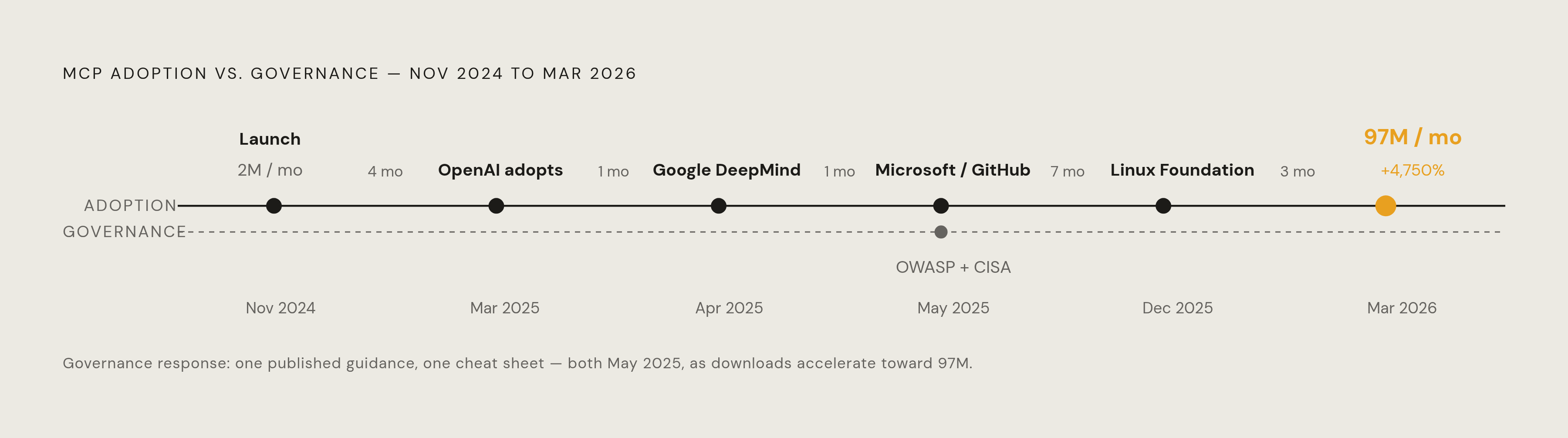
MCP reached 97 million monthly SDK downloads in March 2026, up from approximately 2 million at launch in November 2024. That's a 4,750% increase in sixteen months. It's the kind of number that sounds like marketing until you start tracing the platform adoption timeline that underpins it.
OpenAI adopted MCP across its Agents SDK, Responses API, and ChatGPT desktop in March 2025. Google DeepMind confirmed support in Gemini in April 2025. Microsoft and GitHub joined the steering committee in May 2025, the same month Windows 11 announced native MCP support. By December 2025, Anthropic had donated the protocol to the Agentic AI Foundation under the Linux Foundation, co-founded by Anthropic, Block, and OpenAI. The protocol formally ceased to be Anthropic's.
That last move is architecturally significant. When a protocol transfers to a neutral foundation, it signals that the ecosystem has decided the standard belongs to everyone, and that decision tends to accelerate adoption further, because it removes the last reason for holdouts to resist.
The comparison the research draws is instructive: the adoption curve mirrors foundational infrastructure protocols that took years to govern properly after widespread adoption. npm. REST itself. The pattern is consistent. The technology spreads faster than the organizational and regulatory infrastructure required to use it safely, and the gap between those two curves is where the most interesting and most consequential problems accumulate.
That gap is where MCP sits right now. The protocol is mature enough to be everywhere. The governance layer required to run it safely at enterprise scale is still being built. And the teams that understand why that gap exists, not just that it exists, are the ones positioned to close it deliberately rather than reactively.
The difference between REST and MCP is not just a technical implementation detail. It's a shift in where intelligence lives in a system, where decisions get made, and therefore where accountability has to live. That's the thing worth understanding.