Model Context Protocol Alternatives Compared
MCP's explosive growth masks critical security gaps that enterprises must address before deployment.
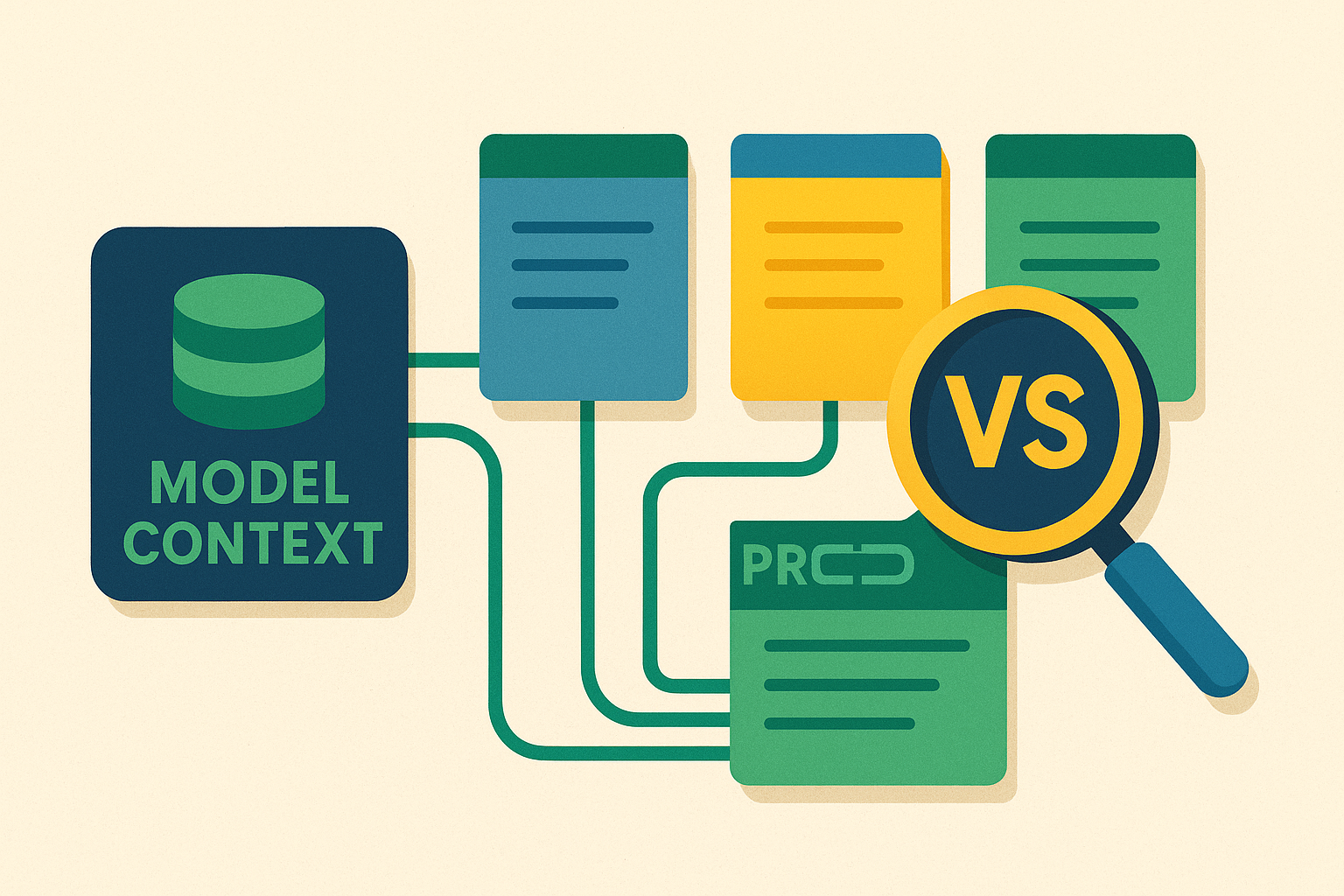
The core mechanic is elegant. You implement a server once for a given data source, and any MCP-compatible AI client can consume it. One implementation, universal access. That is the entire value proposition at the tool-access layer, and it is useful precisely because it is narrow.
The adoption trajectory tells you how badly people needed it. By February 2026, the Python and TypeScript SDKs combined were crossing 97 million monthly downloads. Over 18,000 community-indexed servers existed by March 2026. Every major AI provider, Anthropic, OpenAI, Google, Microsoft, Amazon, now backs the standard. Governance moved to the Linux Foundation's Agentic AI Foundation in December 2025, meaning no single vendor controls the spec. That last detail is easy to gloss over, but it matters: a protocol governed by a neutral foundation is one you can build on without quietly betting your architecture on one vendor's product roadmap.
MCP does not define how agents communicate with other agents. The protocol is stateless, though individual servers can manage their own state. It was not designed with mandatory authentication or enterprise-grade security as foundational requirements. Those were not oversights; MCP was solving a specific, bounded problem. The trouble is that explosive adoption pulled it into contexts it was never architected for, and the security picture that emerges from production data is sobering.
The Security Gaps in MCP That Enterprise Deployments Have to Reckon With
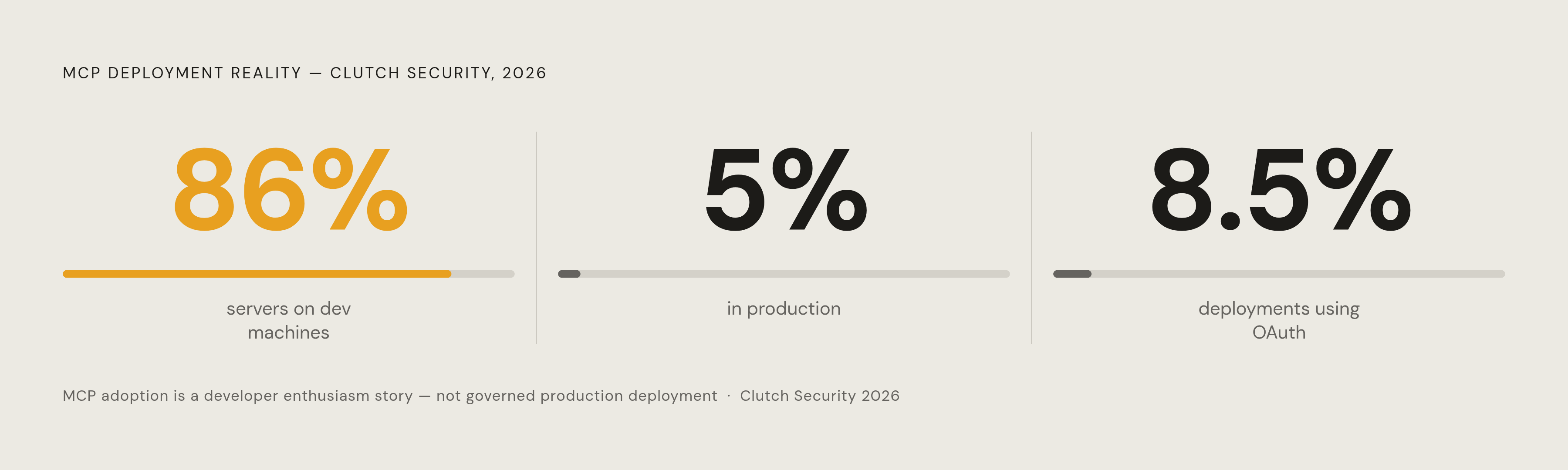
Here is a number that should give anyone pause: 86% of MCP servers run locally on developer machines. Only 5% run in production environments, per Clutch Security research from 2026. That distribution tells you MCP's adoption is still largely a developer enthusiasm story. Only 8.5% of deployments use OAuth, meaning the vast majority operate without any standardized credential layer at all.
The vulnerability record is harder to dismiss. CVE-2025-6514 was a critical OS command injection flaw in mcp-remote, an OAuth proxy with over 437,000 downloads used across Cloudflare, Hugging Face, and Auth0 integrations. The supply-chain dimension is what makes it serious: the vulnerability does not live in your code; it travels through the ecosystem of servers you depend on. CVE-2025-49596, found in Anthropic's own MCP Inspector by Oligo Security in June 2025, scored a CVSS 9.4. A malicious webpage could reach localhost and issue MCP calls that executed arbitrary local commands through STDIO servers. That is not a minor configuration problem.
Gartner's April 2026 projection adds pressure to the timeline: 25% of enterprise GenAI applications are expected to experience five or more minor security incidents per year by 2028, up from 9% in 2025. The curve is moving in the wrong direction precisely as adoption scales.
None of this indicts MCP as a protocol. But any comparison of alternatives that skips the security conversation is a disservice. Evaluating protocols is one problem; governing whatever protocol stack you deploy is a separate problem, and treating them as sequential rather than simultaneous decisions is how organizations end up discovering their attack surface after deployment.
Provider-Native Function Calling: When You Don't Need a Protocol at All
Before reaching for MCP or anything above it, ask whether you need a protocol at all. It is a question teams skip more often than you would expect.
Function calling is the baseline. You define tools as JSON schemas alongside your prompt, the model decides whether to invoke one, and it returns structured arguments your code executes. No separate server, no protocol layer, no ecosystem dependency. MCP adds roughly 10 to 50 milliseconds for the protocol layer; function calling eliminates that overhead, though in practice actual latency is dominated by the tool execution itself, not the protocol.
Where function calling wins without argument: single-provider applications, simple internal tools, low-latency workflows where you are not moving between models. If your tool surface is small and stable and you know you will stay on one provider's API, there is no meaningful case for adding protocol complexity. You are paying a tax for portability you do not need.
Where it breaks down is equally predictable. Each major LLM provider implements its own schema variant. OpenAI's function calling, Anthropic's tool use, and others differ enough that migrating models means rewriting every integration. At scale, with dozens of tools and multiple models, that portability cost compounds aggressively. There is also no resource management, no progress reporting, no standardized server ecosystem to draw on.
One thing worth understanding clearly: many frameworks implement MCP under the hood using function calling. The two are not mutually exclusive. MCP adds a standardization layer on top of the same underlying mechanic. Function calling is the right answer when the organizational problem is small and contained. MCP becomes the right answer when the same integration is being rebuilt by five different teams across an organization, each solving the same problem in isolation, none of them knowing the others are doing it.
LangChain and LangGraph: Orchestration Frameworks That Sit Above the Protocol Layer
LangChain and LangGraph are not protocol alternatives to MCP. They get discussed in the same breath often enough that the distinction needs stating directly, because conflating them leads to confused purchasing decisions.
LangChain provides modular components: tools, memory, chains for building LLM applications. LangGraph extends this with graph-based agent flows that support cycles, conditional branching, and persistent state. LangGraph added MCP support in early 2025, so it can consume MCP servers as tools. These layers were designed to coexist.
The production adoption signal is real. LangGraph has accumulated over 33,900 GitHub stars and tens of millions of monthly downloads. Around 400 companies deploy agents through LangGraph Platform, including Cisco, Uber, LinkedIn, BlackRock, and JPMorgan. LangGraph 1.0 marked the inflection point where the framework moved from experimentation infrastructure to something you can actually run consequential workloads on. Durable state and human-in-the-loop checkpoints are what separate demos from agents you can trust in production, and those capabilities are where LangGraph's design is focused.
What LangGraph addresses that MCP does not: multi-step planning with branching logic, persistent state across agent runs, human-in-the-loop approval gates, audit trails for complex workflows. MCP handles standardized connectivity to external systems. LangGraph handles what happens between those calls. Most serious production deployments use both, with LangGraph as the orchestration layer and MCP servers handling integrations underneath.
If your team is trying to decide between MCP and LangGraph, you are probably asking the wrong question. The more productive one is whether your current friction lives at the connectivity layer or the orchestration layer, because the answer determines which problem you actually need to solve first.
Google's A2A Protocol: What Happens When Agents Need to Talk to Other Agents
MCP solved the agent-to-tool problem. A2A is Google's answer to the agent-to-agent problem. These are different problems, and the distinction is not semantic.
Google created A2A in April 2025 and donated it to the Linux Foundation in June 2025, deliberately mirroring MCP's governance structure. The launch included backing from over 50 technology partners: Atlassian, Box, Cohere, Salesforce, SAP, ServiceNow. By April 2026, more than 150 organizations had committed to the standard.
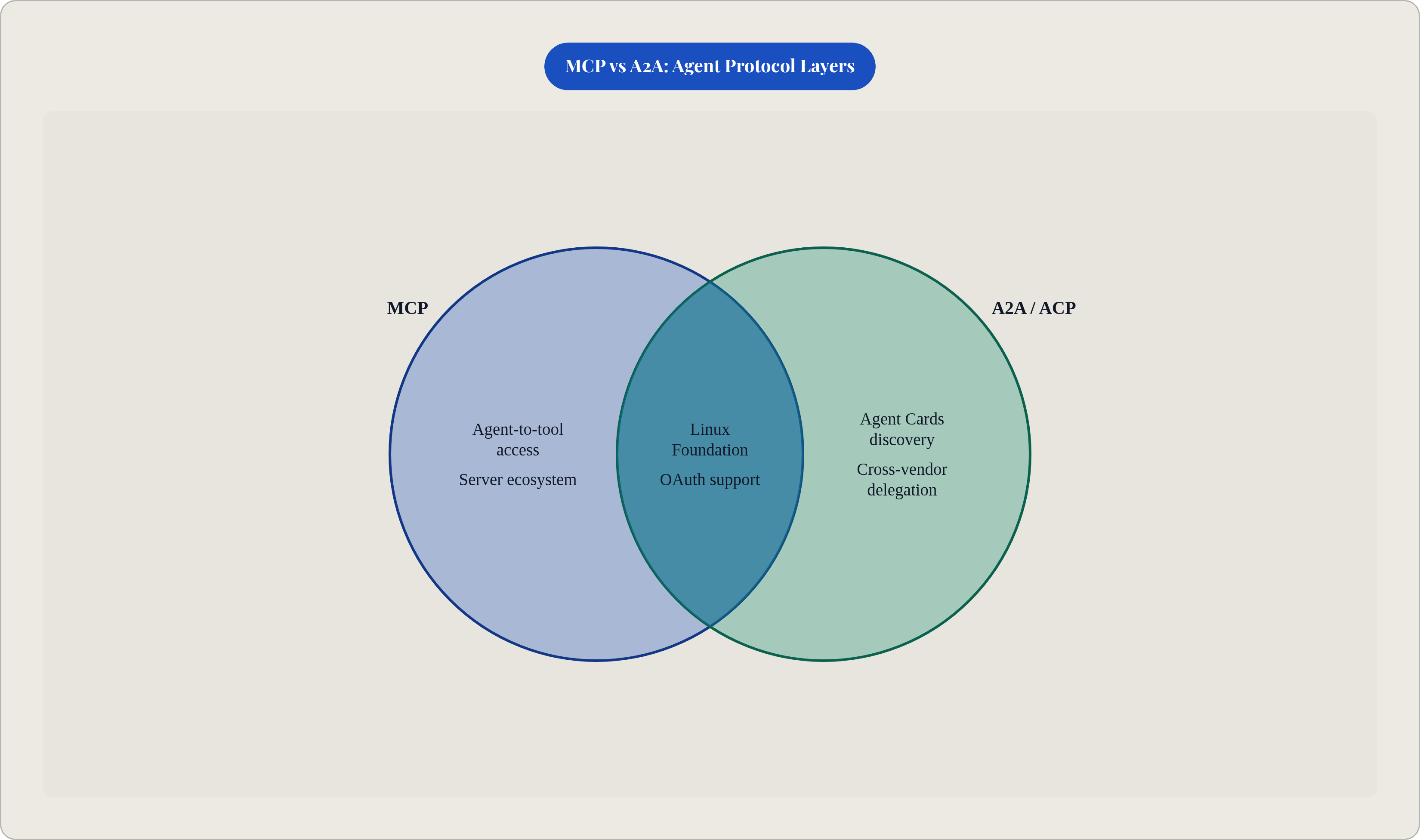
Two architectural concepts carry most of the protocol's explanatory weight. Agent Cards are machine-readable capability descriptors that each agent publishes, functioning like service descriptors in a microservice architecture: they enable discovery without requiring prior bilateral agreement between every pair of agents. Tasks are units of work with a defined lifecycle, submitted through failed, with shared state that gives multi-agent workflows a common language across vendor boundaries. The technical foundation is deliberately conservative: HTTP(S), JSON-RPC, Server-Sent Events, OAuth 2.0 for mutual agent authentication, JWTs. Existing enterprise standards, not a new network stack.
The use case that makes A2A's purpose concrete: a recruiting agent needs to delegate a background-check subtask to a compliance agent built by a different vendor. Neither shares credentials. Neither was designed to know about the other in advance. A2A gives them a common task lifecycle and a discovery mechanism. MCP alone cannot answer that question.
The ecosystem commitments from founding partners are production roadmap decisions, not prototype signals. Atlassian is wiring Jira and Confluence agents to coordinate with third-party agents. UiPath is enabling RPA robots to accept delegated tasks from AI agents via A2A. SAP is connecting ERP agents with external logistics and procurement agents. Intuit is enabling financial agents to delegate subtasks across vendor boundaries. These organizations have meaningful deployment scale. Their commitment to A2A tells you something.
IBM's ACP and Where It Fits Relative to A2A
ACP, IBM Research's Agent Communication Protocol, addresses overlapping territory to A2A but arrives at it from a different starting point and with different design priorities. The distinction is one of emphasis rather than fundamental incompatibility, which is an important framing if you are trying to choose between them.
ACP is a REST-native, framework-agnostic messaging layer for agent-to-agent communication. Agents do not need to expose additional endpoints to participate, which reduces the governance surface area that enterprise IT teams have to manage. Any agent runtime capable of making REST calls can participate. That is an intentionally low barrier, and it reflects a design philosophy oriented toward enterprise environments that need HTTP-native integration without additional protocol dependencies.
Google's protocol prioritizes cross-vendor capability discovery and a structured task lifecycle. IBM's prioritizes compatibility with existing enterprise HTTP infrastructure and minimal new infrastructure requirements. Both are addressing agent coordination; they arrive at it from different organizational contexts and constraints.
The Linux Foundation's Agentic AI Foundation is the likely venue where these two approaches either converge or establish clear complementary roles. That alignment work is ongoing, and watching it closely is more instructive than trying to pick a winner from where things stand now.
For enterprise buyers, the practical logic is fairly direct. If your environment is heavily REST-native and the constraint is minimizing new infrastructure, ACP fits that context. If your problem is cross-vendor agent discovery and task delegation at meaningful scale, A2A's Agent Card and Task lifecycle model is more mature and more broadly backed as of now. Neither competes with MCP; they operate at a different layer of the stack entirely.
How the Three Layers Map to the Decisions Organizations Actually Face
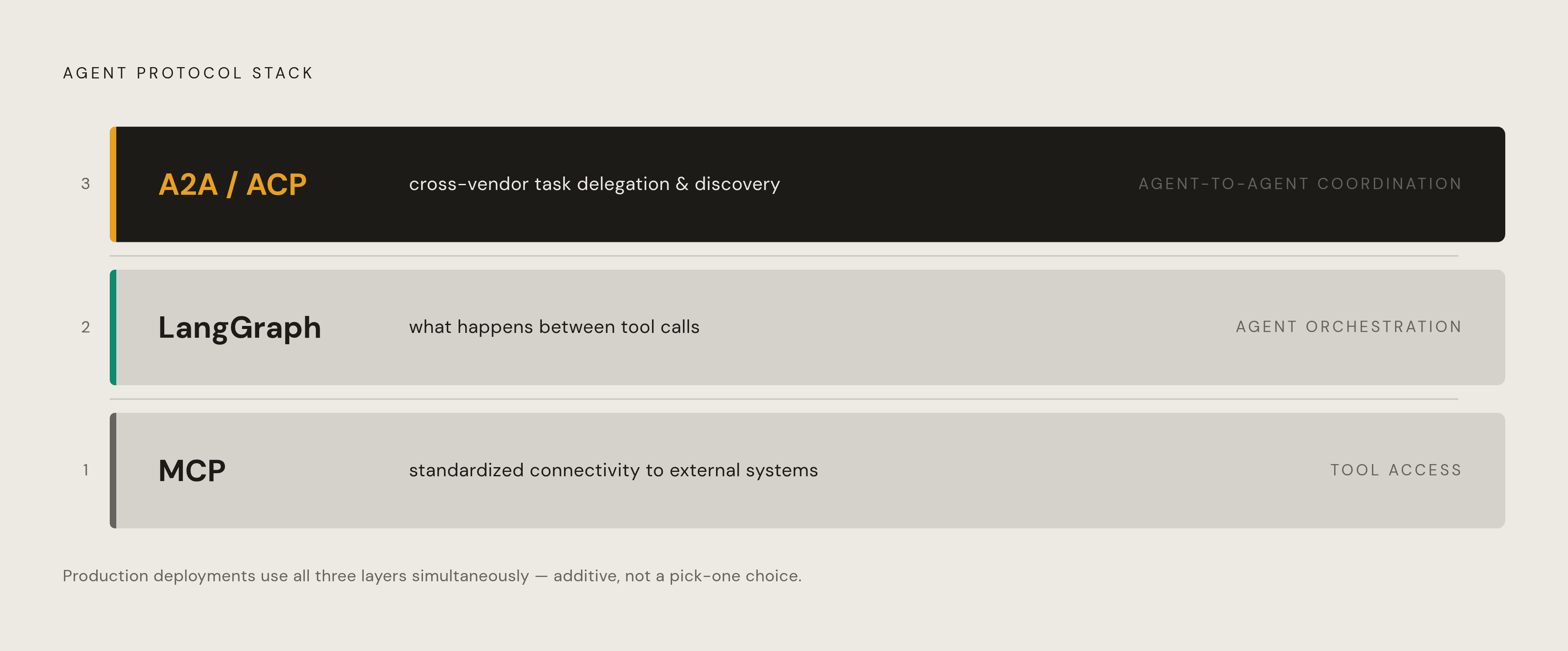
The stack has three distinct layers, and keeping them straight makes the decision logic much cleaner. Tool access is where MCP lives, with function calling as the simpler alternative for contained, single-provider cases. Agent orchestration is where LangGraph and equivalent frameworks operate. Agent-to-agent coordination is where A2A and ACP apply, with the choice between them driven by environment and scale.
The sequencing mistake most teams make is evaluating these as if they are picking one from a list. The real question is which layer is generating the most friction right now, because that is where the investment should go.
A few concrete scenarios illustrate how this plays out. A single agent on a single provider touching internal tools has no real case for protocol overhead; function calling is sufficient. Multiple teams building agents that share access to the same external data sources will reproduce the same integration work across each team independently unless MCP eliminates that redundancy. Single-tenant multi-step workflows with complex conditional logic and persistent state are an orchestration problem, which means LangGraph addresses the actual constraint. Agents from different vendors or teams that need to delegate tasks to each other require A2A; MCP cannot answer that question. Enterprise environments demanding HTTP-native integration with minimal new infrastructure are where ACP deserves evaluation.
The governance dimension cuts across all of these, and it tends to be the dimension teams address last, which is the wrong order. The MCP security data, 86% of servers running locally, 8.5% OAuth adoption, shows that deployment without a governed access and monitoring layer is the norm in practice. That pattern will reproduce itself across A2A and ACP deployments given the same organizational habits.
Protocol selection and governance infrastructure are two separate problems that have to be treated as a single decision. Pick your protocol, then ask governance questions later, and you learn about your attack surface the hard way, after something goes wrong.