Privileged Access Management Controls for AI Agents
Most organizations treat AI agents as privileged identities without governing them like it.

An AI agent that reads a database, calls an API, and kicks off three downstream workflows is a privileged identity, by function, whether or not anyone has formally labeled it that way. The question that matters isn't whether these agents deserve that label. It's whether anyone is governing them like they hold it.
Right now, most organizations aren't. CyberArk's 2025 Identity Security Landscape survey of 2,600 security decision-makers found machine identities outnumber human ones by more than 80 to 1, and 42% of those machine identities already touch sensitive data. Yet 88% of organizations still define "privileged" as a human-only category. The vocabulary we use to govern access doesn't even include the entities doing most of the accessing. That's a significant gap, and arguably the whole floor missing.
How the gap between deployment speed and security readiness became this wide
PwC's 2025 AI Agent Survey put agentic AI deployment at 79% of companies already live. Gartner expects 40% of enterprise applications to carry task-specific agents by 2026, up from under 5% in 2025. That's a curve going almost straight up.
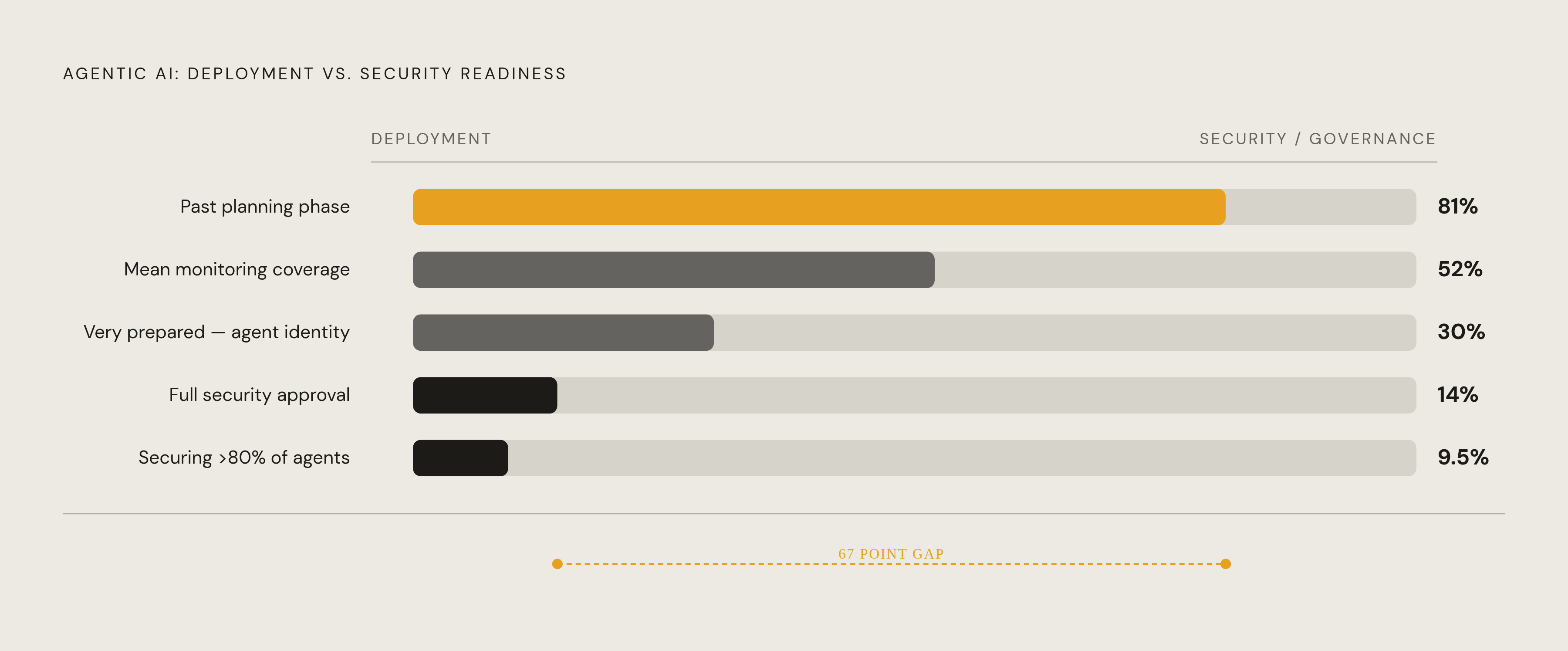
Gravitee's State of AI Agent Security 2026 Report surveyed more than 900 executives and technical practitioners, and the numbers tell a clear story: 81% of teams are past the planning phase, but only 14.4% have full security approval. Deployment ran ahead, and governance is still catching its breath somewhere behind.
The pressure driving this isn't subtle. 81% of respondents feel pushed to ship agents fast even without governance in place, and 25.8% call that pressure significant. So what happens? Only 9.5% of organizations secure more than 81% of their deployed agents. Mean monitoring coverage sits at 52%, which means roughly half of all production agents are running with nobody watching closely.
The agent count itself is exploding, too. Mean agents per organization hit about 37 in December 2025. By April 2026, nearly 38% of organizations reported more than 100 deployed. Ask teams how ready they feel and the answer is uncomfortable: only 30% say they're very prepared to manage agents as distinct authenticated actors, 60% call themselves only somewhat prepared, and 8% admit they're not prepared at all.
Here's what I think gets missed in the discussion: 82% of these same organizations already know AI use creates sensitive access risk. Teams see the risk clearly and are still outrunning their own ability to control it, because product and engineering ship agents faster than governance frameworks can adapt. That's a structural mismatch, not a failure of any one security team.
What makes AI agents fundamentally different from the service accounts and bots PAM was built to handle
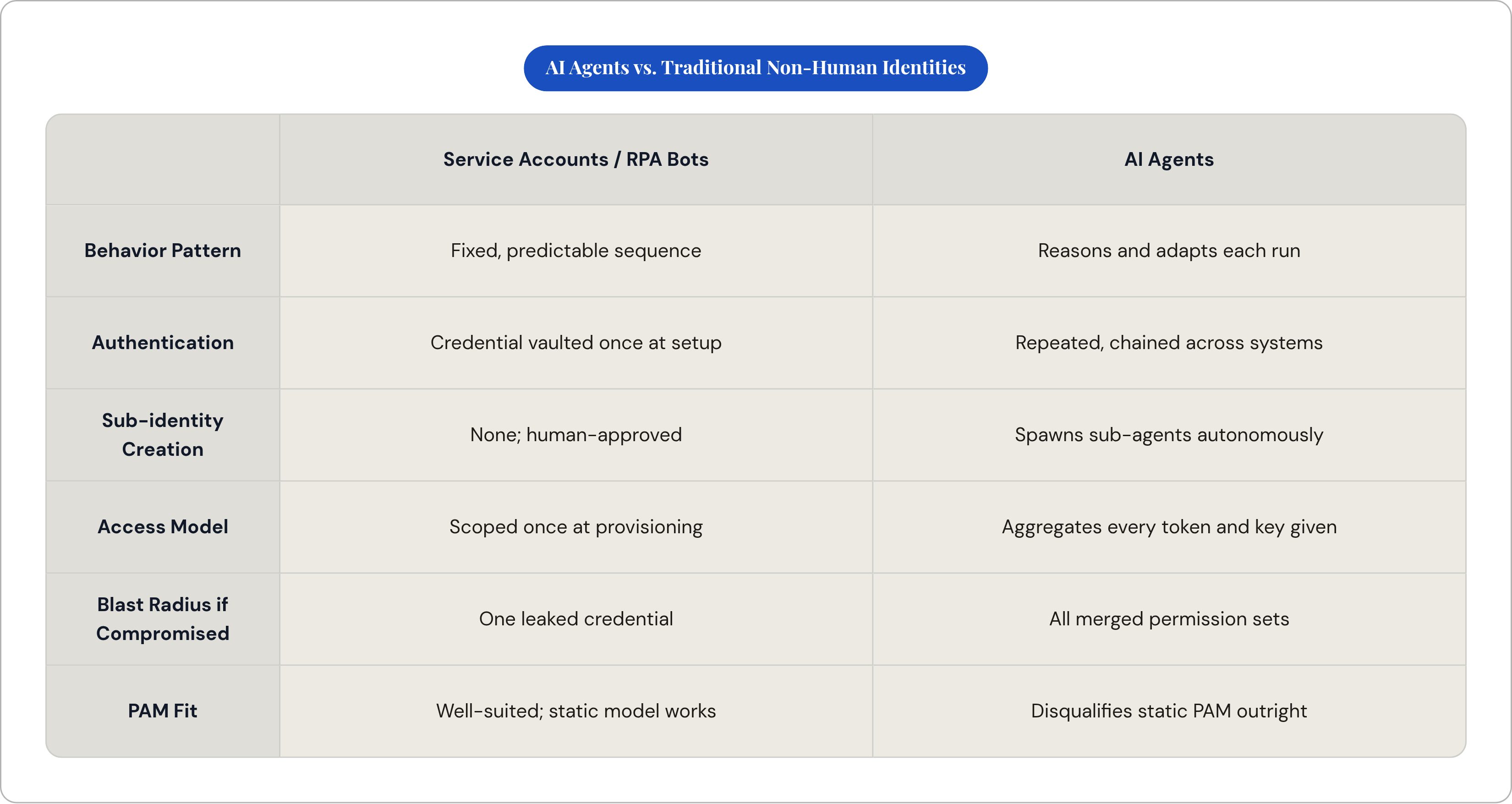
Old-school non-human identities, service accounts, RPA bots, scheduled scripts, run a fixed sequence. You vault the credential, rotate it on schedule, and scope it once at setup. Predictable input, predictable output. PAM was built for exactly that shape of problem.
Agents break the shape. They reason and adapt, so the action taken this hour might not resemble the action taken last hour. They authenticate over and over, chaining tools across system boundaries within a single task. They spawn sub-agents on their own, no ticket filed, no human approving the child identity that just came into existence. They don't log off. They don't do MFA the way a person does. They typically hold standing access and run without anyone watching each individual decision.
Then there's the aggregation problem, which the OWASP NHI Top 10 framing lays out well: an agent acts with the combined authority of every API key, token, and service account handed to it. One execution point, multiple permission sets merged together. So the blast radius of a compromised agent isn't proportional to one leaked credential. It's proportional to everything that agent was ever given.
That unpredictability is what disqualifies static PAM outright. A vault and a rotation calendar assume you know roughly what the identity will do next. With a reasoning agent, you don't, and pretending otherwise is how the gap gets wider. CyberArk's 2025 Identity Security Threat Landscape research found 96% of enterprises recognize AI agents as a risk, yet that recognition has not translated into matching governance controls. The recognition is there. The control model isn't.
The credential surface agents actually present: API tokens, secrets, and certificates at machine speed
Agents authenticate through three main channels: API tokens (often long-lived and handed more permission than needed), secrets (frequently static, sometimes hardcoded, rarely centrally managed), and certificates (facing shorter and shorter renewal cycles under CA/B Forum mandates).
The OWASP NHI Top 10 for 2025 surfaced a number that should make anyone pause: 24 million leaked non-human identity credentials were found on GitHub in 2025, and 70% of the ones from 2022 were still valid. Leaked credentials with a multi-year shelf life amount to a wide-open door left unlocked for years.
The Cloud Security Alliance found 85% of credentials carrying elevated privileges hadn't been used in the prior 90 days. Most of the attack surface out there is just sitting dormant, unnoticed, ungoverned, waiting.
CyberArk's 2025 machine identity research found roughly half of surveyed organizations had a security breach tied to compromised machine identities within the past year. Of those: 51% faced delays launching applications, 44% reported outages, and 43% saw unauthorized access to sensitive systems or data. API keys and SSL/TLS certificates led the way, each behind 34% of cases.
Then there's the August 2025 Claude incident, where Anthropic's AI was exploited to carry out unauthorized access across at least 17 organizations spanning government, healthcare, and emergency services, with ransom demands over $500,000. That happened, recently, and the credential multiplication problem agents create was central to how it spread.
Least privilege and continuous discovery as the starting point for agent PAM
Enterprise agents are routinely granted roughly ten times more access than their actual workflow needs. That gap creates toxic permission combinations, meaning a compromise doesn't just expose one function, it exposes everything adjacent to it too.
Agent sprawl makes this worse. Fast deployment produces privileged identities and secrets scattered across cloud environments with no central inventory tracking any of it.
What least privilege actually requires, specifically for agents:
- Continuous, automated discovery, not a once-a-year audit, to find every agent and every credential it holds
- Mapping each agent's real workflow scope to figure out the minimum access it genuinely needs
- Centralized secrets management enforcing that minimum at runtime, not just when the agent was first set up
- A registry where every deployed agent has an owner and a defined scope; an agent with no registry entry is an identity nobody can govern
Discovery can't be periodic anymore. Agent counts are roughly doubling per quarter according to the Gravitee data, which makes a quarterly audit obsolete before it's even finished. This is exactly where MCP server sprawl shows up in practice: teams add MCP servers without registry entries, and that's a blind spot, plain and simple. An ungoverned server is an identity the organization can't account for, and you can't protect what you can't see.
Just-in-time access and zero standing privilege applied to agent workflows
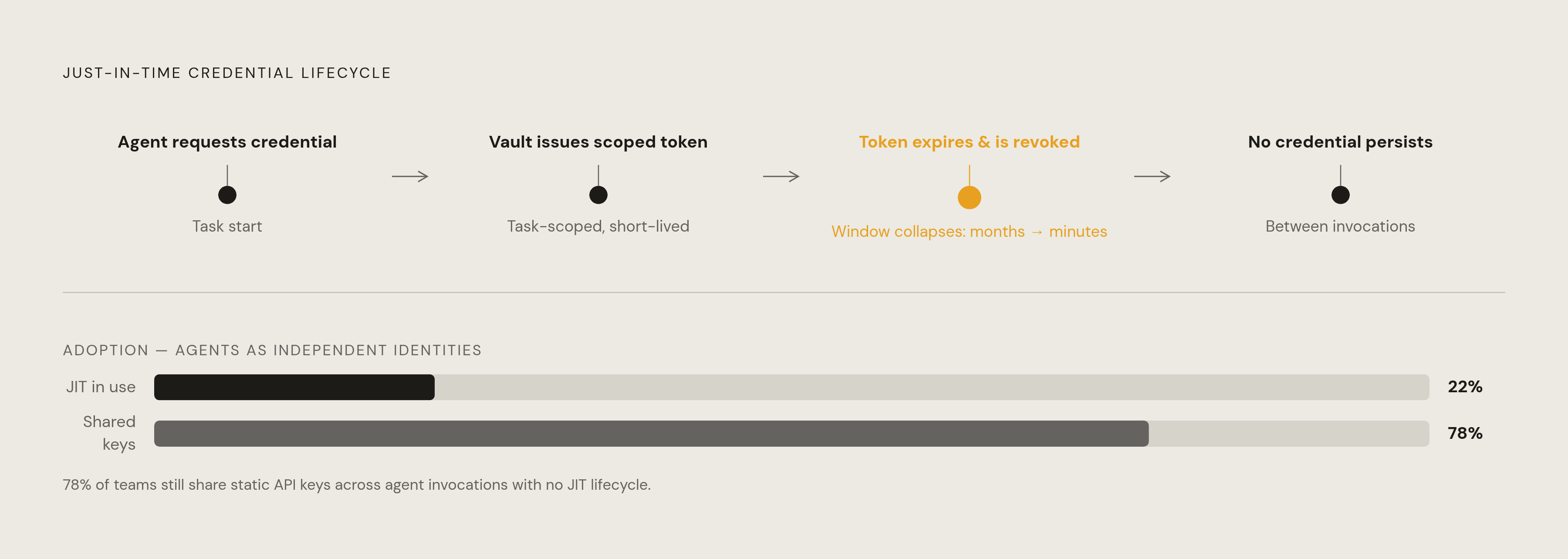
Traditional PAM vaulted static passwords and rotated them on a calendar. That model assumes an identity holding credentials between uses. Agents authenticating hundreds of times an hour need something else entirely.
Zero standing privilege is the target: no identity holds permanent administrative rights, access gets provisioned for the length of one task and revoked the moment it's done. Just-in-time access is how that gets operationalized:
The agent requests a credential from a vault right when a task starts. The vault issues a short-lived token scoped tightly to that task. The token expires when the task completes, or after a set window, it doesn't stick around between invocations.
The payoff is real: if credentials get stolen, the exploitation window is minutes, not the lifetime of a static key. An attacker can't just reuse a stolen token for lateral movement, they need a fresh compromise. JIT also solves the dormant-privilege problem directly. If access only exists when needed, dormant standing access stops being a category that exists at all.
The catch is architecture, not policy. Orchestration has to move fast enough that JIT doesn't become a bottleneck for agents authenticating at machine speed. And right now, per Gravitee's 2026 data, only 22% of teams treat agents as independent identities with their own credential lifecycle. For the other 78%, JIT isn't even on the table yet, because their agents are sharing API keys instead of holding individual identities.
Runtime authorization: verifying intent at the moment of action, not just at login
Static access decisions made at provisioning can't anticipate everything a reasoning agent might try later. Legitimate access to a system doesn't make every action inside that system legitimate, and this is where a lot of teams get tripped up.
Runtime authorization checks each action against intent, context, and policy at the moment it happens, not at login. Take an HR benefits agent with legitimate access to Workday. If it suddenly tries to pull executive compensation records or modify payroll data, that action sits outside its intended purpose and should get blocked, regardless of whether its credential is technically valid. The real question is whether this specific action matches what this agent is supposed to be doing, not merely whether the identity has access at all.
Intent-based controls require defining, ahead of time, the behavioral envelope for each agent: which systems, which action types, which data categories are in bounds. This is where MCP governance connects directly. An MCP gateway enforcing tool-call policy at runtime is doing intent-based authorization, blocking a call the server technically supports but the agent's role doesn't sanction.
Least privilege and JIT shrink the credential attack surface, but without this layer they leave the action surface wide open. An agent holding a perfectly valid, short-lived token can still take a destructive action inside its access window. CyberArk's 2025 research found 68% of organizations lack identity security controls for AI systems specifically, and runtime authorization is among the most missing pieces, because it needs agent-specific tooling that legacy PAM platforms were never built to offer.
Session monitoring and behavioral analytics that can keep pace with agent activity
Privileged Account and Session Management, the session-monitoring half of classic PAM, tracks what a privileged account does after it logs in. The same idea applies to agents, just at a completely different speed and volume.
Agent session monitoring needs to cover every tool call, every API request, every data touch, logged with enough context to reconstruct what happened and why afterward. It needs anomaly detection watching for unusual data volumes, access outside normal workflow scope, or attempts to escalate privilege. And it needs real-time alerting, rather than batch review days later, since catching something during the session, while it's still happening, is the actual safety net.
Identity Threat Detection and Response, applied to agents, means catching a compromised or rogue agent mid-session rather than after the damage is done. The volume problem here is real: agents running at machine speed generate more session data than any human review team can process by hand. Behavioral analytics has to run automated, with human attention pulled in only when something looks off.
The August 2025 Claude incident again proves the point. Credential harvesting and reconnaissance played out across 17 organizations before anyone contained it. Session-level detection of that reconnaissance pattern, in real time, would have been the earliest point anyone could have stepped in. Real-time observability into what each agent touches, which servers, which tools, which data, is what makes ITDR for agents actually workable instead of a slide in a pitch deck.
Identity lifecycle management: onboarding agents with ownership, and deprovisioning them when they're done
An agent with no assigned owner is an identity nobody answers for. An agent that never gets shut down is a standing attack surface that outlives whatever it was built to do.
Onboarding an agent properly means giving it a registry entry at creation: name, purpose, owning team, access scope, and who or what it acts on behalf of. It means mapping precise entitlements at provisioning, tailored to the agent's actual function rather than copied from a human user's permission set or dropped into a shared service account. And it means tethering that agent identity to a human owner who actually answers for its behavior.
Deprovisioning is where this falls apart most often, in my experience. Agents get built for a project or a quick experiment and then just... never get retired. Credentials outlive the agent's actual use, echoing that same 85% dormant-privilege pattern from the machine identity research above. There's no automated trigger to pull access when the owning team changes or the project closes.
The fix is tying agent identities to the same HR and IT signals that already trigger human offboarding. When a team dissolves or a project ends, agent deprovisioning should follow automatically, rather than sitting in a ticket queue waiting for someone to remember. The 2025 Unit 42 Global Incident Response Report found 66% of social engineering attacks specifically target privileged accounts, and an orphaned agent identity with standing privileged access is exactly the high-value, low-visibility target that kind of attack is built to find. The registry is the anchor underneath all of it. Without one, neither lifecycle management nor least privilege enforcement is something you can actually run at the speed organizations are deploying agents today.
Why blocking agents is not a governance strategy, and what a governed path actually looks like
Some security teams respond to all of this by trying to slow deployment down or ban agents outright. I understand the impulse, but it doesn't work, and it isn't really an option anyway, because the business side will route around a blanket "no" every time. Shadow deployment carries more risk than governed deployment.
A governed path looks like the pieces above working together, with no single control carrying the whole weight. Continuous discovery finds every agent and every credential before someone else does. Least privilege trims access down to what a workflow actually needs. Just-in-time credentials replace standing access with short-lived tokens that expire on their own. Runtime authorization checks intent at the moment of action, catching what a valid credential alone would let slide through. Session monitoring and behavioral analytics watch activity as it happens, rather than waiting until after a breach report gets written. Lifecycle management gives every agent an owner at birth and a shutdown plan at the end.
None of this is exotic. It's the same governance logic PAM has run on for years, rebuilt for identities that reason, adapt, and move at machine speed instead of sitting still and waiting for a human to log in. The organizations that get there first won't be the ones that deployed the most agents. They'll be the ones that knew, at every moment, exactly what each agent could touch, and why.