Tools for monitoring and restricting AI agent access to MCP-connected data sources
Security controls are spreading across the MCP stack to plug gaps the protocol itself never filled.
MCP gives AI agents a standard way to reach outside tools, databases, and file systems. It doesn't store anything itself. Think of it as wiring: it lets an agent ask for a file, run a query, or trigger an action somewhere else. That wiring changes who touches your systems and how often, and right now, most organizations running MCP servers can't tell you, with any confidence, who's touching what.
I want to walk through the tools people have built to answer that question anyway: gateways, registries, role-based access controls, observability platforms. Each sits at a different point in the stack. Knowing where is basically the whole difference between a governed deployment and one that finds out about its exposure the hard way.
Here's the root of it. MCP shipped in late 2024 with no built-in access control model. No standard way to define who could do what, under which conditions, none of it. That gap showed up fast: a large share of early MCP servers ran with no authentication at all, and a lot of the ones that bothered relied on long-lived static API keys or personal access tokens. Leak one of those and whoever picks it up is in, indefinitely. No expiration, no check-in, nothing.
Scoping wasn't much better. Only a small slice of early deployments put real limits on tool parameters or permissions, and that's a big reason agent over-privilege turned into one of the most common failures in the space. Connect an agent to a server and, more often than not, it could do far more than its actual job called for.
The spec has moved since then, and fast. OAuth 2.1 with PKCE landed in early 2025. By mid-2025 the spec added formal Resource Server classification and Resource Indicators under RFC 8707. The November 2025 revision made full OAuth 2.1 a hard requirement for remote servers, and the July 2026 revision pulled protocol-layer sessions out entirely, so MCP is stateless at the transport level now. That's a real architectural shift, and it drags its own governance questions along with it.
One gap still hasn't closed. The spec never says how non-human entities, agents acting on their own, are supposed to authenticate to authorization servers. Workload identity for agents is still unresolved. The practical fallout is pretty simple: spec-level authentication solves identity, one server at a time. It won't give you policy that works across servers, a single audit trail, or one place to pull the plug. Gateways and registries exist because somebody had to fill that hole, since the protocol wasn't going to.
The attack surface that grows every time a team adds an unregistered MCP server
The public MCP server ecosystem went from a handful of entries to thousands of them in a matter of months. A meaningful fraction carry security problems you'll never catch unless you're actively scanning for them.
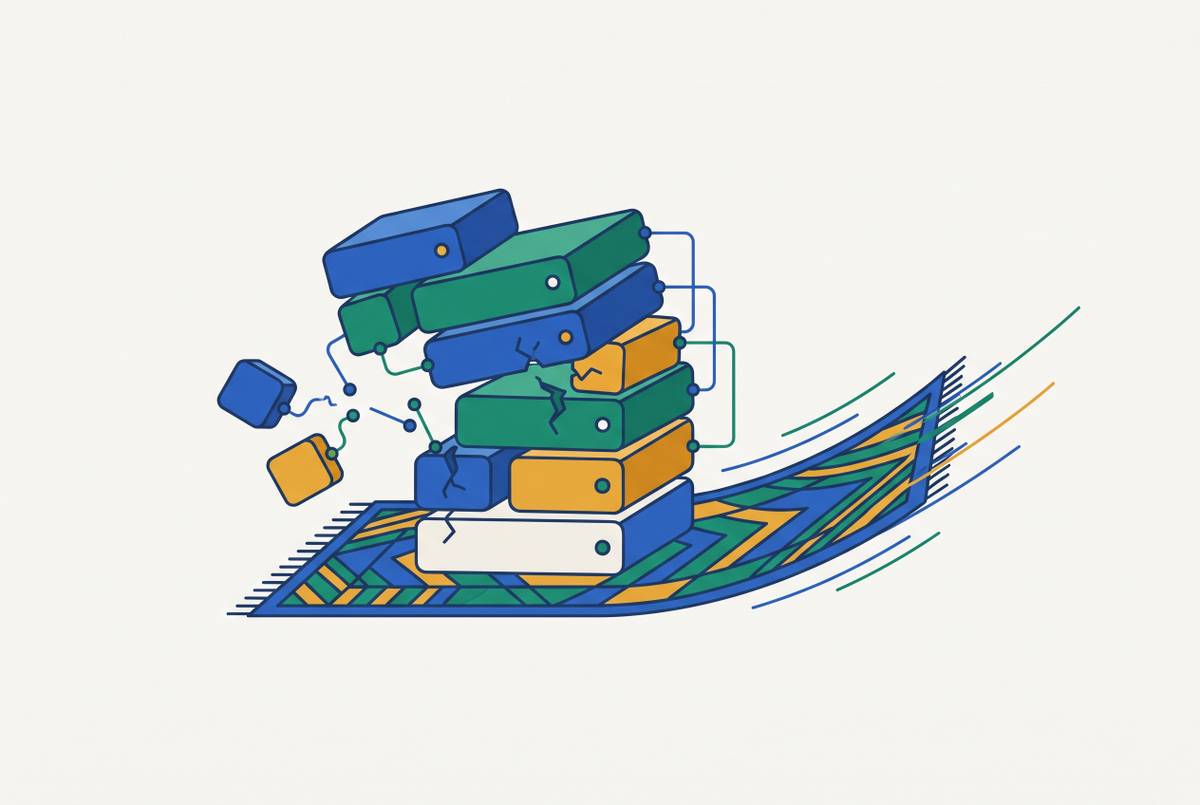
Tool poisoning, cataloged by OWASP as MCP03:2025, is one of the cleanest examples of why. Tool descriptions are free-text fields, no schema validation, no length limit, so an attacker buries instructions inside a description and the LLM just follows them, no user ever the wiser. There's a cousin worth knowing too: the rug-pull, where a tool's description quietly changes after someone's already inspected and trusted it. Most MCP clients show that description once, at connection time, and never flag the edit that comes later. Then there's tool shadowing, where a malicious server overrides or impersonates a tool the agent already trusts and redirects its actions from the inside.
Proof-of-concept work has shown a single poisoned tool description pulling private repository contents and message histories out of a system with zero user interaction required. Lab tests against real MCP servers have clocked success rates for these attacks high enough that anyone paying attention should be losing sleep over it. Session hijacking is its own documented mess, tracked as CVE-2025-6515, where an attacker takes over an already-authenticated session and starts running commands inside it.
Then there's the shadow IT problem, MCP flavor. Developers spin up servers nobody approved, often with default credentials or unsecured APIs sitting wide open, invisible to whatever governance the organization thinks it has running. The NSA's Artificial Intelligence Security Center published a Cybersecurity Information Sheet on MCP security design in May 2026, and that fact alone tells you something. This stopped being a niche concern the moment a government security agency put its name on guidance about it.
None of this is theoretical. The attack surface scales with the number of servers running, and the unregistered ones take the worst of it, because nobody's watching them.
How a layered control stack is organized and why each layer handles a different problem
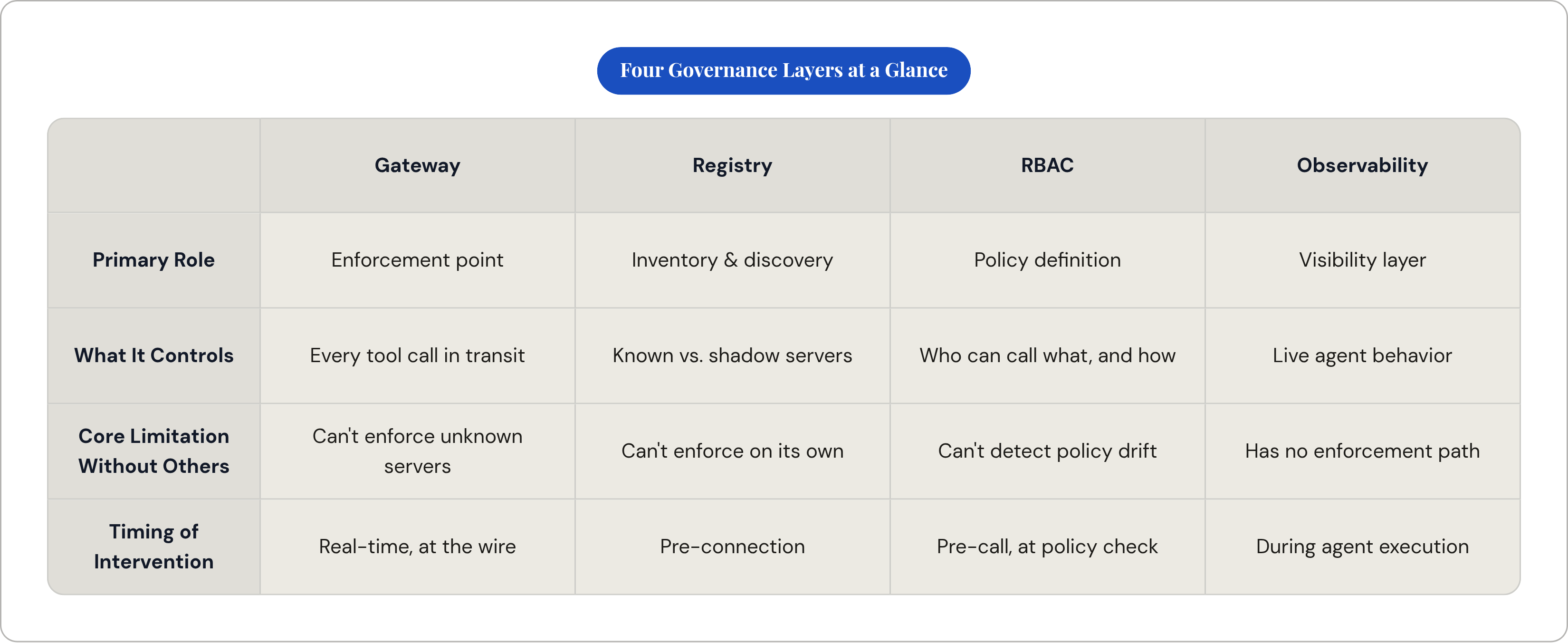
Four layers do the actual work here, and they overlap less than you'd guess.
The gateway is the enforcement point. Every agent's traffic to every server routes through it, so authentication, tool scoping, rate limits, content policy, and logging all get applied once, consistently, instead of piecemeal at each server. The registry is the inventory, every MCP server the organization has actually sanctioned, plus metadata on its tools, permissions, and risk level. You can't govern a server you don't know exists. That's why the registry comes first, logically at least, even if it doesn't always come first chronologically.
RBAC is the policy layer: the rules for which agents or roles can call which tools, on which servers, under which conditions. Authentication proves identity. Logging records what already happened. RBAC is the thing deciding what's allowed in between, and it's doing real work the other two aren't built to do. Real-time observability is the visibility layer, streaming telemetry on tool calls, anomaly detection, alerts while an agent is mid-run rather than a record you dig through once the damage is done.
None of these stand in for each other. A gateway with no registry behind it can't enforce policy on a server it's never heard of. RBAC with no observability can't catch policy drift once it starts creeping in. Observability with no RBAC just generates alerts that go nowhere, no enforcement path attached.
A handful of things matter no matter which tool you're sizing up: how deep the access control actually goes (server level, tool level, or down to individual parameters), whether it supports OAuth 2.1 and plugs into an enterprise identity provider, whether the audit trail is immutable and queryable for compliance, and how flexible deployment really is. The gateway holds a unique spot in all this. It's the only layer that sees every tool call, from every client, to every server, with enough identity context attached to make attribution possible at all. Everything else tends to build around it for exactly that reason.
Open-source gateway and proxy tools and what each one is actually built to do
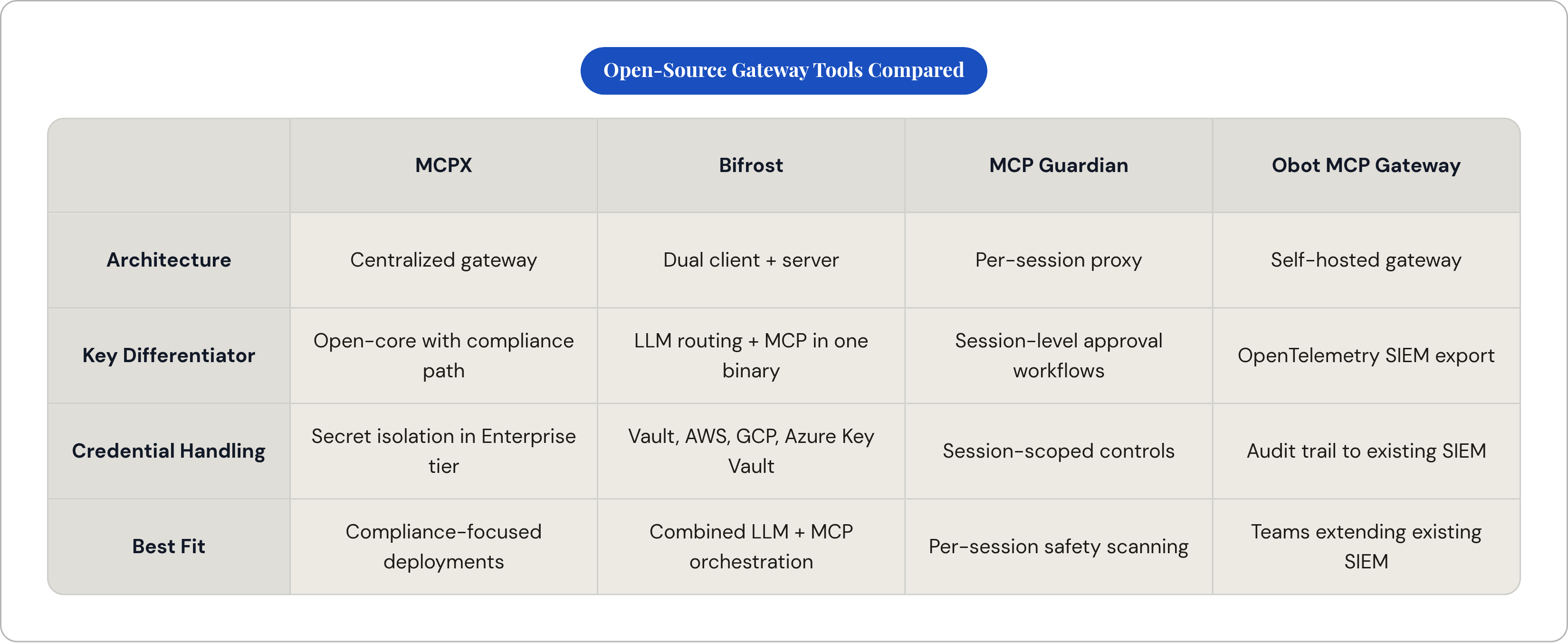
MCPX, from Lunar.dev, works as a single governed entry point for agent-to-tool traffic, enforcing access control, audit logging, and policy across every MCP server an org runs. The core is MIT licensed and covers aggregation, access control, and observability. Deeper governance, SSO and RBAC, secret isolation, automated risk scoring, hosted deployment, lives in a separate Enterprise tier that carries SOC 2 certification. Gartner named it a Representative Vendor in the MCP Gateways category. Good fit if you want a proven open-core starting point with a real path to compliance later, without having to rip out tools mid-flight.
Bifrost, built by Maxim AI, does something the others don't: it runs as both an MCP client and an MCP server at once, handling LLM routing and MCP tool orchestration out of a single binary. It connects to external tool servers over STDIO, HTTP, or SSE, pulls their tools together, and exposes them through one endpoint. Credentials run through HashiCorp Vault, AWS Secrets Manager, Google Secret Manager, or Azure Key Vault. It's Apache 2.0 licensed, and the published benchmarks show barely any added latency even at high request volumes. Makes sense if you're already running LLM routing and MCP orchestration together and don't want two separate pieces of infrastructure to babysit.
MCP Guardian, from eqtylab, sits between apps like Claude Desktop or Cursor IDE and the MCP servers they talk to. It's a per-session proxy, not a centralized gateway, and that's a real distinction, not a technicality. It handles activity logging, request approval workflows, and automated safety scanning at the session level, built around real-time visibility into how an LLM is interacting with outside tools. Right fit where per-session approval and safety scanning matter more than one centralized policy covering everything.
Obot MCP Gateway is self-hostable and MIT licensed, with a full audit trail down to the individual tool call and OpenTelemetry export to whatever SIEM you're already running. Built for teams with a strong preference for self-hosted infrastructure, ones that want to extend an existing SIEM setup to cover MCP traffic instead of standing up a whole new monitoring stack from scratch.
All four enforce at the gateway. None of them depend on individual MCP servers being configured correctly, which matters a lot, because most public servers aren't.
Enterprise security platforms that extend MCP governance to discovery, scanning, and agent identity
Palo Alto Networks rewrote its Prisma AIRS platform for version 3.0, shipped at RSAC 2026. It's built to find every agent running across an organization, red-team it before it goes live, and govern every tool call once it's in production. It maps agents across cloud, SaaS, endpoint, and browser environments, pulling shadow AI and unsanctioned agents into the same view as the sanctioned ones. Its Agent Artifact Scanning checks agent code, MCP servers, and skills for unsafe permissions, hidden vulnerabilities, and indirect injection paths before deployment, not after. Palo Alto also closed an acquisition in mid-2026 that added a production AI gateway already processing a huge volume of tokens every month, which reinforces its gateway position from a different angle entirely. Makes sense for large enterprises that want pre-deployment scanning and runtime governance from one vendor instead of stitching two together themselves.
Cisco AI Defense moved fast on agentic governance through 2026. It built an AI Bill of Materials alongside an MCP Catalog for server inventory, added agent zero-trust identity through Duo and Identity Intelligence, and released DefenseClaw, an open-source governance layer built around an OpenShell Linux sandbox that isolates an agent's network access, filesystem, and system calls. That sandboxing goes straight at the workload identity gap the MCP spec still leaves open: instead of leaning only on protocol-layer controls, it isolates what an agent can physically reach at the operating system level. Strong fit for organizations already running Cisco identity infrastructure that need to isolate where agents execute, not just police their tool calls.
Both platforms share the same instinct, really: cover discovery and pre-deployment scanning on top of runtime governance. That matters most once the number of agents and MCP servers has outrun the organization's own inventory of what's actually running.
Where a control layer sits in this stack and what it is designed to govern
Governance at this layer comes down to one organizational question: what can AI touch, and can you prove it?
A control layer combining gateway enforcement, guardrails, and access controls with real-time observability keeps enforcement, policy, and visibility in one place instead of three separate ones. The registry model means servers, permissions, and risk posture are accounted for before an agent ever connects, not discovered afterward when it's already too late to matter.
RBAC, done well, is a decision the organization makes on purpose, not a restriction bolted on after something breaks. The access policy should reflect what leadership actually chose to allow, not whatever a default configuration happened to leave open by accident. Observability follows the same logic. The point is surfacing what an agent is doing while it's running, not producing a log somebody reads once there's already a fire to put out — real-time visibility rather than after-the-fact review.
Put the pieces together and the guardrails read as an attempt to lower the bar for saying yes to production, not raise it. Governed access can speed adoption up rather than slow it down, because security and engineering stop negotiating every new server one at a time. That approach suits teams that have already outgrown per-server configuration as a strategy and need one control plane covering the whole MCP surface.
RBAC for AI agents and why it operates differently from RBAC for human users
Human RBAC assumes something fairly stable: a known identity, making one deliberate request at a time. Agent RBAC can't assume any of that. Agents act on their own, reason across multiple steps, and a single prompt injection early in that chain can compound across every tool call that follows.
Over-privilege is the failure that keeps showing up, and it's an easy trap to fall into. Agents routinely get the broadest permissions their task could conceivably need, rather than the minimum required for each individual step along the way. It's the MCP equivalent of handing a junior developer production write access because they might need it eventually. Restricting an agent to one server isn't enough by itself, either, if it can still call any tool on that server with any parameters it wants. Real RBAC for agents has to reach down to the parameter level. Server level or tool level alone doesn't cut it.
The workload identity gap shows up here directly, too. Since the spec never defines how non-human entities authenticate to authorization servers, teams building agent RBAC end up solving that themselves, usually through their identity provider or a gateway that handles token issuance on the agent's behalf.
Multi-agent workflows make all of this messier. When one agent calls another through MCP, permissions can compound in ways that are genuinely hard to untangle after the fact, unless the policy layer tracks the full calling chain and not just whoever made the immediate request. OWASP's Agentic Top 10 frames it well: agentic systems add tool use (an agent that can actually take action), multi-step reasoning (where one injection cascades outward), and inter-agent communication (agents calling other agents). RBAC for agents has to account for all three at once. Handle only one or two and you haven't really solved it.
What real-time observability covers that an audit log does not
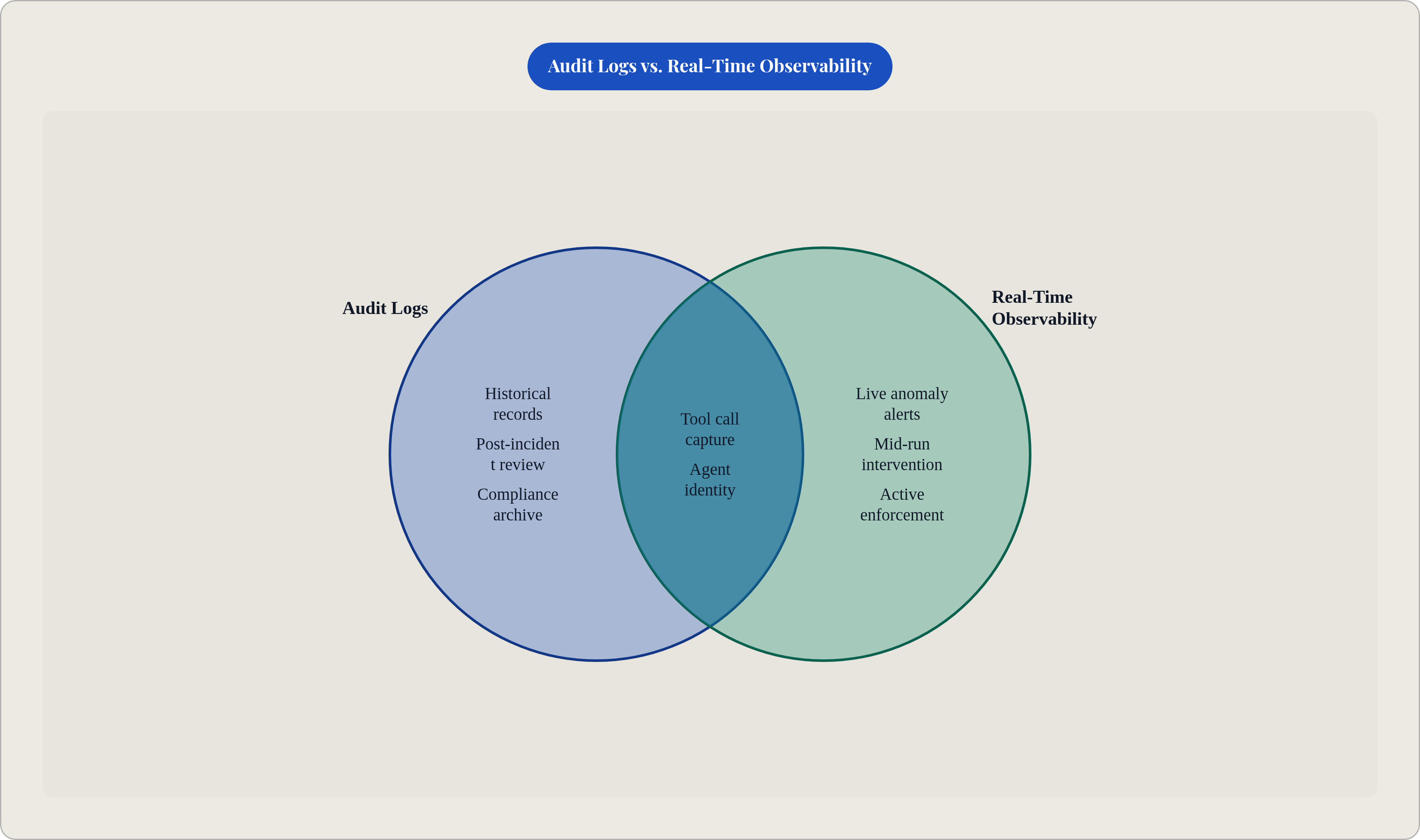
An audit log tells you what happened. Real-time observability tells you what's happening right now. That gap is the whole ballgame; it decides whether governance can step in before damage spreads or just piece together the wreckage afterward.
At minimum, real-time observability needs to capture every tool call, along with the calling agent's identity, the target server and tool, the parameters passed, the response that came back, and timing data on when each of these events happened. An audit log can hold all of that too, sure, but it holds it for later. Observability holds it for now, and governance that only reconstructs an incident after the fact has already burned the one chance it had to stop it.