Consent Signal Integration with Ad Platforms
What consent signal integration actually means in a programmatic context Strip away the legal language for a moment, because the word "consent" carries so much compliance weight…

What consent signal integration actually means in a programmatic context
Strip away the legal language for a moment, because the word "consent" carries so much compliance weight that the operational mechanics disappear underneath it.
Here is what the chain actually does. A user lands on a page, interacts with a consent banner, and a CMP collects that decision as a timestamped, auditable record. That record is the source of truth. Everything downstream reads from it. The CMP encodes the decision into standardized signal formats, and those signals travel to ad servers, DSPs, measurement tools, and data platforms. Each system uses the signal to determine what it's permitted to do: set a cookie, serve a personalized ad, fire a measurement pixel.
CMP to signal to platform to action. That's the whole thing.
What makes this operationally significant, not just legally significant, is that the signal actively gates ad operations. It determines which tags fire. Campaigns don't comply or not comply in some binary sense; they function differently depending on what the signal says, and that difference shows up directly in fill rates, CPMs, and measurement fidelity. These aren't abstract compliance metrics. They're revenue.
Two consent models operate simultaneously within the same infrastructure, applied by geography. Opt-in frameworks like GDPR assume nothing is permitted unless the user says yes. Opt-out frameworks like CCPA and CPRA assume collection proceeds unless the user says no. The same CMP configuration has to handle both correctly, which means the geographic logic of signal application is as important as the signal itself. Most implementations treat this as an edge case. It isn't.
The signal formats that matter in practice: IAB TCF strings for the programmatic supply chain, Google Consent Mode parameters for Google's tag ecosystem, Amazon Consent Signal for data sharing with Amazon Ads, and the IAB Global Privacy Platform for U.S. state-level compliance. Each serves a different slice of the ecosystem, but all of them must reflect the same underlying user decision. That consistency requirement is exactly where most implementations quietly fall apart.
How the IAB TCF string encodes and carries consent through the supply chain
The IAB Transparency and Consent Framework is how consent decisions travel from a publisher's CMP through the programmatic supply chain: SSPs, DSPs, measurement vendors, all of it. The TC string is a compact encoded value recording which purposes the user consented to, which vendors were disclosed, and which legal bases apply to each. It travels in the ad request.
The current version is TCF v2.3, released June 19, 2025. The most significant structural change is making the "Disclosed Vendors" segment mandatory. Previous versions allowed the segment to be omitted, which created a genuine problem: a buyer receiving a TC string had no technical way to verify that the vendors encoded in it had actually been shown to the user in the CMP interface. That ambiguity became legally untenable, and two 2025 court decisions sharpened the pressure. A March CJEU ruling and a May Brussels Court of Appeal judgment both clarified IAB Europe's status as joint controller under GDPR. The practical result is that technical proof of vendor disclosure is no longer optional. If a vendor's consent was encoded in the string but the user was never shown that vendor, the string isn't valid. TCF v2.3 makes that provable, or disprovable, at the string level.
One thing v2.3 does not change: available legal bases or defined purposes. The change is structural, not substantive. The purposes you were using before remain the same purposes.
The migration deadline is March 1, 2026. After that date, strings missing the disclosedVendors segment are treated as invalid by compliant buyers. Google introduced error code 1.4 specifically to flag missing or malformed disclosed-vendor segments and confirmed its systems accept TCF v2.3 strings as of October 17, 2025.
What this means practically: your CMP needs to be certified under TCF v2.3, the disclosed vendors list shown to users must match what's encoded in the string, and the string must surface correctly in ad requests. The mismatch between interface and string is the most common source of non-compliance under v2.3, and it rarely surfaces without deliberate verification. You have to go looking for it.
How Google Consent Mode v2 translates consent signals into tag behavior
Google Consent Mode v2 operates on four parameters: adstorage, analyticsstorage, aduserdata, and ad_personalization. The latter two were added in v2 and became required for EEA and UK compliance under the Digital Markets Act in March 2024. If your implementation predates that update and you haven't added those parameters, you are running an incomplete configuration right now, not historically.
There are two implementation modes, and the difference between them is consequential.
Basic mode blocks Google tags entirely until consent is granted. Simple to configure, but if a user declines, you get nothing: no measurement, no modeling signal. Advanced mode loads tags in a restricted state and sends cookieless pings even when consent is declined. This is what enables conversion modeling. Google's machine learning uses aggregate signals from those cookieless pings to estimate conversions that couldn't be directly attributed. Google has reported recovering up to 70% of conversion losses from consent refusal under optimal conditions, but that figure depends on specific thresholds: Advanced Consent Mode implemented, at least 700 ad clicks over a rolling seven-day period per country and domain pair, seven days of data collection, and a consent rate above roughly 20%. Most advertisers see 10 to 30% modeling uplift in practice.
That gap between the 20% floor and the 70% ceiling deserves attention. It reflects consent rate quality and data volume, and we'll return to it.
Google began automated enforcement on July 21, 2025. Sites without correct EEA and UK signals have conversion tracking, remarketing, and demographic reporting disabled. Non-compliant accounts received suspension warnings ahead of that date, so if you were paying attention, this wasn't a surprise.
A publisher running Advanced Consent Mode with a low consent rate is trading measurement accuracy for a compliant posture. The modeling works, but it's working on a thin signal. The realistic European opt-in benchmark for a legitimately configured CMP sits in the 55 to 65% range, and understanding what your actual consent rate is turns out to be inseparable from understanding what the modeling will be worth.
Where the chain breaks: what misconfigured or missing signals actually cause
Three categories of breakage, each with different visibility.
Complete signal absence is the most legible. Ad requests default to limited or non-personalized ads, fill rates drop, and the damage at least surfaces in reporting. Malformed strings are harder to catch: the signal is present but unreadable, buyers treat it as absent, and the campaign keeps running while inventory is effectively sold without consent data at a discount you aren't realizing you're accepting. The third category is the most insidious. Signal/behavior mismatch: the CMP records consent correctly, but downstream tags still fire or don't fire as they should. Ketch's Data Sentry monitoring found that 76% of data collection events in documented enterprise deployments were not authorized post opt-out. The consent record said no, and data collection continued anyway. That is not a measurement error. That is compliance exposure operating as normal business activity.
The revenue implications are direct. Inventory with TCF 2.0 or later consent strings earns approximately 83% higher eCPMs than inventory with only Boolean-based consent, and roughly three times higher fill rates than inventory passing no consent information at all, per industry analysis of European programmatic inventory. The CPM spread between consented and non-consented impressions on European traffic runs 40 to 70%, depending on vertical and audience. At that scale, technical configuration is legible as revenue, not as overhead.
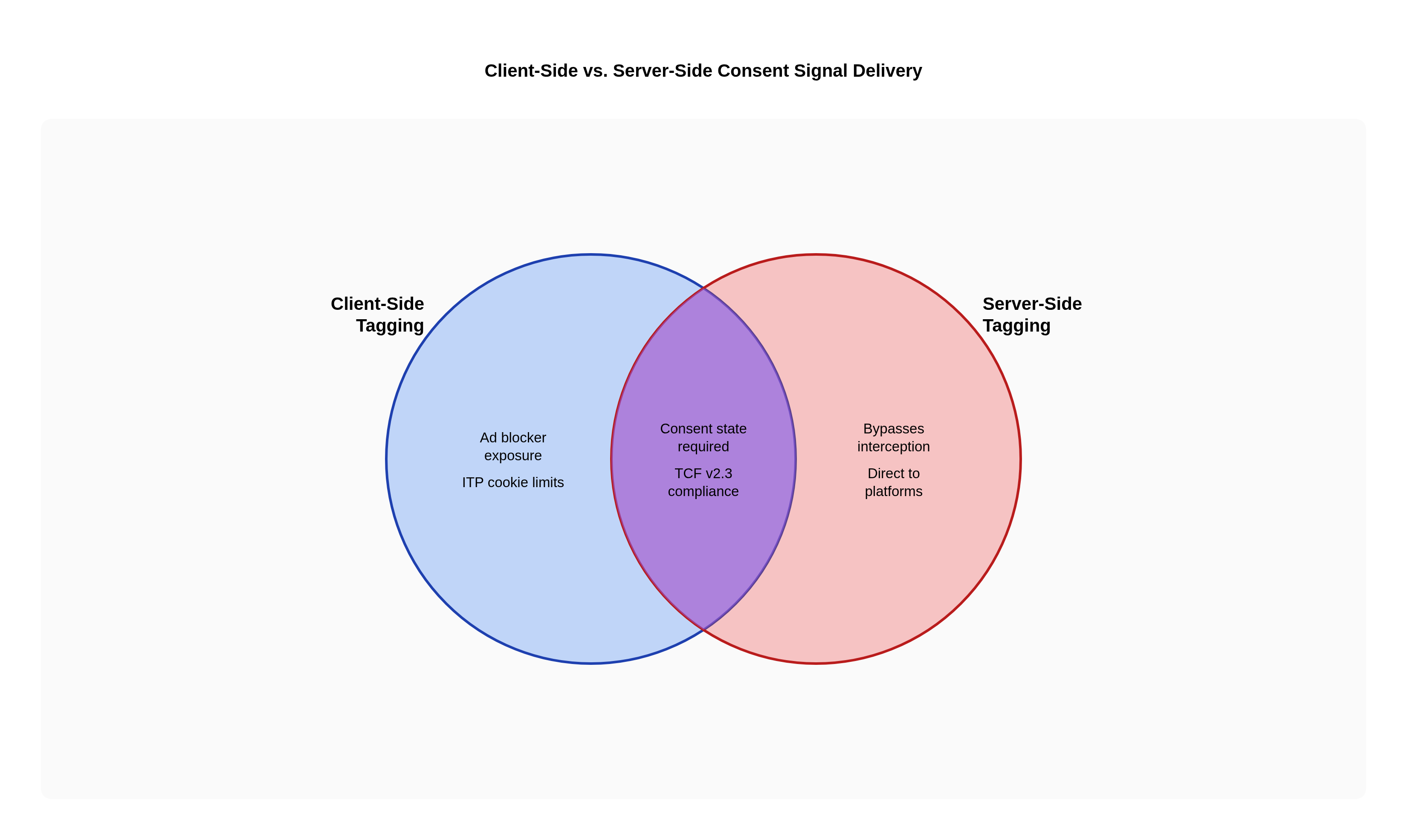
Browser-side risks compound the problem without being consent failures themselves. Ad blockers intercept client-side tags on more than 40% of sessions in key European markets. Safari ITP limits JavaScript-set cookies to seven days. These aren't caused by misconfigured consent signals, but they interact with consent gaps to reduce signal fidelity in ways that are genuinely difficult to disentangle in reporting.
The silent failure pattern persists because campaigns don't stop running when signals break. They keep serving, personalization is stripped, measurement is incomplete, and the damage appears gradually as unexplained performance drops and reporting discrepancies. By the time the pattern is visible, the loss has already compounded. Watch for Google's TCF error code 1.4, Consent Mode parameters defaulting to denied states they shouldn't reach, and measurement discrepancies between platform-reported and modeled conversions that can't be explained by volume alone.
Platform-specific signal requirements beyond Google: Microsoft, Amazon, and the GPP
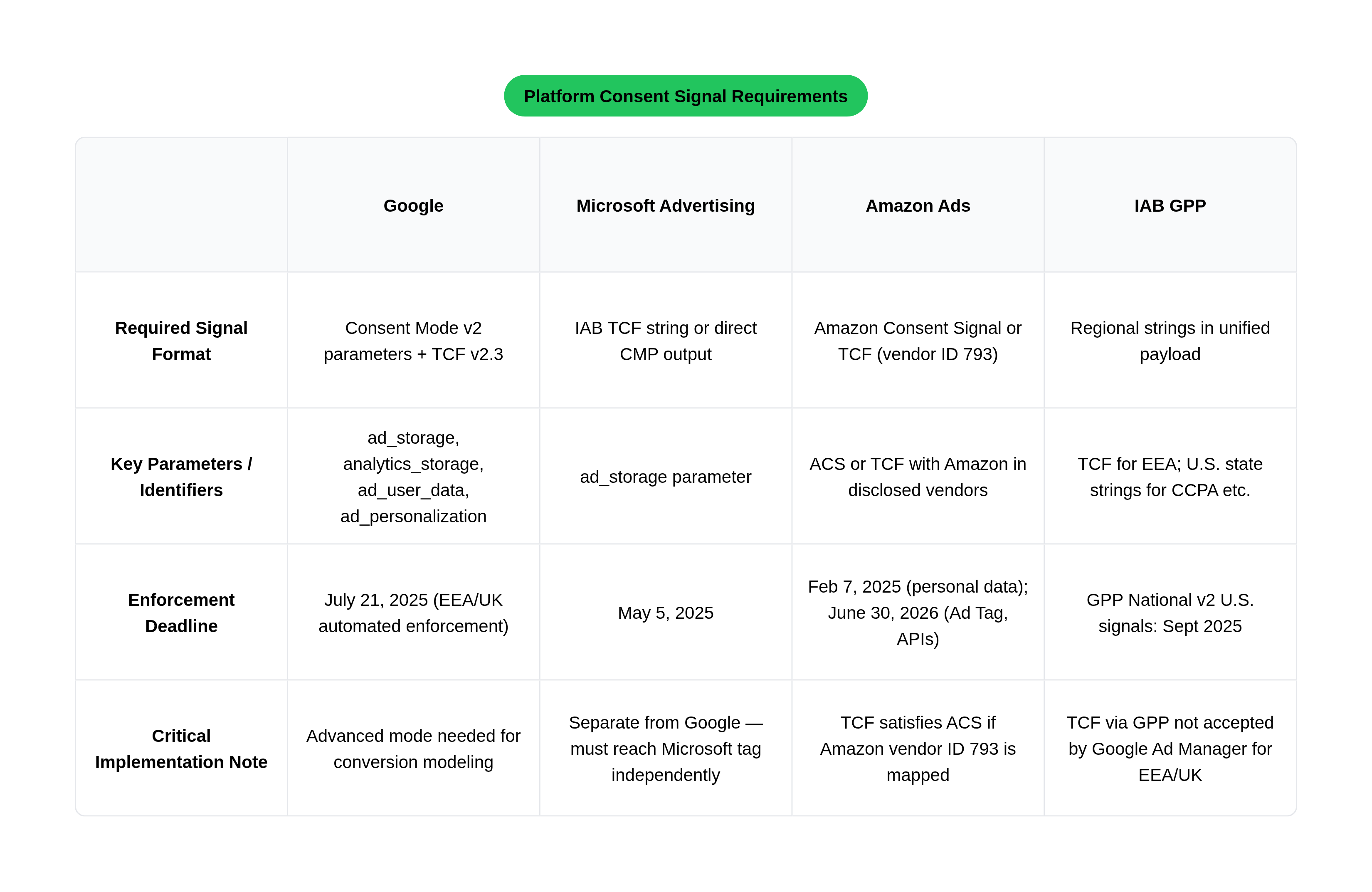
Google is not the only platform enforcing consent signal requirements, and the timelines have been moving quickly enough that a configuration correct six months ago is not correct today.
Microsoft Advertising enforced explicit consent signal provision by May 5, 2025. It accepts IAB TCF strings or direct CMP output and uses the ad_storage parameter to control whether its tag can set advertising cookies. The parameter logic mirrors Google Consent Mode, but it is a separate implementation. Having Consent Mode correctly configured for Google does not automatically satisfy Microsoft's requirement; the signal must reach Microsoft's tag independently.
Amazon's consent framework has two enforcement deadlines. Since February 7, 2025, all advertisers sending personal data from UK and EEA users must include a verified consent signal. A second deadline on June 30, 2026 covers the Amazon Ad Tag, Conversions API, and the newly launched Events API.
Amazon's proprietary format is the Amazon Consent Signal, launched in 2025 and initially covering UK and EEA. What most implementation reviews miss: ACS and TCF are not mutually exclusive. Amazon is a registered IAB TCF vendor with vendor ID 793. If a publisher runs a TCF-certified CMP with Amazon correctly included in the vendor list and purposes mapped, the TCF string satisfies the ACS obligation. ACS is only required where TCF is absent or Amazon is not included in the vendor list. So the practical question is whether Amazon vendor ID 793 appears in your disclosed vendors list with the correct purposes mapped. That's the check most teams skip, and it's also the check that determines whether you need to implement a separate signal format at all.
The IAB Global Privacy Platform is a unified envelope carrying multiple regional consent strings in a single payload: TCF for EEA, U.S. state-specific strings for CCPA and others. It was designed to replace the operational burden of managing separate signals per jurisdiction. As of early 2025, GPP covered 15 U.S. states, and 2025 state sections for Maryland, Indiana, Kentucky, and Rhode Island were finalized and in production. IAB has stated GPP will be the only framework where future global consent signaling is developed.
One critical exception: for EEA, UK, and Swiss ad serving, Google Ad Manager continues to use TCF through a certified CMP. TCF strings sent through GPP are not accepted by Google Ad Manager for those regions. GPP National v2 support for U.S. signals began September 2025.
Starting November 17, 2025, Google began receiving Global Privacy Control signals directly for Delaware and Oregon users and triggers Restricted Data Processing mode in response. Consent signals now interact with browser-level privacy signals in ways that require active monitoring, not a one-time configuration check.
The practitioner implication is straightforward, even if the implementation isn't: a single CMP must output the right format for each platform, TCF v2.3 for programmatic, Consent Mode parameters for Google tags, ACS or TCF for Amazon, GPP strings for U.S. state compliance. All of them must reflect the same underlying user decision. A user who opted out must be opted out everywhere, consistently, and verifiably.
Server-side signal transmission and why it changes the reliability of the chain
Client-side consent signal delivery has a structural vulnerability that exists independently of whether the signals are configured correctly.
Ad blockers intercept client-side tags on more than 40% of sessions in key markets. The consent signal encoded in the page never reaches the platforms meant to receive it, not because consent was refused, but because the tag carrying the signal was intercepted before it fired. Safari ITP's seven-day cap on JavaScript-set cookies means even correctly consented sessions lose continuity for returning users. You can build a technically correct client-side consent chain and still hemorrhage signal, because the problem isn't the chain; it's the delivery mechanism.
Server-side tagging routes events and consent signals from the server directly to ad platforms, bypassing browser-level interception. The consent state travels with the event payload rather than depending on a client-side tag firing correctly in a browser that blocks it.
When Advanced Consent Mode v2 is combined with server-side tagging, Google's conversion modeling has been reported to recover 60 to 70% of conversions lost to consent refusal. Server-side tagging ensures the modeling signal itself isn't also lost to ad blocking, which is the compounding problem with purely client-side configurations: you lose conversions to consent refusal, and then you lose the modeling signal to browser interception. Server-side tracking alone, independent of consent modeling, recovers an estimated 15 to 30% of lost conversion signals.
The configuration step where most implementations go wrong: the server-side container must itself receive and forward the correct consent state. A server-side setup that ignores consent signals and fires all tags regardless of user consent is not a solution; it is a compliance failure that happens to also improve signal recovery. The consent signal must be passed explicitly into the server-side container and mapped to each downstream tag's behavior. Bypassing browser-level interception is the goal. Bypassing consent enforcement is not. That distinction sounds obvious until you pull the configuration and find the mapping absent, which happens more often than people in this industry like to admit.
How consent rate quality shapes what the technical chain can actually deliver
The consent rate is the multiplier on everything upstream. A correctly configured TCF string, a working Advanced Consent Mode implementation, a properly structured server-side setup: all of it is operating on the fraction of users who actually consented. The technical chain doesn't create signal from non-consent; it preserves and transmits signal from consent. What you put in is what you get out, compressed or amplified by configuration quality.
The realistic European opt-in benchmark for a legitimately configured publisher sits in the 55 to 65% range. Below that threshold, identity signal volume becomes insufficient for effective targeting, and modeling quality degrades noticeably. Google's modeling minimum of roughly 20% is a floor, not a target. The practical difference between a 20% consent rate and a 60% consent rate is the difference between rough estimation and actionable measurement.
Per the State of Digital Trust 2025: 42% of consumers read cookie banners "always" or "often"; 46% click "accept all" less frequently than they did three years ago; 44% say transparency about how their data is used is the most important factor in whether they trust a brand. Those figures have a practical implication beyond UX design. Consent rates are not fixed. They respond to how clearly the value exchange is explained and how much genuine control users perceive they have.
First-party data collected through real transparency produces higher and more stable consent rates than data collected through friction-based defaults or pre-ticked boxes. Regulators are increasingly able to distinguish between the two, and users are evidently doing the same, given how consistently the "accept all" rate has declined.
Consent rate optimization is therefore part of the signal chain itself. A perfectly configured server-side container receiving a 20% consent rate produces substantially worse output than a moderately configured implementation receiving a 60% consent rate. The engineering and the UX are solving the same problem from different ends, and treating them as separate workstreams is where a lot of signal quality quietly gets left on the table.
What a correctly configured end-to-end consent signal chain looks like in practice
The sequence: the CMP collects consent and stores an auditable timestamped record. It encodes a TCF v2.3 string with the disclosedVendors segment populated and matching the vendor interface the user actually saw. That string surfaces in ad requests for programmatic buyers. Consent Mode parameters fire to Google tags in Advanced mode with correct default states configured for EEA and UK traffic. The consent state passes into the server-side container, mapped explicitly to each downstream tag's behavior. The ACS or TCF signal transmits to Amazon for data uploads and event tracking. The GPP string outputs for U.S. state signals to relevant platforms.
Each link requires independent verification. A valid TCF string in the ad request does not confirm that Consent Mode parameters are set correctly. A working Consent Mode setup does not confirm that the server-side container is forwarding consent state. A high consent rate does not confirm that post-opt-out data collection has actually stopped.
The disclosedVendors check deserves specific attention because it is the most common source of TCF v2.3 non-compliance in production environments. The vendor list shown to users in the CMP interface must match the vendors encoded in the string. A vendor encoded but not shown is not a disclosed vendor under v2.3. A vendor shown but not encoded is invisible to buyers. Both directions of mismatch create problems, and neither produces an obvious error. You have to verify it deliberately, because the ad request won't tell you.
Monitoring is not a one-time audit. Enforcement timelines across Google, Microsoft, Amazon, and the TCF migration deadline mean the compliance state of a correctly configured system changes as platforms update their requirements. A configuration valid in Q1 is not valid in Q4.
One user consent decision, collected once with genuine transparency, must propagate consistently and verifiably to every system that touches that user's data. Gaps in that propagation are where compliance exposure and measurement loss accumulate together. The system doesn't throw an error when it breaks. It produces a slow revenue drain that looks, for a while, like unexplained performance variance, and by the time the pattern becomes visible, the compounding has already been underway for months.