Cookieless Measurement Strategies for Marketing Teams
Why the cookies-are-back narrative is misleading for measurement teams Google reversed its cookie deprecation plan in July 2024. In April 2025, it confirmed it would not add a…

Why the cookies-are-back narrative is misleading for measurement teams
Google reversed its cookie deprecation plan in July 2024. In April 2025, it confirmed it would not add a separate consent prompt to Chrome. Both announcements were real, both were widely covered, and both got quietly filed under "crisis averted" by marketing teams who were relieved to stop thinking about it.
That relief is doing real damage.
The Chrome story was always only a Chrome story. Safari and Firefox have blocked third-party cookies by default for years. Combine their traffic share with the portion of Chrome users who decline consent prompts or run ad blockers, and more than 60% of web activity is already cookieless, regardless of what Google does next. The reversal changed one browser's policy trajectory. It did not change the web your measurement infrastructure is actually running on.
Then there is the Privacy Sandbox, which deserves a harder look than it received. Google spent years positioning it as the coherent alternative to cookie deprecation, a suite of APIs that would preserve targeting and measurement without individual tracking. Topics, Protected Audience, the attribution components: all retired in October 2025. The Privacy Sandbox brand dissolved entirely. The replacement never shipped. So the Chrome reprieve arrived without the alternative it was supposed to be paired with. That is a strange kind of comfort.
Consumer behavior is pushing in the same direction. A May 2025 report from Usercentrics and Sapio Research found that 38% of US consumers are accepting cookies less often than they were three years ago, and global acceptance has fallen below 40%. Even on browsers that technically support third-party cookies, the signal degrades every time someone declines. And those declines are increasing.
Measurement built on cookie reach is already measuring a shrinking fraction of real user activity. Not a future fraction. A present, structurally diminishing one. The cookies-are-back headline felt like resolution. The erosion it obscured was already underway.
How badly measurement coverage has already eroded
Multi-touch attribution, the methodology most teams built their programs around, has experienced a coverage collapse that the industry has been conspicuously slow to name. Where it once tracked upward of 90% of touchpoints, current estimates put that figure somewhere between 30 and 60%, depending on audience and channel mix. It still has a role. But it is no longer a reliable source of truth for cross-channel budget decisions, and calling it "a tactical layer" at this point is generous.
iOS App Tracking Transparency tells the same story from a different angle. Apple's ATT framework reduced cross-app tracking by more than 40% worldwide after its introduction. Mobile, browser, and increasingly connected TV environments are all moving toward signal restriction, independently, on different timelines, for overlapping but not identical reasons. The mechanisms differ. The direction is consistent.
What I keep returning to is the gap between awareness and readiness, because it has stayed stubbornly wide despite years of conference panels and vendor roadshows devoted to exactly this topic. Nearly every advertising decision-maker expects continued signal loss from privacy legislation and platform changes. Yet a March 2025 Deloitte report found that only 15% of global marketers felt fully prepared for a cookieless measurement environment. After all that discussion, most teams are still exposed.
That gap, between the signal already lost and the infrastructure not yet built to replace it, is what makes this conversation urgent rather than theoretical.
First-party data as the foundation the other strategies depend on
The strategic consensus on first-party data has arrived, definitively and somewhat anticlimactically. By 2025, 78% of marketers identified it as their most valuable data source. Nearly two-thirds of enterprises increased investment in first-party infrastructure during 2024 and 2025. Everyone agrees on the priority. The harder question is whether the infrastructure to actually use it exists, and for most organizations the honest answer is: partially.
The collection surfaces are not exotic. CRM systems store the largest concentrations of structured customer data. Email remains a high-yield targeting channel. Website behavioral data is widely captured. The gap between having data and activating it is where most programs stall, and it is a gap that does not close on its own.
Google and BCG research put the performance case plainly: businesses using first-party data effectively see roughly a 2.9x revenue lift versus those relying on other sources. That lift does not come from collecting the data. It comes from building the pipelines that let you act on it. The organizations sitting on large, underused CRMs are not seeing the lift, and they will not until that connective work gets done.
Customer data platforms have become the primary vehicle for that work. A CDP's structural value is unification: it resolves identity across devices and sessions and creates a single source of record that downstream methods like modeling and clean room matching can reliably consume. Per Salesforce's ninth State of Marketing report, 72% of marketers worldwide now use them alongside other tools.
One thing worth sitting with: first-party data collected with transparent disclosure is two to three times more accurate than comparable third-party datasets, and it carries defensible provenance under regulatory scrutiny. Consent-based collection is not a privacy concession; it is an accuracy upgrade. That reframing matters internally, because it changes the investment case considerably.
Zero-party data and what it adds that first-party collection cannot
Zero-party data is information consumers share deliberately: preference surveys, product quizzes, loyalty enrollment questions, feedback forms. The term has accumulated marketing-speak baggage, but it points at something real and genuinely difficult to replicate.
First-party behavioral data tells you what someone did. Zero-party data tells you what they want and why. Behavioral inference gets you surprisingly far, but it cannot distinguish between a customer who bought a product as a gift and one who bought it for themselves. It cannot surface preferences the customer has never acted on. The inference ceiling is real.
The adoption picture is instructive. Forrester research finds that 90% of marketers report adjusting their strategy to capture zero-party data. Supermetrics' 2025 Marketing Data Report finds that only 16% are actually using it. That gap between stated intention and operational execution shows up throughout this space and is worth taking seriously as a diagnostic: strategy consensus is easy; building the infrastructure to act on it is the actual work.
Loyalty programs are the most scalable mechanism most brands already have available. 68% of companies cite them as a primary zero-party collection channel, and enrollment is one of the few contexts where consumers willingly provide preference data in exchange for something tangible and immediate.
The constraint that limits all of this is simple: none of it works without genuine exchange. Preference collection that delivers no perceptible benefit to the person sharing it erodes the trust that made them willing to share in the first place. Consumers recognize one-way extraction dressed up as personalization, and they respond by sharing less.
Server-side tracking as the plumbing that keeps first-party data clean
Client-side pixels have been the workhorses of web measurement for two decades, and they are now routinely blocked, degraded by Intelligent Tracking Prevention, or simply not fired because browser restrictions prevent execution. A team can have a robust consent management platform and a thoughtful first-party data strategy and still be measuring through a client-side layer that is silently losing a material fraction of events. The consent problem and the pixel problem are distinct, and conflating them is a common mistake.
Server-side tracking moves the measurement call from the browser to the server, bypassing the failure points that browser-based tracking now faces structurally. Per a 2025 Oberlo survey, 67% of B2B companies use server-side methods and achieve materially better data quality than those relying on client-side tracking alone. Server-side implementations capture 25 to 35% more conversions than browser-pixel measurement. Meta's Conversions API specifically recovers 20 to 30% of conversions that pixel-only setups miss.
The implementations are not exotic. Google Enhanced Conversions, Google Tag Manager Server-Side, and Meta's Conversions API are the primary vehicles. The technical work is real, but teams have been running these implementations for several years now.
The reason server-side tracking belongs in this conversation alongside modeling and testing methodologies is that it feeds inputs into everything downstream. MMM models, incrementality tests, and clean room matching all improve when the underlying event data is more complete. Noisy inputs produce noisy outputs regardless of how sophisticated the methodology sitting on top of them happens to be. The plumbing determines what is possible everywhere else. That makes it a strategic foundation, not a back-end technical detail.
Marketing Mix Modeling for budget decisions that don't require user-level data
Marketing mix modeling predates user-level tracking by decades. It was the dominant methodology before individual-level attribution became technically feasible, and it is experiencing a genuine resurgence, not because it is new, but because the conditions that made it less appealing have reversed.
MMM works from historical, channel-level inputs: aggregated spend, impressions, sales, external variables like seasonality and macroeconomic conditions. No cookies, no device IDs, no individual-level tracking of any kind. It is compliant with GDPR and CCPA by design, because it does not touch personal data. For teams operating in a landscape where individual-level data is increasingly unavailable or legally fraught, that structural property is significant.
The adoption numbers reflect a real shift. Google's 2025 Data-Driven Measurement Report documented a 212% year-over-year increase in MMM adoption since 2023. In a July 2025 EMARKETER and TransUnion survey, MMM was the most-cited reliable measurement methodology. The MTA coverage collapse accelerated a transition that cost and complexity had been delaying for years.
Open-source tooling is what changed access. Google Meridian and Meta Robyn removed the cost barrier that historically confined MMM to large enterprise budgets with expensive consulting engagements attached. Brands with the right data inputs are seeing efficiency gains in the range of 10 to 30% within the first year of implementation.
The limits deserve direct naming, because enthusiasm for MMM sometimes outruns what it can actually do. It requires meaningful ad spend, roughly $2 million annually as the practical floor for generating reliable signal. It requires a diverse channel mix and at least two years of historical data. It cannot attribute performance to specific creatives or audience segments, and it operates on quarterly or annual runs, not real-time optimization loops. It is a strategic planning tool. Anyone using it for campaign management is misapplying it, and the misapplication leads to confident wrong answers.
Incrementality testing as the ground truth that validates MMM output
MMM tells you how budget allocation performs across the portfolio. Incrementality testing tells you whether a specific channel or campaign is actually driving net-new results, or simply capturing demand that already existed. That distinction is the whole game when you are deciding whether to scale a channel or move its budget somewhere else.
The method is conceptually direct: expose one group to an ad, withhold it from a matched control group, compare outcomes. The lift you observe is the incremental effect. What MTA cannot determine, because it lacks counterfactual data, incrementality testing answers directly. They are solving different problems, and confusing them leads to bad planning decisions.
Per the July 2025 EMARKETER and TransUnion survey, 52% of US brand and agency marketers currently use incrementality testing. The adoption is real, but so are the execution problems. The IAB and BWG Global's State of Data 2026 report found that 44% of practitioners question the reliability of their incrementality results, 43% struggle to apply it consistently across ad types and targeting methods, and 41% report insufficient technology to run it well. Widespread adoption and inconsistent execution are not mutually exclusive, and this space has both simultaneously.
The access barrier has come down. Google reduced the minimum budget for incrementality experiments from roughly $100,000 to $5,000 through Bayesian statistical models. Geo holdout tests are now within reach for mid-market teams, not just large enterprise programs with dedicated data science functions.
Used together, MMM and incrementality testing form a calibration loop that neither can form alone. MMM sets the directional budget allocation. Incrementality testing validates whether that allocation is actually generating causal lift on the channels that matter most. Each method becomes meaningfully more interpretable when paired with the other.
Data clean rooms for attribution where direct matching is not possible
There are attribution problems that MMM and incrementality testing cannot fully resolve, specifically the ones requiring two first-party datasets, held by different organizations, to be matched against each other. A brand and a retailer. A brand and a publisher. A brand and a streaming platform. Cookie-based cross-domain matching used to handle this. That mechanism is gone for most of the web, and the data clean room is the structural replacement.
Clean rooms allow two parties to match audience data in encrypted, anonymized environments using cryptographic techniques that prevent either party from seeing the other's raw records. Matching happens on hashed identifiers; outputs are aggregate insights, not individual-level exports. No raw personal data changes hands, which is what makes the arrangement compatible with privacy regulation in a way that cookie-based cross-domain matching was not.
In controlled pilots run by major CPG brands during 2024 and 2025, clean room attribution came within 4 to 8% of ground-truth conversion data. Pixel-only last-click models, for comparison, typically underreport by 25 to 35%. That gap is not measurement noise. It is the difference between defensible budget decisions and confident misallocation.
Adoption grew 70% year over year during 2024 and 2025. Amazon Marketing Cloud became free to all Sponsored Ads advertisers in September 2025, removing the prior DSP-only requirement and expanding access well beyond the largest retail media buyers. Google Ads Data Hub, integrated with BigQuery, and Meta Advanced Analytics round out the primary platforms.
The precise framing matters here: clean rooms are not a replacement for MMM or incrementality testing. They restore attribution clarity in specific channel relationships where two first-party datasets need to be joined. Their role in the stack is bounded, and understanding that boundary prevents both over-reliance and under-utilization.
How the methods fit together as a working measurement stack
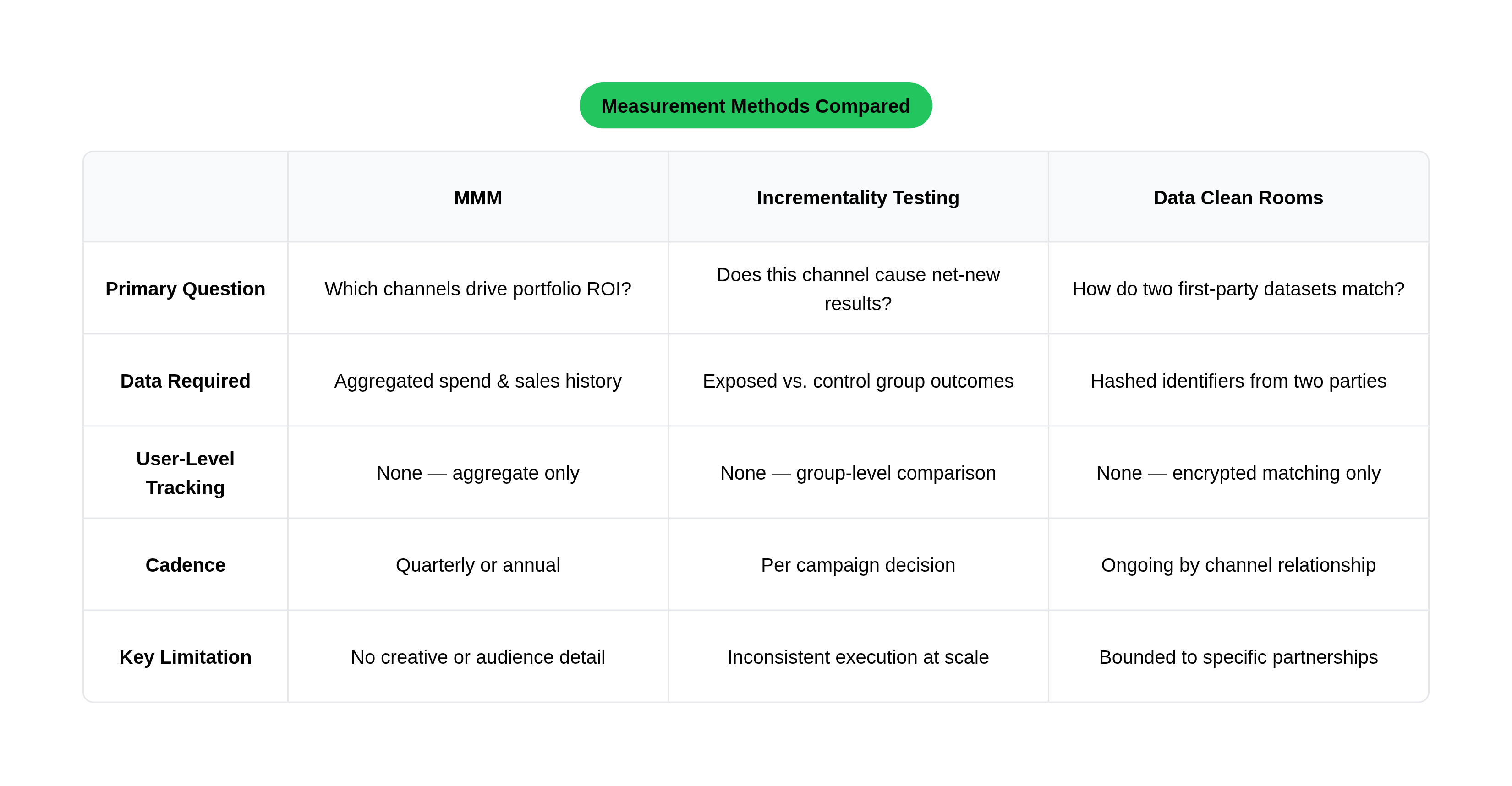
No single method replicates what third-party cookies did. Anyone selling you a single solution to the measurement problem is either oversimplifying or selling something. The defensible program for 2026 is explicitly layered, each method covering the blind spots of the others, and each method understood clearly enough to know where its coverage actually ends.
The logic of the stack runs in a specific order. Server-side tracking feeds clean event data into everything else; the quality of inputs determines the quality of everything downstream. First-party and zero-party data feed both MMM inputs and clean room matching. MMM handles strategic, portfolio-level budget allocation on a quarterly or annual cadence. Incrementality testing provides causal ground truth on the priority channels within that allocation. Platform attribution, the figures inside Google Ads or Meta's interface, stays in the stack as a directional signal for in-flight optimization, with explicit acknowledgment that it reflects 30 to 60% of touchpoints and should not be used as a planning input.
A concrete reference architecture, drawing on the stack The Matchbox outlined for 2026: GA4 with custom channel groupings for diagnostics; MTA for in-platform signal, with documented coverage limitations; MMM built on Meridian or Robyn for the portfolio view; geo and holdout incrementality for causal validation on key channels; server-side tracking feeding all of it.
The organizational reality that tends to get soft-pedaled is that these methods run on different cadences, require different skill sets, and are often owned by different teams. MMM runs quarterly or annually. Incrementality tests are designed around specific campaign decisions. Server-side tracking is infrastructure maintained continuously. Teams that treat this as a single analytics project rather than a persistent, multidisciplinary operational capability tend to struggle at execution even when their strategic understanding is solid. The harder problem is never building the measurement program. It is keeping it running when competing priorities, team turnover, and organizational friction make the path of least resistance doing nothing.
Consent infrastructure as a prerequisite, not an add-on
Every method in this stack depends on data collected with user awareness. First-party data, zero-party data, server-side event data, clean room matching: each requires a consent layer that is accurate, documented, and enforceable. This is not a legal formality running alongside the measurement program. It is the structural prerequisite for the program to function legally and accurately. Teams that treat it as a compliance checkbox tend to discover this the hard way, usually when a regulatory inquiry or a platform audit surfaces the gap.
The regulatory environment is not stabilizing. The conditions that made third-party cookies problematic continue to evolve through new legislation, expanding enforcement, and platform policy changes that do not always move in the same direction or on the same timeline. Consent management is the mechanism that keeps the first-party data foundation legally durable as that environment shifts.
There is also a measurement dimension to consent infrastructure that most teams leave on the table entirely. Reliable, granular consent signals let you segment audiences by consent status, measure the behavioral gap between consenting and non-consenting users, and use that gap to calibrate model inputs. A consent management platform that only blocks or allows data collection is a narrower tool than it needs to be.
The 38% of US consumers accepting cookies less often than three years ago are not expressing an inherent objection to data sharing. They are reacting to a trust deficit accumulated through years of opaque collection, confusing consent interfaces, and experiences where sharing produced no perceptible benefit. Users who understand what is being collected and why are measurably more likely to consent. Transparency functions as a trust mechanism, not a compliance burden, and treating it that way changes both the design of consent interfaces and the yield they actually produce.
The tools in this stack exist. The methodologies are documented. The cost barriers have come down substantially. The constraint is organizational: consent, data infrastructure, and measurement have to be built as a connected system, not managed as three separate problems by three teams that rarely coordinate. Closing that gap requires internal alignment, and internal alignment is a harder problem than selecting a vendor. That is where most organizations are actually stuck, and it is worth being clear-eyed about why.