MCP Gateway and Server Management Platforms Compared
Most "MCP gateway" products are not built for production scale.
MCP moved from Anthropic's open-source release in November 2024 to over 110 million monthly SDK downloads by mid-2026. Somewhere in that climb, a plain fact got buried: not every product wearing the "MCP gateway" label does the same job. Some are full control planes with identity, audit, and policy built in from day one. Others are local dev tools, integration wrappers, or bolt-ons to gateways that were never built with MCP in mind, and treating them as interchangeable is how a platform team ends up rebuilding its access control layer six months into production. Moving past its first server and into real load exposes the gap fast, and most of what gets sold as an "MCP gateway" is not built to survive that jump.
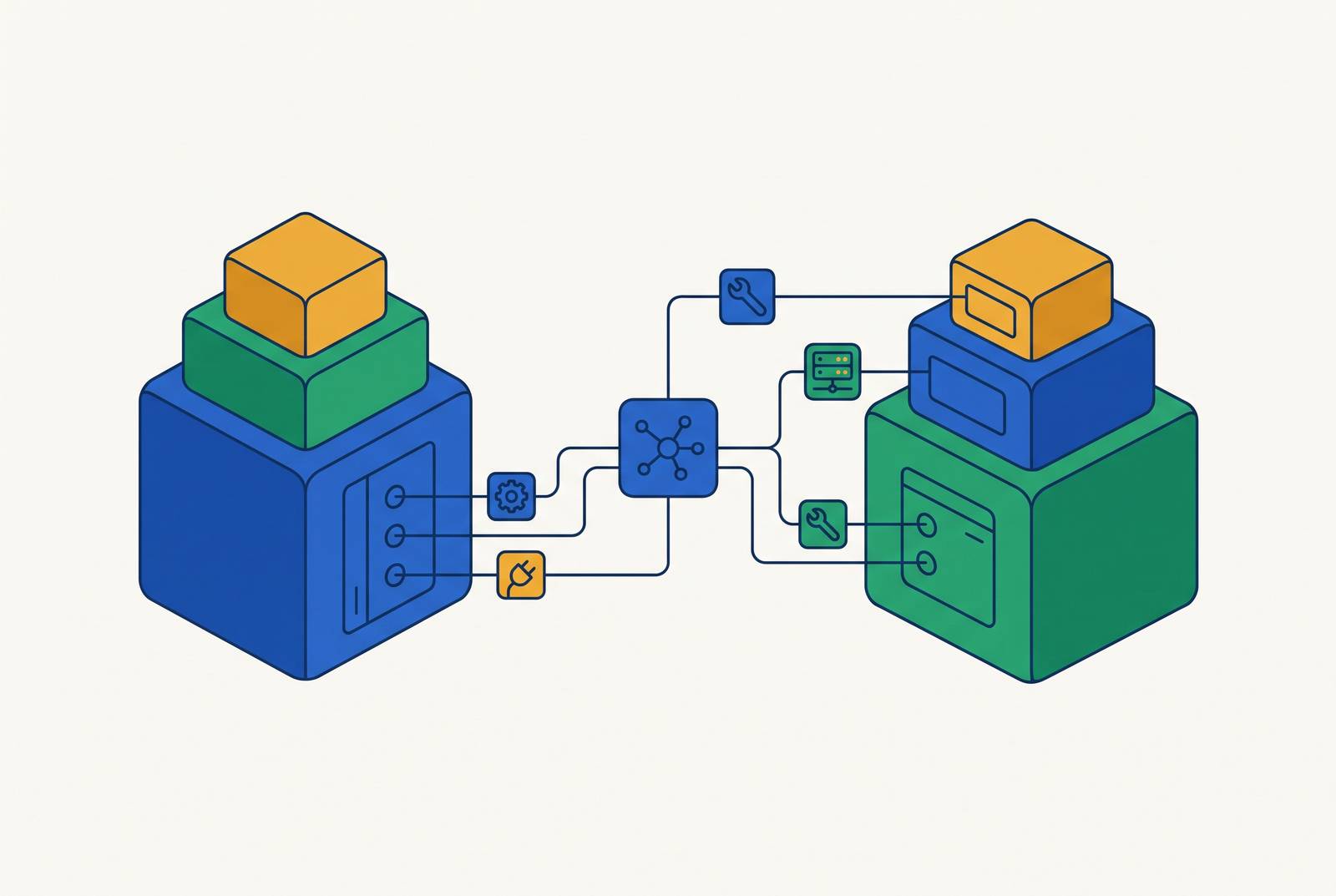
Why a gateway is the structural answer to the N×M problem in production
Before MCP, connecting N models to M tools meant building N×M one-off integrations. MCP flips that to N+M: each tool wires into the protocol once, each model does the same. That's why the protocol has 81,000 GitHub stars and crossed 15,926 mcp-server repositories by May 2026. But the math that made adoption cheap makes governance expensive at scale, and that tension is where most enterprise MCP programs actually live.
Picture the naive setup: every agent talks straight to every tool. Fine for a demo. Ten agents times ten MCP servers gives a hundred separate integration points, though, each with its own credentials, its own auth flow, its own way of breaking, and none of it visible from one place. Gartner's guidance on emerging API practices makes the same point about MCP: put a gateway in front of the surface, don't let every consumer talk to every producer directly.
Cost matters as much as security here, and it appears as a number someone on a platform team actually has to explain. Past 10 MCP servers and 100 tools, dumping every tool description into an LLM's context window on every single call gets expensive fast, not as a hypothetical, but as a line item on a bill. Authentication hits the same wall: OAuth 2.0 flows, API keys, custom headers, token refresh, credential rotation, all of it needs to run from one place, because managing credentials per server stops working somewhere around server number five. Nobody keeps five separate rotation schedules straight for long.
None of this is theoretical anymore. The gateway pattern is written into the MCP protocol roadmap itself, and the 2026 roadmap names audit logs, SSO-integrated auth, gateway behavior, and configuration portability as specific gaps the protocol still has to close. A gateway earns "production-grade" by doing a specific set of jobs: routing and aggregation across many servers behind one endpoint, centralized authentication that holds credentials and runs OAuth on behalf of users, tool-level authorization rather than just server-level, full audit logging of every call including the denied ones, defense against prompt injection through tool descriptions and tool poisoning, and reliability work like rate limits, retries, and timeouts for when a downstream server's schema shifts under you.
Real-time observability deserves its own line. An audit log read after an incident is a postmortem, useful, but late. What actually matters operationally is seeing what an agent touches while it's touching it, not reconstructing the damage afterward.
Running one MCP server on a laptop and running dozens in a governed production environment are not the same problem. They don't get solved by the same tools, and vendors that pretend otherwise are the ones worth being skeptical of.
The four architectural categories that the "MCP gateway" label covers
Lumping every MCP gateway into one bucket is the fastest way to pick the wrong one. The label spans at least four distinct architectural roles, and knowing which one a product occupies tells you more than any feature list will.
Application and authorization gateways sit between MCP clients and servers and own the whole job: authentication, authorization, policy enforcement, tool management. MCPManager, Usercentrics' AI data-access governance layer, occupies this space as well. TrueFoundry, Amazon Bedrock AgentCore, and IBM ContextForge all live here, and this is the category that actually deserves the name "governance platform."
Local MCP management tools stay scoped to a developer's machine or a local environment. Docker MCP Gateway fits this category in its baseline form, and its governance depth stops exactly where the laptop does. Calling these an enterprise solution is the single most common mistake teams make when they first go shopping.
Integration and downstream-auth infrastructure handles connections to third-party services and OAuth token management, without pretending to be an enterprise control plane. Composio solves tool connection well. It is not solving governance, and it was never built to.
Existing gateway extensions bolt MCP support onto an API gateway that already existed for other purposes. Kong AI Gateway is the clearest case here: worth it if a company already runs Kong, but not the place to start if someone is building MCP governance from scratch.
Across all four, the same checklist separates something demo-ready from something production-ready: support for STDIO, HTTP, and SSE; centralized tool discovery; access control granular down to the tool level, not just the server; health monitoring with automatic reconnection; full observability with metadata on every execution; centralized credential rotation; and some answer to rising token cost once a deployment crosses 100 tools.
Before any of that, though, comes a harder constraint that gets skipped too often: managed SaaS, self-hosted Kubernetes, or VPC deployment. Regulated industries frequently can't touch pure SaaS at all, so that filter has to run first, before anyone starts comparing feature lists.
Platforms built as full enterprise control planes: TrueFoundry and MCP Manager
A handful of platforms treat governance, identity, and observability as the foundation, not features stapled on after launch. A pattern across TrueFoundry and platforms like it makes the actual argument here: governance built in from day one is what gets a company to production faster, not what slows it down.
TrueFoundry shows up as a Representative Vendor in Gartner's 2025 Market Guide for AI Gateways and picked up Frost & Sullivan's 2026 Global Transformational Innovation Leader recognition. Its architecture does something specific: it deploys and hosts MCP servers on the same platform that governs them, so one control plane covers deploying the tools, deciding who touches them, and watching how agents use them afterward. The company reports handling over 10 billion requests a month across Fortune 1000 customers, with latency overhead in the 3 to 4ms range and benchmark figures around 350 requests per second per core. Granular RBAC, secret management, full observability down to token-level traces, plus SOC 2, HIPAA, and ITAR certifications, with deployment inside a customer VPC or fully on-prem. The tradeoff is a dedicated platform team to run it; this is not the fastest route to a first server running, and nobody should pretend otherwise.
Other platforms sit in the same category with a different emphasis: gateway, guardrails, and observability built as one layer, on the premise that centralized policy enforcement is what lets a company say yes to production deployment. RBAC for agents gets treated as a deliberate organizational decision. Its registry-first model runs on a simple idea: any MCP server that isn't in the registry is an identity nobody's accounting for, and unaccounted identities get exploited. Real-time observability is the operative layer, giving security teams the picture as it happens instead of a log to read the morning after. Folding in Usercentrics' data governance background puts governance at the center of the infrastructure.
Amazon Bedrock AgentCore Gateway and Kong AI Gateway: cloud-native and existing-infrastructure paths
Two more paths exist for teams whose infrastructure decisions are already made: stay inside AWS, or extend a gateway already running in production. Pick based on where the infrastructure already lives, not on feature comparisons; both of these only make sense as extensions of a decision a company already made.
Amazon Bedrock AgentCore Gateway is fully managed and serverless, routing agent-to-tool, agent-to-agent, and agent-to-LLM traffic through one secure endpoint. It turns existing APIs and Lambda functions into MCP-compatible tools with zero code changes, and it supports IAM authorization alongside OAuth, which matters for teams already running permissions through IAM. As of March 10, 2026, AgentCore Runtime added support for stateful MCP features: elicitation, sampling, and progress notifications, on top of the standard resources, prompts, and tools. A registry in preview lets teams publish MCP servers and agents into a searchable catalog with an approval workflow, discoverable by both humans and agents through semantic and keyword search.
Pricing, verified against the AWS pricing page as of August 5, 2026, is consumption-based across nine named capabilities: Runtime, Gateway, Policy, Identity, Memory, Observability, Evaluations, Browser, and Code Interpreter. No subscription, no minimum. Runtime bills at $0.0895 per vCPU-hour and $0.00945 per GB-hour, active consumption only. That's 12 independently billable components spread across 5 billing patterns, and The bill is fragmented across all nine line items, and teams can easily underestimate total cost when planning only for the most visible capability. This is the strongest option when Lambda functions, APIs, and remote MCP servers all need to sit inside the same IAM and CloudWatch control plane a team already runs. It's a much heavier lift for anyone spread across multiple clouds or running on-prem.
Kong AI Gateway took a different route, adding an AI MCP Proxy plugin in its October 2025 v3.12 release, with OAuth 2.1 support for MCP and MCP-specific Prometheus metrics. An Agent Gateway followed in v3.14 (April 2026), governing LLM, MCP, and agent-to-agent traffic from one control point. Its standout trick is generating MCP servers automatically from existing REST APIs, no code changes needed. But MCP support here runs through plugins rather than as a native capability, so anything complex may mean custom plugin work. Tool-level policy and agent-identity controls require additional configuration on top of the existing plugin framework, and enterprise governance depth is not fully documented. Deployment is self-hosted Kubernetes or managed through Kong Konnect; the core gateway is open source, but AI Gateway and Konnect features are commercial. Realistically, this is a months-long project for a dedicated platform team, best suited to organizations that already have Kong's licensed data plane in place and want MCP added to that investment. It serves that purpose. It is not a starting point for greenfield MCP governance, and treating it as one wastes months.
IBM ContextForge and Microsoft MCP Gateway: open-source paths with real governance ceilings
Open-source options exist too, and both come from companies with obvious enterprise credibility. Both also come with a governance ceiling that no amount of internal engineering time fully erases.
IBM ContextForge reached General Availability on April 30, 2026, currently at v1.0.10 (v1.0.4 shipped June 23, 2026). It's a genuinely broad piece of infrastructure: a Tools Gateway handling MCP, REST, and gRPC-to-MCP translation with TOON compression, an Agent Gateway supporting the A2A protocol with OpenAI-compatible and Anthropic routing, an API Gateway with rate limiting and retries, over 40 plugins, and OpenTelemetry tracing that plugs into Phoenix, Jaeger, and Zipkin. It deploys via PyPI or Docker and scales up to multi-cluster Kubernetes with Redis-backed federation, all under Apache 2.0 and built in Python on FastAPI. Response times run 100 to 300ms. Observability is flexible but shallow out of the box, and its access control model is partial, so enterprise governance ends up less documented than ContextForge's federation capabilities. The platform can be extended to close that gap, but the work of extending it falls entirely on whoever's running it. This fits a large enterprise with a platform team willing to own that configuration, and it does not fit anyone looking for governance out of the box.
Microsoft MCP Gateway is an open-source reverse proxy with session-aware routing and lifecycle management built for Kubernetes, with an optional path into Azure API Management. Its governance depth runs exactly as deep as APIM's policy engine. That engine is entirely rule-based. What Microsoft calls "intelligent routing" is load balancing and circuit breaking, nothing that reads intent or context. Tool-level RBAC and agent-identity attribution both require building on top of APIM rather than coming with the gateway itself. Compliance inheritance from the Azure stack only holds if the whole deployment lives in Azure, so it offers nothing for multi-cloud or on-prem setups. Response times run 80 to 150ms, and Azure monitoring gets extensive once it's set up, though the setup itself is not simple. This is the right tool for a platform team already deep in Entra ID, Azure Monitor, and APIM, since that team gets real compliance value out of the integration. Anyone outside that stack pays for integration complexity and gets governance that only gets them partway there.
Real-time observability, the kind that shows what an agent is touching as it happens rather than after the fact, is the specific capability that separates a postmortem tool from an operational one. That's the design principle behind governance layers for AI data access, which turn raw MCP activity into something compliance and security teams can act on instead of reviewing after the fact. Across every category here, a gateway's value rests on whether it can show someone what's happening while it's still happening. Whether it can log a call after the fact barely matters by comparison.