MCP Gateway Platforms Compared on Prompt Interception and Sanitization Capabilities
Early interception stops tool-poisoning attacks; late filtering just documents the damage.
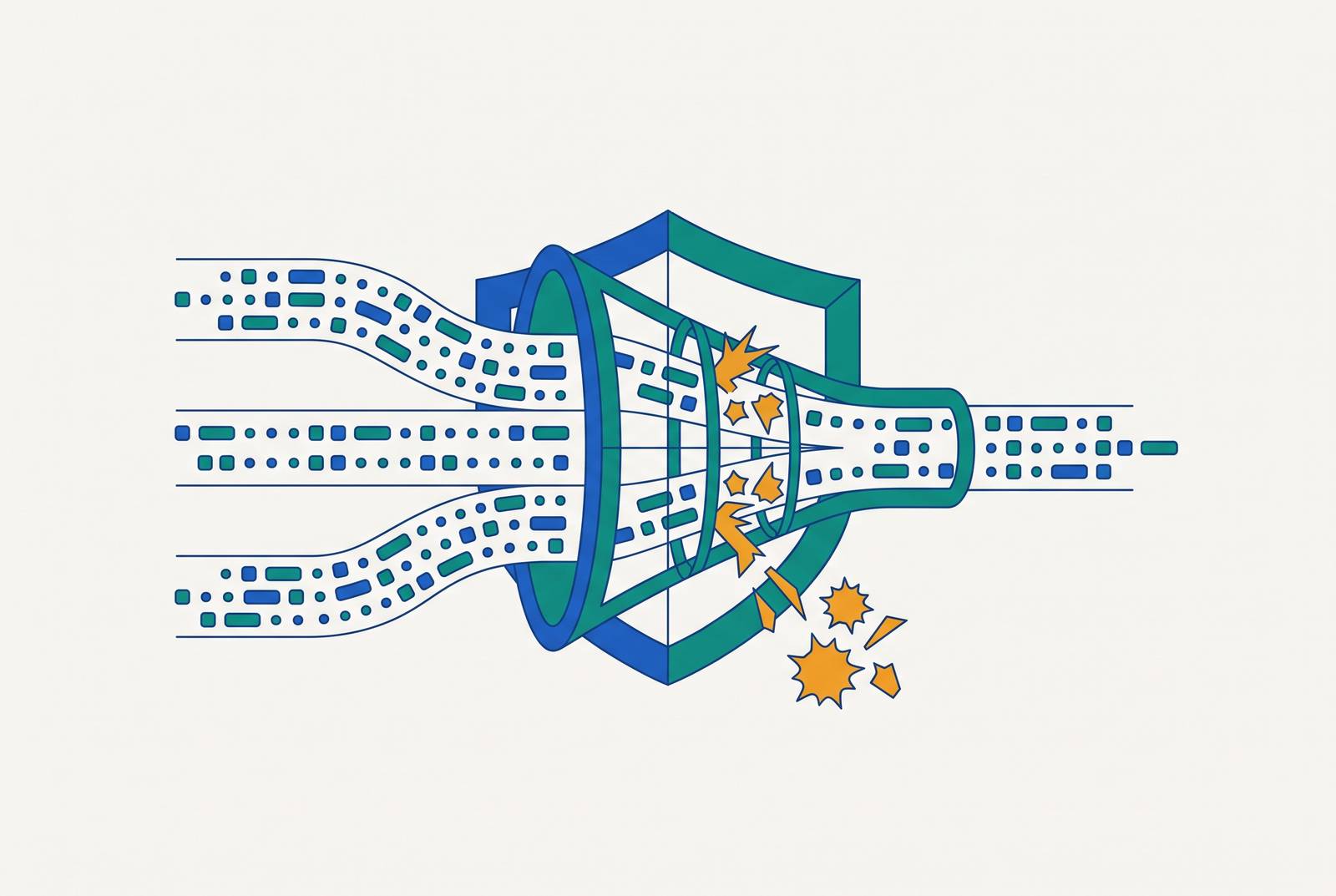
MCP gateways exist because the model context protocol has a wide-open trust problem, and by 2026, that problem sits at the center of production AI infrastructure. Four platforms below handle it in genuinely different ways, and the differences aren't cosmetic: where a gateway steps in, and how early, decides whether an attack gets stopped or just written down after the fact. Get that timing wrong, and the fanciest detection logic in the world is just an expensive incident report.
MCP gateways and the trust collapse that makes interception necessary
MCP isn't a niche standard anymore. By 2026, it has first-class support in Claude, ChatGPT, Cursor, Gemini, Microsoft Copilot, VS Code, and many other clients. Over 10,000 public MCP servers run right now, with SDK downloads clearing 97 million a month, marking it as production plumbing rather than a lab experiment. This is production plumbing, not a lab experiment.
A user's prompt, a developer's system message, and a third-party tool's description all land in the same context window, side by side, as plain text, which should worry you more than any adoption number. The model has no built-in way to tell "my developer told me to do this" apart from "some vendor wrote this description." Both appear as bytes in the context window, because bytes are all a model ever reads. It doesn't know who wrote what, and it never will, because nothing in the protocol tags the source.
That's why fixing this at the model level doesn't work, no matter how good the model gets. The MCPTox benchmark tested it directly and found that even Claude-3.7-Sonnet, the model that refused malicious tool-poisoning actions most often among those tested, still went along with the attack the vast majority of the time. The model follows instructions that read as legitimate, because as far as its context window is concerned, they are legitimate. That's the design working exactly as built, not a training gap. That's the design working exactly as built, and no amount of fine-tuning changes what a context window fundamentally is.
The two attack channels gateways must cover
Two separate attack paths get lumped together constantly, and treating them as one problem is a mistake. Each needs its own fix, built at a different point in the pipeline.
Prompt injection is an input problem. Malicious text rides in through content a user brings into the conversation, an email, a PDF, a scraped web page, a calendar invite. It enters the agent's context the moment a request gets made. The attack surface is anywhere user-supplied text touches the prompt.
Tool poisoning works differently. It's a supply-chain issue. The payload sits inside the tool's own metadata, including the JSON Schema fields, the natural-language descriptions, and the parameter hints. It loads when the agent boots up and fetches its tool list, before any user has typed a word. The attack surface here is configuration.
Security reviews routinely skip tool descriptors because they read like config files, not instructions. The model doesn't see it that way. It treats those descriptor fields as instructions, full stop, and one survey of MCP clients found that 5 out of 7 run no static validation at all on server-provided metadata. Nobody's checking the fine print, and the fine print is where the attack lives.
Then there's the refresh gap, and this one's worse than a missed audit. MCP servers can update their tool list mid-session. A server registers a clean, harmless tool, passes review, gets trusted, then swaps in a poisoned descriptor on the next refresh cycle. Every audit that came before that swap is now worthless. It happened, it passed, and none of it counts going forward.
How severe the undefended attack surface is
The numbers here aren't subtle. The MCPTox benchmark ran 1,312 malicious test cases across 10 attack categories against 45 live MCP servers with 353 real tools, and tested the whole setup against 20 different large language models.
The average tool-poisoning attack succeeded 36.5% of the time. Against the single most vulnerable model tested, the success rate hit 72.8%.
The pattern across models tested offers no comfort that capability alone provides protection. This isn't a bug some future release quietly patches out. The attack works because these models are good at following instructions, and following instructions is the whole point of building one.
Infrastructure scans back this up from a different angle. Among popular MCP servers, 43% had command-injection flaws, 22% allowed path traversal or arbitrary file reads, and 30% were exploitable through server-side request forgery. Plenty of these run with no authentication turned on by default. That's what's sitting on servers right now, reachable today, no exotic exploit required.
The architectural spectrum: where in the request lifecycle a gateway can intervene
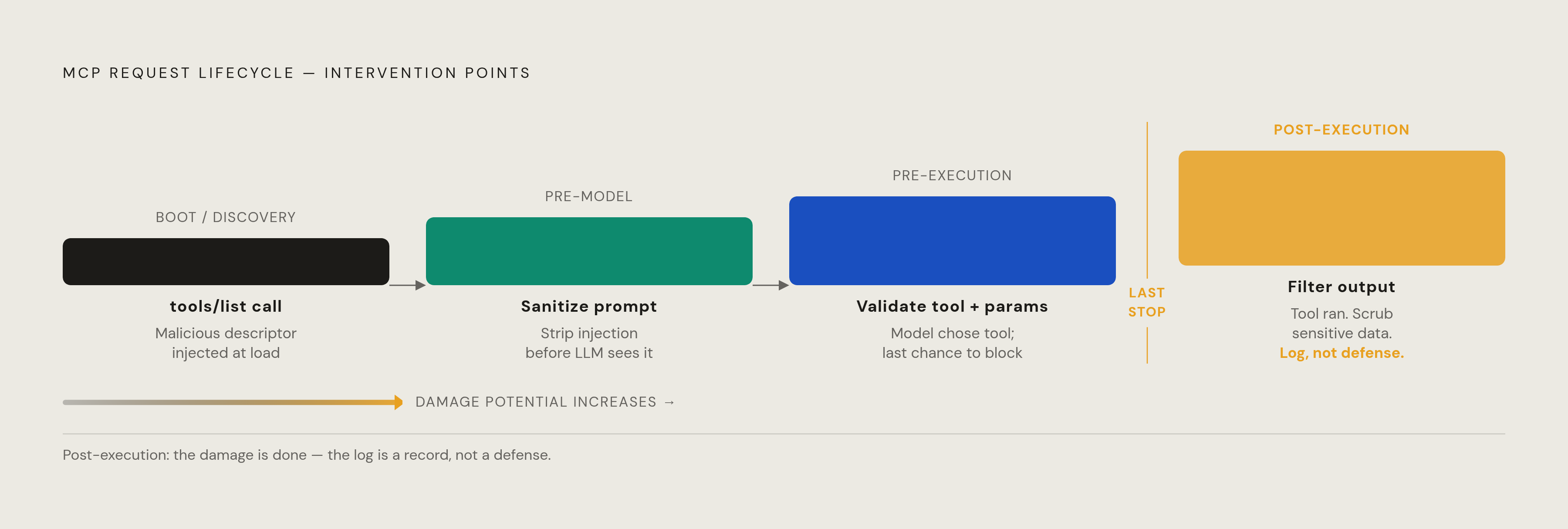
A gateway can step into the request lifecycle at four points, and where it steps in matters as much as whether it steps in.
Boot-time, or discovery, is the earliest point: when the agent calls tools/list and pulls down tool descriptors, before any user request even exists. Next comes pre-model sanitization, after a prompt arrives but before it hits the LLM, where injection payloads in user content can get stripped out. Third is pre-execution validation, after the model has already picked a tool and set its parameters, but before that tool actually runs. This is the last real chance to block a harmful action. Last is post-execution filtering, after the tool has already run and sent its output back, where sensitive data or instruction-like text gets scrubbed before the model reads it.
Later is worse, and it's not close. A gateway that only filters responses has already let the model decide based on possibly poisoned context. A gateway that only logs after the tool executes has already let the tool run. The damage is done by then, and the log is just a record of it, not a defense.
Palo Alto Networks' Unit 42 lays out what a full defense stack looks like: request sanitization first, response filtering second, and access controls (capability declarations, context isolation, rate limits) as the structural layer both depend on. Each layer covers a different point in that lifecycle. Skipping one doesn't get made up for by the others.
One more wrinkle, and it's the one teams get wrong most often: boot-time checks on tool metadata can't be a one-and-done thing. Given the refresh gap above, a gateway has to re-validate on every refresh cycle. Validate once, cache it, call it done, and mid-session poisoning walks right past the whole system without tripping a single alarm.
Lasso Security MCP Gateway: plugin-based sanitization with intent-level anomaly detection
Lasso Security launched its MCP Gateway in April 2025 as an open-source, security-first product, aimed at enterprise teams where a data leak carries legal weight on top of reputational cost.
The core design is a central proxy that all MCP traffic routes through, paired with a pluggable guardrail system, so teams can bolt on custom checks as needed. A PII detection plugin scans and sanitizes sensitive data in both directions, catching it at the gateway before it reaches the model or leaves toward an external tool. Token masking keeps credentials from ending up inside the context window itself. Prompt injection filters sit at the request layer, checking input before it moves further into the pipeline.
What sets Lasso apart is what the company calls an "intent deputy," a layer that checks whether a given tool call actually matches the agent's stated goal, rather than just checking whether the permissions technically allow it. A request can be fully authorized and still get flagged, because permission and intent aren't the same thing. Treating them as interchangeable is how tool poisoning slips through elsewhere.
It reads both the content of a request and the context around it, aiming to catch adversarial patterns before they reach a high-permission tool.
Kong AI Gateway: plugin-assembled security with regex and semantic prompt guarding
Kong AI Gateway 2.0 went GA in September 2026, built on the API management foundation Kong has run for years, with security assembled from a set of independently configured plugins rather than baked in as one fixed system.
That word "assembled" matters, and it cuts both ways. The security posture depends entirely on which plugins a team turns on and how they're wired together: AI MCP Proxy, AI MCP OAuth2, Prompt Guard, AI Semantic Response Guard, PII sanitization. If a team leaves one plugin out, that gap belongs to whoever configured it, not to Kong. This is the tradeoff of a modular system: flexibility for teams that know what they're doing, and quiet risk for teams that don't.
On the interception side, the AI Prompt Guard plugin runs regex-based policies against known injection patterns, catching attacks that already have a known signature. The AI Semantic Prompt Guard plugin goes a layer deeper, using semantic reasoning to catch attacks that don't match a known pattern but still read wrong contextually. Teams can also bolt on third-party tools like Azure Content Safety or a dedicated PII sanitizer for extra governance.
Kong cites a figure of 94% of known jailbreak attempts blocked by its automated prompt sanitization, without needing changes to the underlying application models. That number comes from Kong's own case study, a vendor claim until outside testing confirms it, not an independently audited result.
TrueFoundry MCP Gateway: on-behalf-of token injection and hybrid VPC deployment
TrueFoundry showed up on Gartner's 2025 Market Guide for AI Gateways, and Frost & Sullivan named it a Transformational Innovation Leader in its Global Enterprise AI Control Plane report. The platform is positioned as a unified control plane for AI infrastructure, bringing together model and tool management in one place.
A core concern TrueFoundry addresses is authorization scope: ensuring the agent only ever acts within the bounds of what a specific user is allowed to do, with no shared API keys and no ambient over-privilege where an agent quietly touches things no single user was ever cleared for. This targets what security researchers call an agent tricked into misusing its own authority on behalf of an attacker, and it does that at the authorization layer, not by scanning content for bad words.
Data privacy and deployment isolation are considerations the platform addresses, recognizing that sensitive MCP servers need controls over where their traffic flows and what endpoints it crosses.
MCP Manager: governance-first gateway with centralized visibility into MCP server deployments
Usercentrics built MCP Manager around a different starting question than the other three platforms here. Instead of leading with sanitization filters or token injection, it leads with governance: knowing what MCP servers and tools exist across an organization, in one place, before worrying about filtering their traffic. That's the right instinct, because there's no sanitizing traffic from a server nobody knew existed.
The governance-first approach centers on giving a security or platform team one consolidated view of what MCP servers and tools are actually live across the organization. Given how easily a poisoned tool descriptor sneaks in through an untracked server, that visibility alone closes off a real path of attack, just by making sure nothing connects without someone knowing about it first.
Ongoing observability across MCP traffic sits alongside that governance layer, giving teams the ability to spot unusual patterns and step in before damage spreads. It's a different bet than Lasso's intent-deputy model or TrueFoundry's authorization-layer controls: instead of one clever mechanism doing the heavy lifting at a single choke point, it's centralized visibility spread across the entire lifecycle of an organization's MCP connections.
Taken together, these four platforms prove there's no single right place to draw the line against prompt injection and tool poisoning. Anyone selling a one-mechanism fix is selling half the picture. Some gateways bet on catching bad intent early. Some lock down authorization instead. Some bet on simply knowing what's out there before anything else runs. What they share is a flat rejection of the idea that model-level safety training is enough on its own. Given what the MCPTox numbers show, that rejection is just correct.
Sources
- MCP Tool Poisoning: How AI Gateways Defend Against It
- Model Context Protocol Threat Modeling and Analyzing Vulnerabilities to Prompt Injection with Tool Poisoning
- MCP Security in 2026: Stopping Prompt Injection
- New Prompt Injection Attack Vectors Through MCP Sampling
- businesswire.com
- developer.konghq.com
- developer.konghq.com
- developer.konghq.com