AI Governance Frameworks
Frameworks aren't bureaucracy anymore; they're the operational core every board now requires.

AI Governance Frameworks.
AI Governance Frameworks as an Operational Requirement, Not a Policy Exercise
That's the whole game now. Understanding what these frameworks actually require in day-to-day operation is the fastest route to an AI strategy that moves quickly without moving blind.
The scale of this alone tells you it's not a side project anymore. The OECD AI Policy Observatory now tracks more than 1,000 AI policy initiatives spread across 69 countries, evidence of a landscape that's genuinely, seriously complex AI Governance Regulatory Landscape 2026 kslaw.com artificial-intelligence-wiki.com. Out of that sprawl, three instruments have become the ones that matter for any organization operating across borders: ISO/IEC 42001:2023, the NIST AI RMF, and the EU AI Act labs.cloudsecurityalliance.org.
What changed is who's asking about them. By 2026, it's a boardroom conversation: boards want to know how AI is actually being used inside the company, legal wants to know where the exposure is hiding, and the business side wants a green light to keep moving aljazeera.com labs.cloudsecurityalliance.org Bridging AI Risk Frameworks. Three different audiences, one shared question, and the frameworks are the closest thing to a common answer labs.cloudsecurityalliance.org.
Despite the differences in legal weight and geography, a shared operational core connects all three and produces visibility into what AI systems exist, controls over who and what can access them, and accountability that survives a deployment going wrong. That's the throughline for everything that follows.
There's a complication baked in from the start, though. The foundational version of the NIST AI RMF, published January 2023, was written before agentic AI architectures became a mainstream way to deploy systems labs.cloudsecurityalliance.org. So even the frameworks organizations are racing to adopt are already running to catch up with what they're supposed to govern.
Current and upcoming enforcement under the EU AI Act
August 2, 2026 is the date to know AI Governance Regulatory Landscape 2026 aljazeera.com annexops.com globalpolicywatch.com labs.cloudsecurityalliance.org Bridging AI Risk Frameworks. On August 2, 2026, the EU AI Act became fully enforceable, making the EU the first jurisdiction to impose comprehensive, binding AI regulations AI Governance Regulatory Landscape 2026 aljazeera.com annexops.com globalpolicywatch.com labs.cloudsecurityalliance.org Bridging AI Risk Frameworks. It didn't arrive all at once, though. The rollout has been staged over several years, and the staging matters as much as the destination.
Prohibited practices and AI literacy obligations started applying back in February 2025 aljazeera.com mcdermottlaw.com arXiv:2606.04037 - Toward Pre-Deployment Assurance for Enterprise AI Agents. Rules for general-purpose AI models followed in August 2025, and transparency requirements kicked in this August aljazeera.com mcdermottlaw.com arXiv:2606.04037 - Toward Pre-Deployment Assurance for Enterprise AI Agents labs.cloudsecurityalliance.org Bridging AI Risk Frameworks. Ahead: Annex III high-risk AI rules are now scheduled for December 2, 2027, with high-risk systems embedded inside already-regulated products (think medical devices, machinery) facing their deadline on August 2, 2028 AI Governance Regulatory Landscape 2026 annexops.com globalpolicywatch.com arXiv:2606.04037 - Toward Pre-Deployment Assurance for Enterprise AI Agents. That's a five-stage rollout stretched across four years, and each stage changes what "compliant" actually means for a given organization kslaw.com artificial-intelligence-wiki.com.
Part of why the later deadlines slipped is the AI Omnibus, a package of amendments agreed provisionally on May 7, 2026 and in force since July 27, 2026, marking the first changes to the Act since it was originally adopted in June 2024 aljazeera.com insideprivacy.com annexops.com nist.gov labs.cloudsecurityalliance.org Bridging AI Risk Frameworks arXiv:2606.04037 - Toward Pre-Deployment Assurance for Enterprise AI Agents. The delays trace back to something mundane but real: the harmonized technical standards needed to actually meet these obligations were behind schedule, and EU policymakers decided it made more sense to push deadlines than to leave companies guessing at compliance with no guidance to follow.
The Omnibus also softened some edges aljazeera.com insideprivacy.com annexops.com nist.gov labs.cloudsecurityalliance.org Bridging AI Risk Frameworks arXiv:2606.04037 - Toward Pre-Deployment Assurance for Enterprise AI Agents. Small and mid-sized companies, defined generously here as businesses with up to 750 employees and €150 million in annual revenue, now get simplified guidance, reduced fines, sandbox access, and standardized documentation templates lw.com. At the same time, two new categories joined the list of prohibited practices: AI-generated or manipulated non-consensual intimate imagery, and CSAM. The deadlines moved, the obligations didn't disappear.
Enforcement, as of August 2, 2026, is the joint responsibility of the AI Office and Member State authorities aljazeera.com digital-strategy.ec.europa.eu labs.cloudsecurityalliance.org Bridging AI Risk Frameworks. Those fines aren't symbolic. Up to €35 million, or 7 percent of a company's global annual revenue, whichever bites harder, making this one of the steepest penalty structures anywhere in AI regulation 10 Key AI Governance Frameworks In 2026.
The Act's risk-tier system, unacceptable, high-risk, limited-risk, minimal-risk, sounds like classification busywork until you realize the operational demand hiding inside it: an organization has to inventory every AI system it runs before it can even say which tier applies. You can't classify what you haven't counted. And none of this stays inside EU borders AI Governance Regulatory Landscape 2026 aljazeera.com annexops.com globalpolicywatch.com labs.cloudsecurityalliance.org Bridging AI Risk Frameworks. Non-EU organizations are not exempt: the Act applies to any provider placing systems on the EU market, the so-called "Brussels effect" extending its reach far beyond Europe. What changed for organizations in the Omnibus:.

The US federal approach amid complicating state laws
The US, by contrast, has no single AI law. Instead there's a stack of executive orders, agency guidance, and a fast-growing pile of state statutes, and the federal posture leans hard toward speed over restriction. In July 2025, the White House released "Winning the AI Race: America's AI Action Plan," built on three pillars: accelerate innovation, build out AI infrastructure, secure international leadership aljazeera.com mcdermottlaw.com arXiv:2606.04037 - Toward Pre-Deployment Assurance for Enterprise AI Agents. Removing friction, not adding it, is the explicit goal.
Then on June 2, 2026, a further executive order, "Promoting Advanced Artificial Intelligence Innovation and Security," laid out two tracks: strengthen cyber defenses across government and industry, and build voluntary benchmarking frameworks for frontier model development AI Governance Regulatory Landscape 2026 aljazeera.com annexops.com globalpolicywatch.com labs.cloudsecurityalliance.org Bridging AI Risk Frameworks. Voluntary is doing a lot of work in that sentence, though. The order asks AI developers to share new models with the federal government up to 30 days before those models reach other partners mcdermottlaw.com. Nobody's forced to comply, but any company chasing federal contracts or partnerships is going to comply anyway, because the alternative is getting frozen out.
Meanwhile, states didn't wait around. California's Transparency in Frontier Artificial Intelligence Act and Texas's Responsible Artificial Intelligence Governance Act both took effect January 1, 2026 aljazeera.com kslaw.com labs.cloudsecurityalliance.org artificial-intelligence-wiki.com Bridging AI Risk Frameworks. Then, on December 11, 2025, Trump signed an executive order proposing a uniform federal framework that preempts state AI laws deemed inconsistent aljazeera.com mcdermottlaw.com kslaw.com artificial-intelligence-wiki.com arXiv:2606.04037 - Toward Pre-Deployment Assurance for Enterprise AI Agents. The order goes further than words: it directs the Department of Commerce to condition $42 billion in BEAD broadband infrastructure funding on states repealing AI rules the administration deems too onerous paulhastings.com. Money as leverage, in other words.
So here's where things stand: state laws are actively in force while the federal government is simultaneously trying to override them aljazeera.com labs.cloudsecurityalliance.org Bridging AI Risk Frameworks. That's not a stable arrangement, and it's not a reason for any company to sit on its hands waiting for clarity. The absence of one binding federal AI statute doesn't lower the compliance burden, it raises it, because organizations operating in multiple states now have to track a set of obligations that overlap in some places and directly conflict in others.
What the NIST AI RMF requires organizations to do
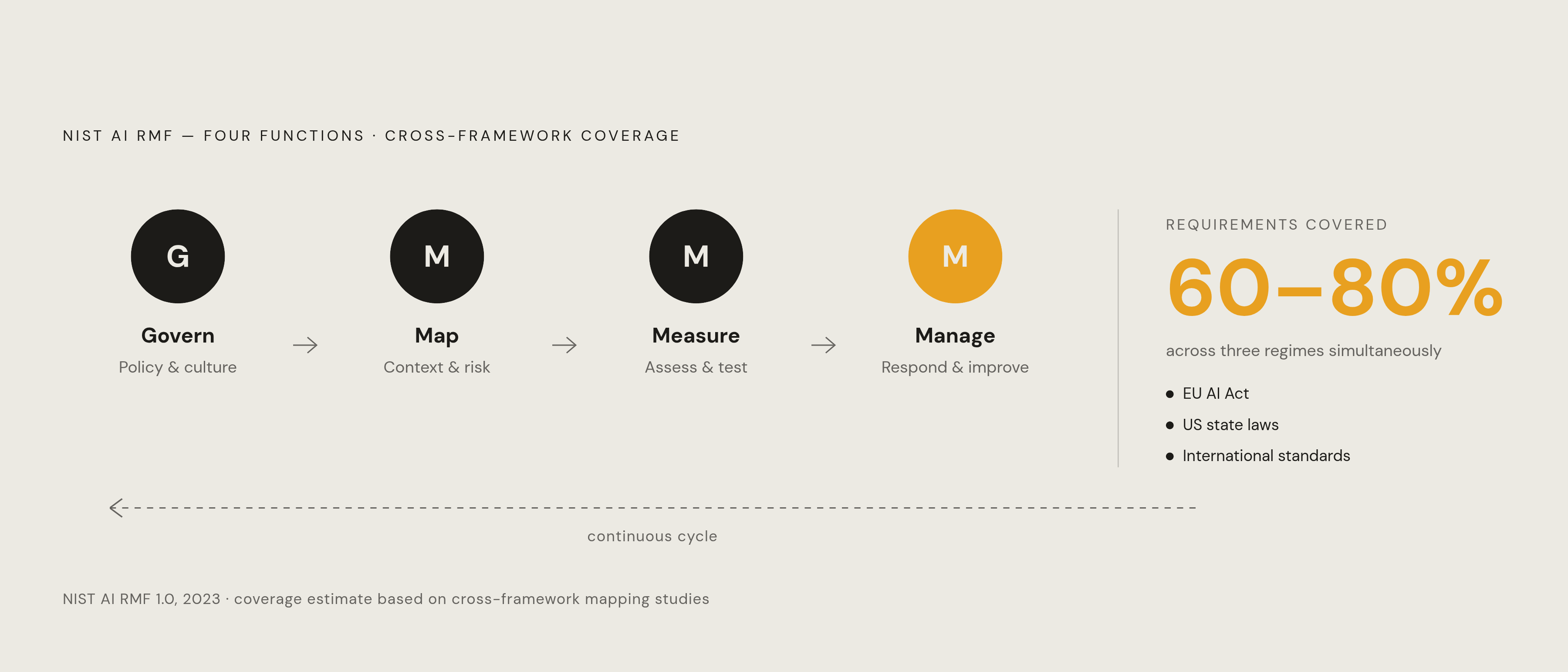
Of the frameworks in play, the NIST AI RMF has become the most widely used voluntary governance structure in the United States, and it's since been incorporated into state law and federal procurement baselines. It organizes everything around four functions: Govern, Map, Measure, Manage.
Govern means building the actual accountability structure, the policies, and the internal culture around AI risk, someone has to own the decision when something goes sideways, and that ownership has to be named before the fact. Map means identifying and cataloguing every AI system in use, what context it operates in, what it could realistically affect, because governing something you haven't identified is a contradiction in terms. Measure is where assumption gets replaced by instrumentation: assessing and analyzing risk requires actual measurement tools, not a gut feeling that things are probably fine. Manage closes the loop, prioritizing the risks that got identified and treating them, with monitoring that never really stops.
None of this was left as pure suggestion for federal agencies. Executive Order 14110, from October 2023, pushed federal agencies toward adopting AI RMF principles, and OMB's follow-up guidance in March 2024, known as M-24-10, required agencies to implement frameworks consistent with NIST by December 2024 kslaw.com labs.cloudsecurityalliance.org. Voluntary for private companies, mandatory for federal agencies and anyone selling to them.
There's a practical upside buried in all this complexity, too. Adopting the NIST AI RMF is estimated to satisfy 60–80% of requirements across the EU AI Act, state-level US laws, and international standards simultaneously underdefense.com. That makes it a genuinely high-leverage starting point for any company operating across more than one jurisdiction, rather than one framework among many with no relationship to the others.
Agentic AI governance hasn't gone away, though. NIST, through CAISI's AI Agent Standards Initiative announced in February 2026, acknowledged that the original January 2023 AI RMF predates agentic architectures becoming a standard way to deploy systems, and a dedicated AI Agent Interoperability Profile is planned for release in the fourth quarter of 2026 aljazeera.com labs.cloudsecurityalliance.org labs.cloudsecurityalliance.org Bridging AI Risk Frameworks. Separately, on April 7, 2026, NIST released a concept note for an AI RMF Profile on Trustworthy AI in Critical Infrastructure, a sign the framework is actively evolving and organizations should track these additions aljazeera.com nist.gov labs.cloudsecurityalliance.org Bridging AI Risk Frameworks. AI RMF 1.0 itself is being revised as part of the White House AI Action Plan, and the very document most companies are implementing right now is openly, actively in revision. NIST knows this. The gap is acknowledged, it just isn't closed yet.
What ISO/IEC 42001 adds that the other frameworks do not
ISO/IEC 42001:2023 holds a different kind of distinction: it's the first international standard built specifically for AI management systems, and the first framework that turns organizational AI governance maturity into something you can actually get certified against labs.cloudsecurityalliance.org. NIST and the EU AI Act tell you what principles to hold and what obligations to meet.
The standard is built around a small set of blunt questions that every organization has to be able to answer. Who owns AI risk internally? How are AI decisions monitored once the system is live? When does someone actually step in, and how? What's the proof that governance is a continuous practice and not a one-time audit that happened once and got filed away? ISO 42001 treats AI as a governance and risk discipline first, a technology second, applying oversight across the entire lifecycle from design through retirement, and pinning accountability to outcomes rather than good intentions.
It also plays well with what many organizations already have running. ISO 42001 was built to integrate with ISO 27001, the information security management standard, so companies already following established management-system practices can often extend that same muscle to cover AI without starting from zero annexops.com arXiv:2606.04037 - Toward Pre-Deployment Assurance for Enterprise AI Agents. And because certification is jurisdiction-neutral, it works as a parallel track alongside EU AI Act compliance and NIST RMF adoption, rather than competing with either.
The pressure to adopt it is becoming less optional by the year. By 2026, organizations without AI governance practices that meet something close to ISO 42001's level of rigor are going to find it harder and harder to explain their approach to boards or regulators asking pointed questions aljazeera.com labs.cloudsecurityalliance.org Bridging AI Risk Frameworks. Still, the limits here are precise. ISO 42001 certification does not substitute for legal conformity under the EU AI Act. That's not a gap a crosswalk document can paper over; it's a structural difference between voluntary certification and binding law, and no amount of mapping makes one stand in for the other. Key questions ISO 42001 forces organizations to answer:.
Where the three frameworks converge on the same operational demands
Despite differing in legal status, in what they govern, and in how they even define risk, ISO/IEC 42001, the NIST AI RMF, and the EU AI Act are all aimed at the same underlying goal of trustworthy AI, a convergence formal enough that researchers have organized it into what's been called a Unified AI Governance Taxonomy, built around five analytical layers kslaw.com artificial-intelligence-wiki.com.
Normative purpose is the first layer, and it's where the frameworks agree loudest: all three want trustworthy AI, the EU AI Act just enforces that goal through binding law while the others rely on certification and voluntary uptake. Governance subject is the second layer, where the frameworks technically look at different things, the AI system and its actors, the risk-management lifecycle, the organization's broader management system, but in practice those different focal points end up covering the same ground. Real divergence in risk logic occurs when comparing methods: the EU AI Act works off list-based categorization, NIST leans on contextual and iterative assessment, ISO 42001 treats it as a lifecycle process. Different lenses on the same problem. Evidence and assurance matters most for anyone actually running a compliance program, because all three demand documentation and ongoing proof of governance, not a policy statement signed once and forgotten.
Putting those layers together makes a genuine payoff available: organizations can run a single control library and evidence base that supports ISO/IEC 42001 certification, NIST AI RMF adoption, and EU AI Act compliance without duplicative effort, if the architecture is designed with that convergence in mind.
There are real limits to how far unification goes. Legal conformity under the EU AI Act is not fungible with voluntary certification (the enforcement asymmetry is real and cannot be crosswalked away), and the mismatch between list-based and contextual risk ontologies creates gaps that simple mapping tables miss. What does hold steady across all three, regardless of legal status, is a set of domains that never disappears: accountability, risk identification, access and data governance, transparency and documentation, monitoring, human oversight, incident response. Different frameworks dress these up differently, but they occur in every one of them. Any enterprise building a governance program should anchor on those stable domains first, then layer in framework-specific requirements on top, not the other way around. The five layers where convergence is meaningful, per the UAGT:.
The governance gap when AI agents are in the picture
NIST AI RMF 1.0, ISO/IEC 42001:2023, and the EU AI Act were all written before agentic AI architectures became a mainstream way of deploying systems, and researchers studying the space have called the resulting gap between these instruments and general-purpose, agentic AI an explicit, named limitation labs.cloudsecurityalliance.org.
Agentic systems break assumptions these frameworks were built on. An agent doesn't just return an answer, it acts across multiple systems, tools, and data sources, taking real actions with real consequences rather than sitting passively behind a query box. The access surface it operates within is dynamic too: what an agent can reach expands the moment it's handed a new tool or connected to a new MCP server, frequently with no governance review attached to that expansion at all. Standard post-deployment monitoring assumes a system that responds when asked something. Agents that act on their own initiative make audit trails both more critical and considerably harder to hold onto.
NIST has said as much itself. The AI Agent Standards Initiative, announced in February 2026, is aiming for an AI Agent Interoperability Profile in the fourth quarter of that year aljazeera.com labs.cloudsecurityalliance.org Bridging AI Risk Frameworks. The gap is formally recognized. The guidance to close it just isn't out yet.
There's research quantifying how wide that gap really is. A paper on pre-deployment assurance for enterprise AI agents generated 1,800 test scenarios and evaluated them against 125 primary-source regulatory requirements aljazeera.com kslaw.com labs.cloudsecurityalliance.org artificial-intelligence-wiki.com Bridging AI Risk Frameworks arXiv:2606.04037 - Toward Pre-Deployment Assurance for Enterprise AI Agents. Ontology-grounded generation clearly beat the dominant baseline approach on regulatory coverage, 48.3 percent versus 33.1 percent aljazeera.com kslaw.com labs.cloudsecurityalliance.org artificial-intelligence-wiki.com Bridging AI Risk Frameworks arXiv:2606.04037 - Toward Pre-Deployment Assurance for Enterprise AI Agents. Read that both ways: pre-deployment verification for agentic systems is achievable, the better method proved it, but most current approaches are still leaving well over half the regulatory ground uncovered. Singapore stands out here as one of the few jurisdictions actually designing governance rules for agents from scratch, rather than trying to retrofit rules written for simpler AI systems onto something that behaves nothing like them. That's the direction the rest of the field still has to travel. What makes agentic AI structurally different from governed AI systems:.