Team-Scoped Tool Access Policies in Enterprise MCP Deployments
Enterprises need team-scoped policies to control which AI agents access which tools.
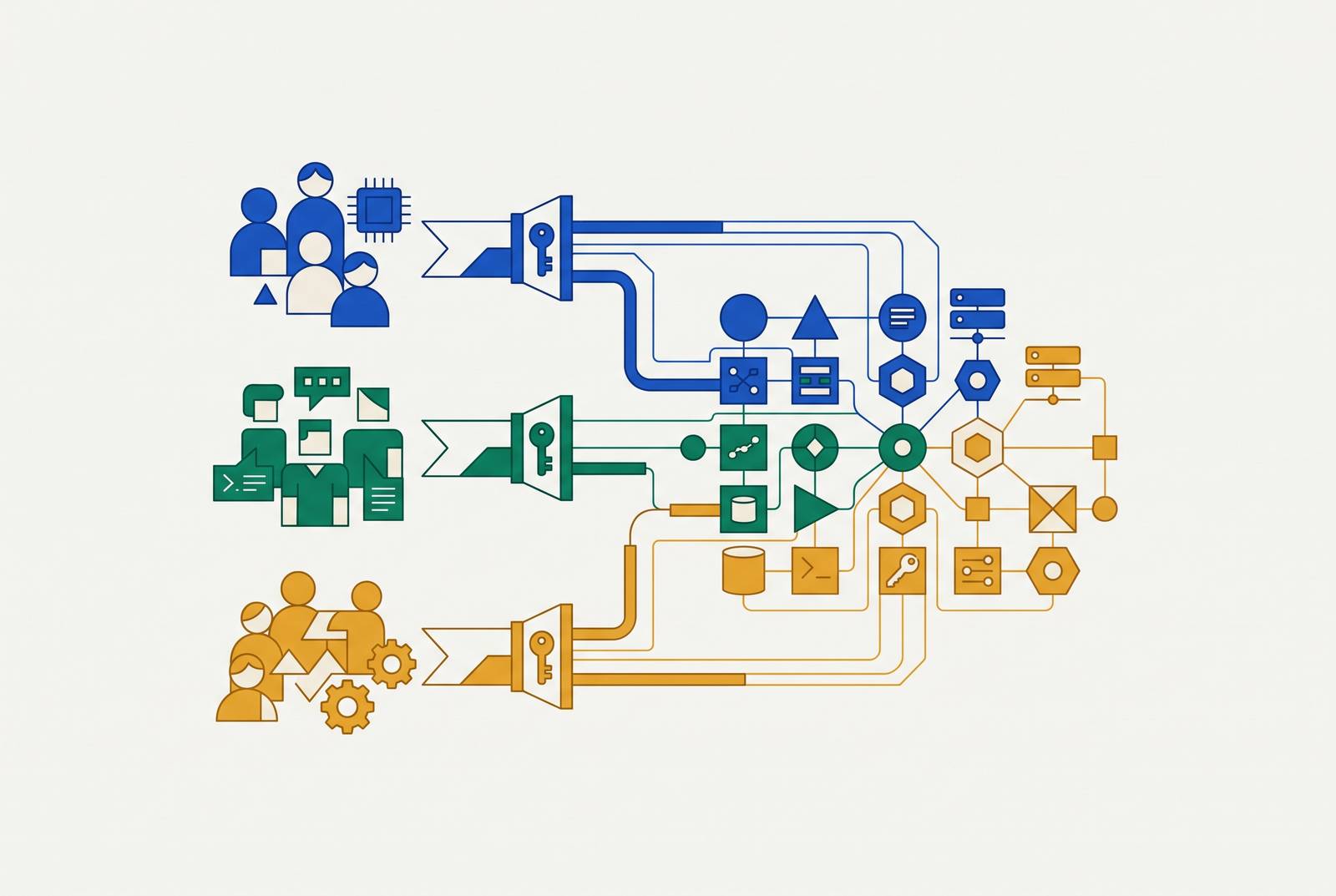
Enterprises use a centralized gateway with team-scoped access policies, identity binding, and per-operation authorization to control which AI agents can reach which MCP tools. MCP supplies connectivity. Team-scoped tool access policies make multi-team deployments governable by defining which agents, serving which teams, may use which tools under what conditions.
Why MCP's transport-layer design leaves authorization entirely to the enterprise
A common connector makes systems easier to connect, but it does not decide what a connected system may do. MCP standardizes how AI agents discover and invoke tools across enterprise systems. It does not enforce who may invoke each tool under which conditions, so authorization remains an enterprise responsibility.
The specification moved toward OAuth 2.1 for remote servers, but implementations still use different credential mechanisms. Accepting a token is not the same as deciding whether its holder should perform a particular operation. That distinction matters because agents discover tools at runtime, and a vendor update can expand the available catalog without an approval step. The official GitHub MCP server exposes over 90 tools, including destructive operations and benign ones.
What ungoverned MCP access looks like at enterprise scale
Without team-scoped policies, agents inherit the permissions of their connections, exceeding the limits of their jobs. A code-generation agent gets write access to production repositories, while a database agent gets admin access when it needs only to read specific tables. A CRM agent receives full API access for a workflow that only queries contacts. These connections give bad instructions, including prompt injection, a path to trusted data sources with more power than the task requires.
When employees and agents use one token, their actions appear under the same credential, erasing the identity needed to trace responsibility. With unregistered servers, the organization also loses track of what those servers can access. These are operational failures before they become compliance questions under the EU AI Act. Credential-level enforcement and continuous monitoring, which MCP Manager provides, keep the audit identity and live visibility that are lost with shared tokens and unregistered servers.
Why most enterprises have not closed the gap despite knowing it exists
Awareness does not resolve the mismatch between traditional identity management and the agent-to-tool credential layer. Knowing who an employee is does not establish who owns every MCP credential or how each connection should expire. A team running multiple agents across multiple servers accumulates dozens of credentials with separate provisioning, rotation, and storage arrangements. Those connections need a common operating model.
Without that model, the approved path can become the slowest path. When developers face OAuth consent screens again for each server, they are more likely to use shared tokens and local stdio servers outside central oversight. Those local deployments leave IT and security without a centralized audit trail or a reliable way to revoke access when someone leaves. Deferring governance then creates a trap because blocking MCP pushes adoption underground while demand persists. The exit is to make governed access easier to obtain than an unaccounted connection.
How do enterprises enforce role-based access across multiple MCP servers
A centralized gateway with team-based provisioning replaces scattered server URLs with administrator-defined access profiles. Developers find approved servers through an internal portal, and each profile sets which tools their team can reach. Sales can receive CRM and Slack tools, Engineering can receive GitHub, Jira, and CI tools, and Finance can receive accounting read-only tools.
Streamable HTTP supports this architecture by making MCP servers network services compatible with standard load balancers, reverse proxies, and OAuth 2.1 integration. TrueFoundry and another gateway vendor are concrete examples of the centralized gateway pattern. MCP Manager bridges the authorization gap through a centralized governance layer that translates team-scoped policies into runtime controls at the protocol level. The relevant comparison is whether a gateway can enforce team boundaries across servers and make those decisions observable.
How identity binding makes team-scoped policies enforceable in practice
A team profile needs a dependable link to the person behind each request. Developers authenticate through SSO using SAML or OIDC and receive short-lived gateway tokens carrying their group memberships. The gateway can then apply the appropriate team policy on every request. When someone changes teams or leaves, centralized identity binding applies that change across MCP servers without the need for credential rotation at each one. Dedicated OAuth app registrations per server keep remote connections from depending on a shared credential.
MCP Enterprise-Managed Authorization (EMA) reached stable status June 18, 2026, replacing per-user consent screens with a zero-touch, IdP-delegated flow. Okta was the first supported identity provider, with Anthropic, Visual Studio Code, and seven MCP servers shipping launch support. Those servers were Asana, Atlassian, Canva, Figma, Granola, Linear, and Supabase, with Slack actively rolling out support. EMA removes onboarding friction, but it does not authorize individual actions after token issuance. Where a downstream integration supports only API keys, the transitional pattern is a vaulted key with a maximum TTL, a unique key per server instance, and continuous monitoring.
The critical distinction between session-level access and per-operation authorization
Session-level authorization answers whether an agent may connect. Per-operation authorization answers whether this user may perform this action on this data now. EMA addresses session-level access, so a properly authenticated agent can still act beyond its intended job. Runtime checks must evaluate each tool invocation against the user’s team-scoped permissions. When a catalog update makes new tools discoverable, it must not silently give agents permission to use them.
The Grafana MCP server vulnerability shows why trusted access does not make every request safe. CVE-2026-19516, CVSS 9.1, disclosed August 2026, involved the grafana_api_request tool honoring a caller-supplied X-Grafana-URL header without validating the destination. Callers could direct outbound requests toward internal services and cloud metadata endpoints. The flaw required destination validation and was fixed in mcp-grafana v1.1.0. It was separate from the application-level session-validation issue and was not fixed by the July 2026 specification’s removal of Mcp-Session-Id.
A connection check cannot substitute for tool-level permission checks, scope constraints, or input validation. Even with per-operation authorization, an action that is permitted may be unwise. Human approval is still needed for irreversible actions, including when an authorized agent acts on bad instructions.
How to structure team profiles for common enterprise team types
Four scope controls turn team profiles into enforceable boundaries. First, separate server environments by trust boundary, so read-only analysis agents do not share connections with production deployment agents. Second, give each connection only the permissions its workflow needs. Third, use named per-tool allowlists so new tools stay blocked until they are permitted. Fourth, give security and compliance teams read-only access across virtual server environments so they can audit them without operational access.
Engineering profiles can include GitHub, Jira, and CI tools scoped to the repositories and pipelines the team owns. Only roles that expressly include release engineering should have production deployment tools. Sales profiles can include CRM read/write and Slack tools, limited to named accounts and channels, without access to finance or HR systems. Finance profiles should give access to accounting read tools through a read-only ERP virtual server.
A contact-query workflow needs less CRM access than a workflow that updates accounts, even when both serve Sales. A fixed allowlist keeps the permission boundary unchanged until an administrator deliberately expands it.
Credential lifecycle management as the operational discipline that keeps policies from drifting
Provisioning is only the start of a credential’s life. Durable policies also require rotation, revocation, and exposure detection across config files, environment variables, CI/CD pipelines, and vault references. Dedicated credentials per agent and server make those tasks manageable without coordinating every team around one shared token. For remote servers connecting to internal APIs and databases, vault-issued dynamic credentials or workload identity are the recommended pattern.
Policy should explicitly prohibit hardcoded credentials in repository configs, shared tokens, reused personal access tokens, plain-text refresh tokens, and static database connection strings in server manifests. Secret scanning should run as a CI/CD gate, while offboarding should test whether removing IdP group membership immediately revokes MCP access across servers. A failed revocation test means the identity policy is not operating as intended. By consolidating credential lifecycle, access policy, and audit logging, MCP Manager’s centralized approach removes the scattered credential administration and per-server consent friction that encourage shortcuts.
What real-time observability adds that audit logs alone cannot provide
Audit logs support investigation, but a record read after damage is not a live safety net. Operation-level observability must show which named tool an agent invoked, on behalf of which team-scoped user, against which data resource, and at what timestamp. These are also the facts needed for authorization, so the gateway can emit the same context as an observability record. That links the permission decision to the action rather than leaving separate systems to reconstruct it afterward.
Real-time monitoring adds the chance to flag an invocation outside a team profile or a call volume inconsistent with normal work before irreversible actions complete. Local stdio processes without centralized telemetry cannot provide that view across an enterprise deployment. MCP Manager combines gateway controls, guardrails, and real-time observability so team policies can be visible and enforceable at the operation level. In a comparison with gateway options such as TrueFoundry and another vendor, these are distinct capabilities to assess. An enterprise MCP gateway with built-in RBAC and observability needs both an enforceable permission boundary and a record of each operation crossing it.
Putting it together through a rollout sequence that preserves adoption speed
Start with an internal registry before any agent reaches production. Every server needs an entry, an owner, and a declared team scope so its access can be accounted for and revoked. Then place a centralized gateway in front of those registered services as the single access point. All MCP traffic should pass through it for authentication, allowlist enforcement, and observability records. Prohibit stdio deployments that bypass the gateway for servers touching shared resources.
With that path established, bind team profiles to IdP groups through SAML or OIDC SSO and short-lived, group-carrying tokens. EMA-compatible identity providers can handle organizational delegation without repeated developer consent screens. Next, keep named tool allowlists narrow and expand them based on the workflow seen in use. This order gives each permission a known identity and each newly added tool an explicit decision.
Before the first production agent goes live, put credentials in a vault, enforce the bans on prohibited credential patterns, and make secret scanning a CI/CD gate. Then enable per-invocation records and set alert thresholds for anomalous tool-call patterns. Add human confirmation requirements for irreversible actions as the final boundary when a permitted agent follows bad instructions. Subsequent deployments can then join an existing governed system instead of triggering a fresh access design and security review. Speed and safety become the same engineering problem because the shared path that makes access accountable also makes it repeatable.