AI Governance Professional Certification Programs Compared
Individual credentials and organizational certifications serve different purposes in AI governance.
A compliance officer passes the IAPP AIGP exam and lists it on her professional profile, so she assumes her company is covered when a major client's procurement team sends over an AI vendor questionnaire. It asks for proof of an ISO 42001 certificate. Her AIGP does not answer that question, because it was never built to. In the opposite direction, a company can spend a year and real budget earning ISO/IEC 42001 certification, pass its audit, and still find its staff cannot explain what the EU AI Act actually requires of them day to day. Both of these are the same mistake, approached from different ends: treating individual credentials and organizational certifications as substitutes for each other.
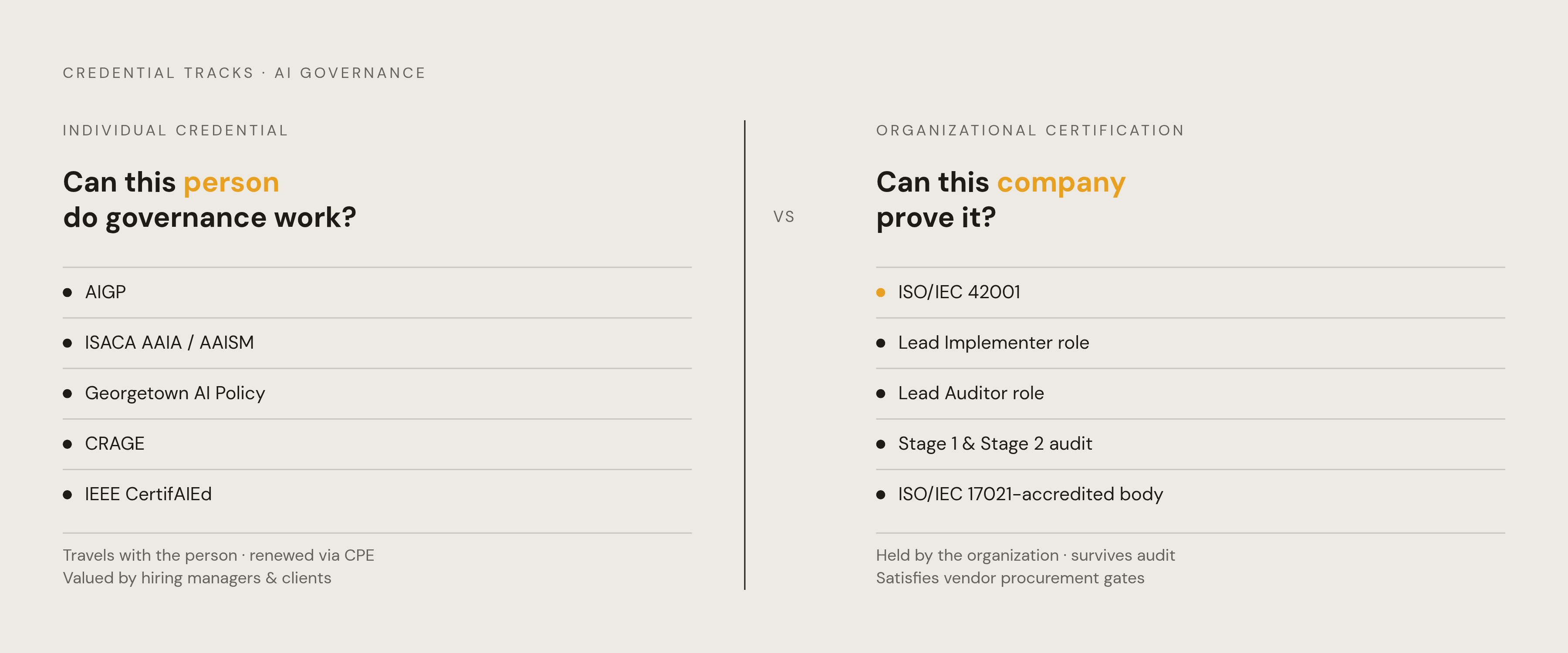
They are not substitutes. An individual credential, like the AIGP, proves that a named person can design and run an AI governance program. It travels with that person from job to job, gets renewed through continuing education credits, and tells a hiring manager or a client that the person in front of them knows the material. An organizational certification, like ISO/IEC 42001, proves something different: that a company runs an AI Management System capable of surviving an audit by an outside certification body. It exists to satisfy vendor due diligence and procurement gates, not to advance anyone's career.
Part of the confusion is built into how these programs get sold. Training providers market "ISO 42001 Lead Implementer" courses directly to individuals, complete with a certificate and a credential to list after your name, which makes the whole thing look like a personal qualification equivalent to the AIGP, but it isn't one. A Lead Implementer is a practitioner who is trained to help an organization build the management system that earns the actual ISO 42001 certificate. The person holds a skill. The organization holds the standard.
That distinction has teeth now because procurement has caught up to AI the way it caught up to information security. ISO 27001 became a baseline vendor requirement in security procurement roughly a decade ago, and ISO 42001 is following that same path for AI now. Enterprise buyers are starting to put it on vendor requirement checklists. If you hold an AIGP, however well-earned, it does not check that box. Getting this wrong costs time twice: once when a company discovers its workforce credentials don't satisfy a client's audit requirement, and again when an organization that holds ISO 42001 realizes none of its people can translate the certificate into daily operating practice.
AI governance credentials in 2026, from career hedge to operational requirement
Three forces pushed AI governance credentials from a resume booster into something closer to a licensing requirement: active regulatory enforcement, the rise of organizational standards as a commercial gate, and a shortage of people who actually know this material.
The EU AI Act became broadly applicable on 2 August 2026, and the Commission's enforcement and penalty powers against general-purpose AI providers took effect that same day, building on GPAI obligations that had already applied since 2 August 2025. That date matters because it moved the entire conversation from planning to operations. Penalties for the most serious violations, the prohibited practices under Article 5, can reach 7% of a company's global annual turnover, with most other violations carrying a lower ceiling and the larger of the two sums applying. Article 4 literacy obligations and Article 50 transparency requirements are both already in force, so companies now need staff who can turn dense regulatory text into working policy, not just employees who have read the Act once. On the standards side, EN ISO/IEC 42001:2026 was approved by CEN on 13 March 2026, and member countries must grant it national-standard status by September 2026. That gives the standard real European standing even ahead of full harmonized-standard status under the AI Act, and it makes the organizational certification path considerably more solid for companies that are trying to prove good faith. American companies face their own tangle: the NIST AI RMF as a voluntary baseline, Colorado's AI Act banning algorithmic discrimination, and EU Act exposure for any company with European users. A single AI system can sit under all three sets of obligations at once.
Regulators wrote rules faster than universities and professional bodies could produce people qualified to implement them, and the result is a large gap between the number of open AI governance roles and the number of people who can credibly fill them. That shortage is what gives individual credentials their market value right now, and it's the reason the next section matters: picking the right individual credential is about mapping it to the actual governance work in front of you.
Individual credentials: what the leading programs test and who each one is built for
Individual AI governance credentials have split by audience and depth, and the right choice comes down to which part of governance work actually lands on your desk, not which name sounds most prestigious.
The IAPP's AI Governance Professional (AIGP) credential holds the broadest recognition of any individual certification in this space, especially among privacy officers, compliance staff, legal counsel, and GRC professionals who already know IAPP through its CIPP and CIPM programs. The exam covers four domains: understanding the foundations of AI governance, understanding how laws, standards, and frameworks apply to AI, understanding how to govern AI development, and understanding how to govern AI deployment and use. Nothing on that list touches model architecture or training pipelines. The focus stays on policy and process throughout. Scoring runs on a 100 to 500 scale with 300 as the passing mark, retakes are allowed after a short waiting period, and there are no formal prerequisites to sit the exam. The exam itself costs $799 for non-members, before you add any training or self-study materials. AIGP is not yet accredited by an outside accreditation body, unlike IAPP's own CIPP, CIPM, and CIPT credentials. That reflects the program's age more than any shortfall in rigor, and it rarely affects how employers view the credential, though some procurement teams do ask about accreditation status directly. AIGP fits compliance officers, data protection officers, legal counsel, privacy professionals moving into AI work, and product owners inside regulated industries.
ISACA offers two credentials for people who already work in audit or security and need to extend that work into AI. Advanced in AI Audit (AAIA) targets audit and assurance professionals, and it requires holding an active CISA, CIA, or one of several comparable designations (including US, Canadian, Australian, and Japanese CPA licenses, ACCA/FCCA, and others) in a role focused on IT audit or IT advisory work. AI Security Management (AAISM) is built for security leaders and typically requires an existing CISM or CISSP. Both assume a mature audit or security function that is expanding its scope to cover AI systems, so neither works well as a first credential for someone new to governance.
The Georgetown Certificate in AI Governance & Compliance takes a different shape. It runs across three modules: demystifying AI and generative AI while building trustworthy systems, AI governance frameworks, and legal and ethical considerations, finishing with a capstone project where participants build an actual AI governance plan. The faculty includes Frederic Lemieux and Daniel Spar. Fall 2026 runs two cohorts, XTCT-900-301 from September 28 to November 8 and XTCT-900-302 from November 9 to December 20, with Spring 2027 cohorts running January 11 to February 21 and May 3 to June 13. The format is online, with a weekly two-hour evening Zoom session. There is no proctored exam. Instead, participants earn continuing education units and a Georgetown credential, and the program is aimed squarely at senior leaders who need to govern AI programs at a strategic level rather than practitioners implementing controls line by line. It pairs naturally with an AIGP for a compliance manager who wants both the institutional weight of a Georgetown credential and the exam-based recognition of IAPP.
EC-Council's CRAGE is newer to this market, and its recognition is still building relative to AIGP. Its appeal lies in structure: a multi-track suite that lets an organization credential staff across governance, defense, and adoption roles under one umbrella rather than piecing together credentials from several different bodies. IEEE's CertifAIEd takes a narrower angle, focused on accountability, transparency, privacy, and bias mitigation in autonomous systems, built around the IEEE AI Ethics Framework and requiring several weeks of study before an assessment. It fits best as a complement to a broader governance credential rather than a replacement for one, since it does not go deep on regulatory compliance.
Looking across the field, a real split separates regulatory-theory programs like AIGP and CRAGE from operationally-oriented ones like CAIG and the ISO 42001 Lead Implementer training. Choosing between them depends on whether the job in front of you is advising on and designing policy, or building and auditing the systems that enforce it. Every credential in this section answers one question: can this person do governance work. The organizational certifications covered next answer a separate question: can this company prove it.
Organizational certifications: what ISO/IEC 42001 requires and the two practitioner roles that support it
ISO/IEC 42001:2023 sets out the requirements for an AI management system, built around 38 Annex A controls and nine objectives spanning AI policy, risk assessment, operational controls, performance evaluation, and continual improvement. EN ISO/IEC 42001:2026 was approved by CEN on 13 March 2026, and member countries must grant it national-standard status by September 2026. That gives the standard solid footing as a procurement and regulatory reference even before it reaches full harmonized-standard status under the EU AI Act.
Earning the certification means you pass a Stage 1 and Stage 2 audit conducted by a certification body accredited under ISO/IEC 17021. After that, it holds through annual surveillance audits, and you need full recertification every three years. The standard is not yet a harmonized standard under the EU AI Act, so certification alone does not grant a presumption of conformity with the Act. Companies should treat it as the strongest available signal of governance maturity on the market today, not as a complete EU compliance solution on its own.
A growing list of companies has already earned it. AWS announced its certification in November 2024, becoming the first major cloud provider to hold it. Anthropic followed in January 2025, among the first frontier AI labs to certify. Microsoft has certified several of its products, including GitHub Copilot and Microsoft 365 Copilot. Synthesia became the first AI video generation company to certify, working with A-LIGN. Automation Anywhere announced its certification on November 10, 2025, placing it among the first 100 companies worldwide to earn it. Anaplan announced its certification on September 10, 2026, among the first companies in corporate and enterprise performance management to do so.
Two practitioner roles support organizations working toward and maintaining this certification, and they are not interchangeable. The ISO 42001 Lead Implementer trains someone to design, build, and deploy an AI management system aligned to the standard: gap analysis, AI policy development, risk assessment methodology, a statement of applicability, and operational controls. Cost varies by accredited training provider, among them PECB, BSI, and SGS, and typically covers mandatory multi-day training plus a written exam, with some providers adding case studies or practical exercises. This is the larger market right now, because most organizations are still building their first AI management system from the ground up, so demand for Lead Implementers currently outpaces demand for Lead Auditors. It fits quality managers, management system consultants, AI program leads, and anyone who is tasked with building an organization's AI governance infrastructure from nothing.
The ISO 42001 Lead Auditor trains a different skill: assessing whether an existing AI management system is actually working, through audit principles and methodology, evidence gathering, nonconformity reporting, and audit planning. Where the Lead Implementer builds the system, the Lead Auditor checks it.
None of this answers a question that comes up the moment an AI system goes live inside a real organization: who can see what the AI is actually touching. ISO 42001 certifies that a company's management system can survive an audit, but it says nothing about whether the people running that system can govern the specific access patterns of an AI agent pulling from a CRM, a file server, and a customer database at the same time. That gap becomes a real operating problem once AI systems start reaching into business data across multiple channels at once, and it's a gap that neither an AIGP certificate nor an ISO 42001 badge closes by itself. Some tools sit in that gap, providing the operational layer that tracks and controls what AI systems are actually accessing, rather than just documenting that a policy exists on paper.
That shift from paper policy to operational control is also what Article 4 and Article 50 of the EU AI Act are pushing toward. Both are already in force, and both assume organizations have real-time visibility into what their AI systems are doing, with a governance manual sitting in a shared drive not being enough. That is one reason organizations are increasingly pairing individual governance credentials, whether AIGP, CAIG, or an ISO 42001 Lead Implementer qualification, with centralized access-control infrastructure. If you hold the right credential, or your organization holds the right certificate, you still need a working system that turns both into auditable daily practice. Regulators and procurement teams are starting to look for that next.