Building a First-Party Data Collection Framework
There is a version of this conversation that starts with cookies. It usually ends there, too. Someone mentions deprecation …

There is a version of this conversation that starts with cookies. It usually ends there, too. Someone mentions deprecation, someone else mentions consent banners, and the room nods along like the problem is a UI tweak away from being solved. After years of watching that conversation repeat, I am convinced the banner is not the problem. The banner is the symptom. The problem is architectural, and it starts much earlier than most teams want to admit.
Why First-Party Data Has Become the Default Currency for Digital Marketing
Let me give you the direct version of how we got here.
Third-party cookies were never a great solution. They were a convenient one. The economics of digital advertising in the 2000s and 2010s were built on the assumption that user behavior could be tracked across the open web cheaply, at scale, without the user's meaningful involvement. That assumption held until it didn't.
Safari blocked third-party cookies by default. Firefox followed. Between those two browsers alone, 34.9% of US browsers were already blocking third-party cookies by default as of 2024, per EMARKETER analyst Evelyn Mitchell-Wolf. Then Apple introduced App Tracking Transparency, which gave iOS users a real, unambiguous choice. Ninety-six percent of US iOS users opted out of tracking, per Flurry Analytics. That number deserves a moment of stillness. When users are actually asked, clearly and without friction, nearly all of them say no.
Google's Chrome deprecation was paused in April 2025, and some marketers exhaled. I would not exhale. A pause is not a reprieve; it is borrowed time. Google's future policies still shape every planning cycle worth taking seriously, and the structural forces pushing against third-party tracking are not Google's to reverse. Regulatory pressure, platform-level privacy defaults, and user behavior are all moving in the same direction, independently of any single company's timeline.
The dependency is what makes the transition particularly hard. In 2024, three quarters of marketers across eight countries reported that they heavily relied on third-party cookies to target and measure their marketing efforts. That is not a technology problem — it is an organizational habit built over decades, and habits at that scale do not break cleanly.
Signal loss is the immediate pressure. Regulatory exposure is the slower-burning one. Both converge on the same structural answer: data you collect directly, from people who understand what they are sharing and why, from properties you own and govern. First-party data. But only if it is collected correctly. That qualification is doing a lot of work, and the rest of this piece is about unpacking it.
What a First-Party Data Framework Actually Covers
People conflate the components with the system, and that conflation causes real problems. But what if the tools you have already deployed are not actually a framework at all?
A pixel, a CRM, a tag manager — these are instruments, not a framework. The framework is the logic connecting them to a governed data strategy, and that distinction matters enormously once you are trying to scale.
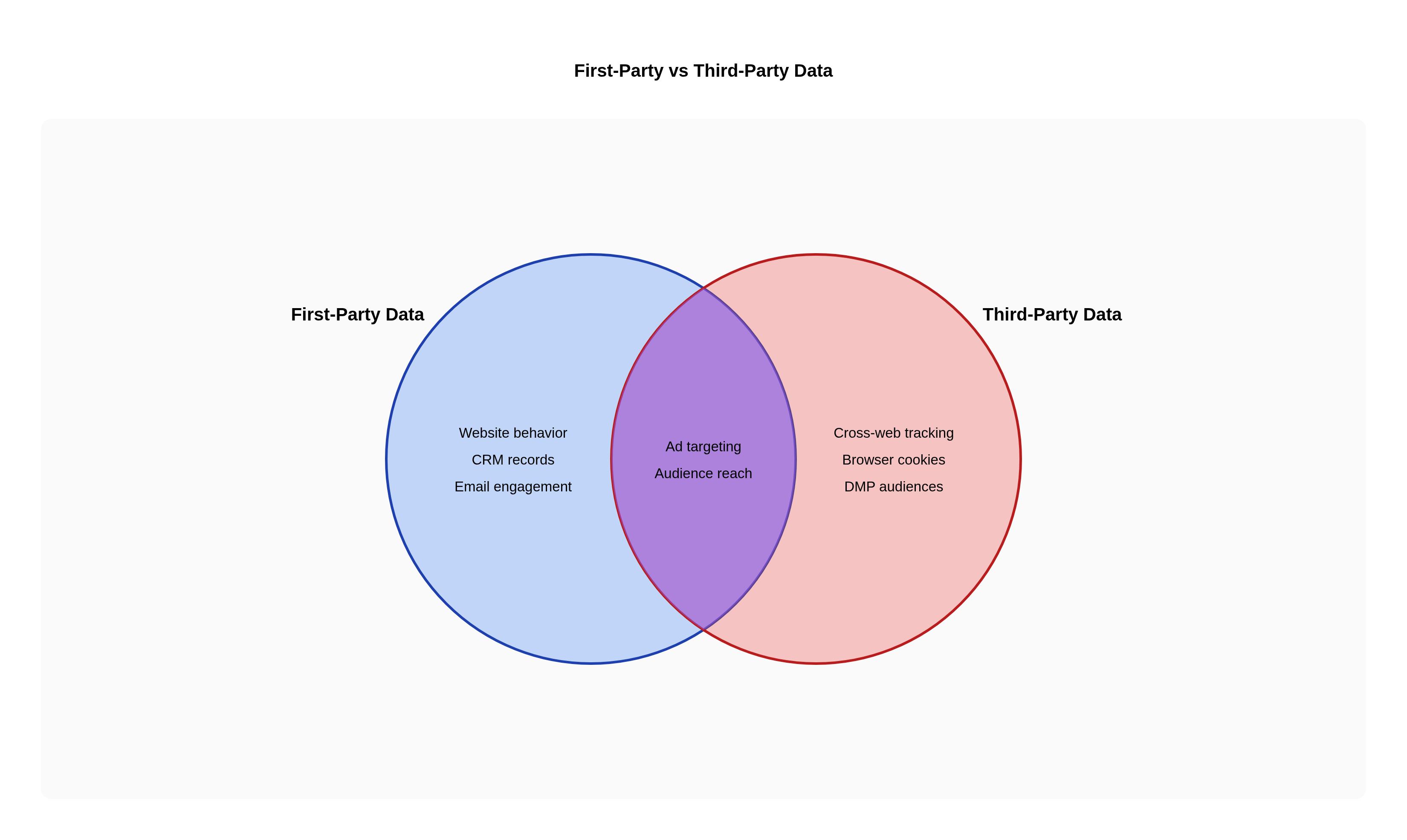
First-party data is behavioral and transactional signal collected from your own properties: website visits, form fills, CRM records, email engagement, purchase history. It is data generated through a direct relationship between your organization and the person using your product or service.
Zero-party data is distinct, and worth naming precisely. It is information customers voluntarily and intentionally share: quiz responses, preference center inputs, loyalty program sign-ups. The distinction from first-party data is the level of conscious intent. Zero-party data is declared by the user; first-party data is observed from the user's behavior. Both are essential, and they complement rather than compete with each other.
The framework spans four domains: collection, storage, governance, and activation. Most organizations build collection infrastructure competently. Governance is where programs break. Storage without governance is a liability; activation without governance is a compliance risk. The framework's value is determined almost entirely by the coherence of its governance layer.
There are also three levels of collection worth distinguishing. Collection at the point of transaction captures purchase signals and account activity. Collection at the point of engagement captures content interaction, email opens, app behavior. Collection at the point of intent captures search queries, product page depth, comparison behavior. Each level generates different signals, and each level requires its own consent moment — which is the part most teams skip.
Where Most First-Party Data Programs Break Before They Scale
I have seen this pattern enough times to recognize it before the post-mortem.
An organization decides to build a first-party data strategy. A team is assembled, a CDP is purchased, a CMP is deployed. The banner goes live. And then, six months later, the data is messy, the governance is inconsistent, and the activation use cases are stalled. The technology is in place. The framework is not.
In a March 2025 Deloitte survey, only around 15% of global marketers felt fully ready for a cookieless world. That readiness gap is not primarily a budget or talent gap — it is an architectural one, rooted in a specific, recurring structural flaw: consent is captured client-side and then lost in backend databases. This happens because organizations build collection infrastructure faster than governance infrastructure.
The banner fires, the user clicks, the consent signal is recorded in the CMP, and then that signal does not propagate to the data warehouse. It does not flow to the CDP. It does not govern what happens to the data downstream. The consent interaction happened at the interface. The data lived somewhere else entirely.
Per the Supermetrics 2026 Marketing Data Report, 52% of marketing teams do not own their data strategy, and only 6% have fully embedded data-driven approaches into their workflows. That is not an ambition problem — it is a fragmentation problem. When data strategy is distributed across IT, legal, marketing, and product without a governing owner, the consent architecture has no one responsible for making it coherent.
The regulatory consequence of that fragmentation is measurable. In late 2025, France's CNIL levied nearly half a billion euros in combined fines against platforms for deploying cookies without clear, prior user consent. That figure reflects what happens when organizations treat consent as a UX problem rather than a data architecture problem.
The pattern worth naming directly: companies design consent as a banner and then design their data infrastructure separately, as if the two systems do not need to communicate. They do. When they do not, the consent is performative and the data is ungoverned. Recognizing that pattern in your own organization is the first useful thing this article can do for you.
Why Consent Designed Into Collection Produces Better Data Than Consent Bolted On Afterward
Here is the counterintuitive part, and I want to spend real time on it because it changes how you think about the economics.
The instinct in most organizations is to maximize collection. More data, more signals, more coverage. The consent layer is tolerated as a regulatory requirement, not understood as a data quality lever. That instinct is expensive. One might argue that collecting more data tends to produce better outcomes — but does the quality of how that data was obtained affect its usefulness downstream?
Data collected with clear user understanding is more accurate. Users who knowingly share information are more likely to provide correct details, maintain those preferences over time, and update them when their circumstances change. A person who fills out a preference center because they understand what they are getting in return is a qualitatively different data source than a person whose behavior was passively observed without their comprehension.
McKinsey found that 85% of consumers feel better about a company when it demonstrates clear and easy-to-understand consent processes. Trust compounds. A positive consent experience does not just produce a data point; it produces a relationship condition that makes subsequent data more reliable.
Nearly half of consumers clicked "accept all" for cookies less often in 2025 than they did three years earlier, per the Usercentrics State of Digital Trust report. Consent is increasingly active and considered. Users are not passively complying. They are making decisions. A framework built on the assumption of passive acceptance is building on a foundation that has already shifted.
The implication that took me a while to internalize: consent rate is a data quality signal. Low opt-in from dark patterns produces a noisy, shrinking dataset built on interactions users did not meaningfully understand. Clear opt-in produces a smaller but more reliable, legally defensible, and ultimately more actionable dataset. The size of the consented audience is not the primary variable. The quality and durability of the signal is.
BCG found that roughly 90% of consumers are willing to share personal information when they receive clear value in return. The value exchange works when it is transparent. It erodes when it is not. That erosion is not just a trust problem; it is a data accuracy problem, a compliance problem, and eventually a revenue problem. Consent-first design means that every collection point has a declared purpose, a governance path, and a user expectation. That structure is what makes the downstream data usable.
The Collection Touchpoints That Anchor a Consent-Grounded Framework
One design principle to state upfront: collection and consent should be co-located. The user should understand what they are sharing and why at the moment they share it, not in a footer privacy policy they will never read.
Email newsletters are the most widely used first-party data collection channel; 63% of advertisers deploy them for that purpose. They are also one of the clearest consent moments in the entire digital ecosystem. Subscription is explicit. The user initiates the relationship. That clarity is worth protecting, which means not treating the subscription confirmation as permission for every downstream use you can imagine.
Loyalty programs are among the cleanest zero-party data collection mechanisms that exist at scale. Members enroll with explicit expectations of a value exchange. The consent is embedded in the enrollment architecture. The challenge is maintaining that clarity as the program matures and new data uses are added.
Progressive profiling is a discipline more than a technology. The principle is simple: collect only what is needed at each stage of the relationship, and deepen the profile over time as trust develops. Do not front-load friction. A first-time visitor does not need to provide their full preference set. A returning customer who has experienced your value proposition is in a different relationship with you, and the data you can appropriately collect reflects that.
Surveys, preference centers, and quizzes yield the highest-quality zero-party signals when the value exchange is clear. The user is intentionally sharing. The quality of that signal depends almost entirely on whether the user understands what they are getting in return.
Website behavioral data, mobile in-app events, point-of-sale data linked to loyalty accounts, and customer service records each add signal, and each requires its own consent moment and governance path. The collection surface is larger than most organizations have mapped.
The Technology Stack That Governs Data From Collection Through Activation
Three tools are frequently confused, and the confusion produces real architectural mistakes.
A CRM tracks known contacts and the history of your interactions with them. A DMP targeted anonymous audiences using third-party cookie data; with third-party cookies largely defunct, the DMP's core function has eroded significantly. A Customer Data Platform unifies all first-party data, maintains persistent cross-device identity resolution, and enables native activation across channels. The CDP is the operational core of a first-party framework.
Adoption reflects the recognition: 72% of marketers worldwide now use CDPs alongside other tools, per Salesforce's ninth edition State of Marketing report, and nearly 80% of respondents in IDC's July 2024 Future of Customer Experience Survey planned to increase CDP investment.
Server-side tracking is the architectural move most organizations delay and later regret. Shifting data collection from the browser to a secure server bypasses signal loss from browser extensions, Apple's Intelligent Tracking Prevention, and privacy-first browsers. More importantly, it is where consent signals from a CMP can be enforced at the data layer, not just at the interface layer. A server-side implementation makes the consent architecture durable in a way that client-side alone cannot achieve.
Google Consent Mode v3 extends consent signals to analytics storage, ad storage, ad user data, and ad personalization. Implementing it correctly on the server side is not optional for compliant conversion tracking in the EU under the Transparency and Consent Framework 2.2. This is one of those areas where the technical implementation and the legal requirement are inseparable, and treating them separately creates risk.
Data clean rooms deserve mention because they address a distinct use case. They are secure environments for matching first-party data with partner datasets without exposing raw personally identifiable information. Adoption grew 70% year-over-year in 2024 and 2025. They are not a substitute for internal data governance; they are a multi-party collaboration tool layered on top of it.
It is also worth considering the governance gap that the technology alone cannot close: consent preferences captured by a CMP must flow automatically into the CDP, the data warehouse, and every downstream activation tool. If that integration is not built, the consent-first design is cosmetic. The user's choice exists at the interface and nowhere else.
What the Business Case Looks Like When the Framework Is Working
These numbers are real, but they are downstream of the framework. Organizations that see these returns built governance in from the beginning. They are not available as a shortcut.
Google and BCG found that businesses using first-party data in marketing campaigns saw a 2.9x revenue lift compared to those using other data sources, and that linking all first-party data sources can double incremental revenue per ad.
Forrester's 2024 research found that first-party behavioral data improves customer acquisition costs by 83%, customer satisfaction scores by 78%, conversion rates by 73%, and return on investment by 72%.
Two brand cases worth grounding the numbers in. Adidas saw a 259% increase in average order value and a 13% lift in conversion rate within a single month from personalized customer journeys built on unified customer data. Pandora integrated first-party sales data and recorded a 220% increase in offline revenue alongside 77% growth in total Google Ads revenue in 2023.
The privacy investment return is also measurable in aggregate. For every dollar spent on privacy infrastructure, the average company receives $2.70 in associated benefits. Eighty percent of organizations report increased customer loyalty as a direct result of privacy investment.
The common thread is not the channel or the specific tactic — it is data that was accurate, unified, and clearly consented. The companies seeing these outcomes did not find a better way to collect data. They built a better relationship with the data they were collecting, which made the data trustworthy enough to act on at scale.
How to Sequence the Build So Consent Governance Doesn't Get Deferred
This is where most implementation plans lose the plot.
Begin with an audit. Map every existing collection point and its current consent state before adding new ones. This is tedious and the findings are often uncomfortable. Do it anyway. You cannot govern what you have not located, and the audit frequently surfaces collection touchpoints that nobody in the organization currently owns.
Before building any new form, modal, or collection flow, define the value exchange for that touchpoint. What is the user receiving in return for sharing this information? What will you do with it? What will you not do with it? The user-facing language and the backend governance path should be designed together, by the same people, in the same conversation. If they are designed separately, the gap between them is where compliance risk accumulates.
Implement a consent management platform as infrastructure, not as a banner vendor. Consent signals need to propagate automatically to every downstream system: the CDP, the data warehouse, the advertising platforms. If propagation requires manual intervention or a custom integration, it will likely fail — invisibly, until it becomes a liability.
Build progressive profiling into the implementation roadmap from the start, not as a future optimization. Collect minimum viable data at first contact. Deepen the profile as the relationship matures and as the user has experienced the value of that relationship. Front-loading data collection creates compliance risk, user friction, and a data asset that is less reliable than one built incrementally.
In 2024 and 2025, 62% of enterprises increased budgets for first-party data infrastructure. The investment cycle is real. But budget without sequencing produces the same governance gaps described earlier in this piece, just with more expensive technology sitting on top of them.
The durable point to hold onto: regulations will continue to evolve. New jurisdictions will tighten, new enforcement patterns will emerge, and the specific technical requirements will shift in ways none of us can fully anticipate. A framework built on clear consent and declared data use is structurally defensible regardless of which jurisdiction moves next, because its validity does not depend on a regulatory loophole. It depends on the actual quality of the relationship between the organization and the people whose data it holds.
That is worth building toward. Not because it is the safe choice, though it is. Because it is the one that compounds.