Data Flow Mapping for Privacy Compliance
What Data Flow Mapping Actually Is and What It Produces Start with the outputs, because people conflate them constantly. A data map produces two distinct artifacts. The first is a…

What Data Flow Mapping Actually Is and What It Produces
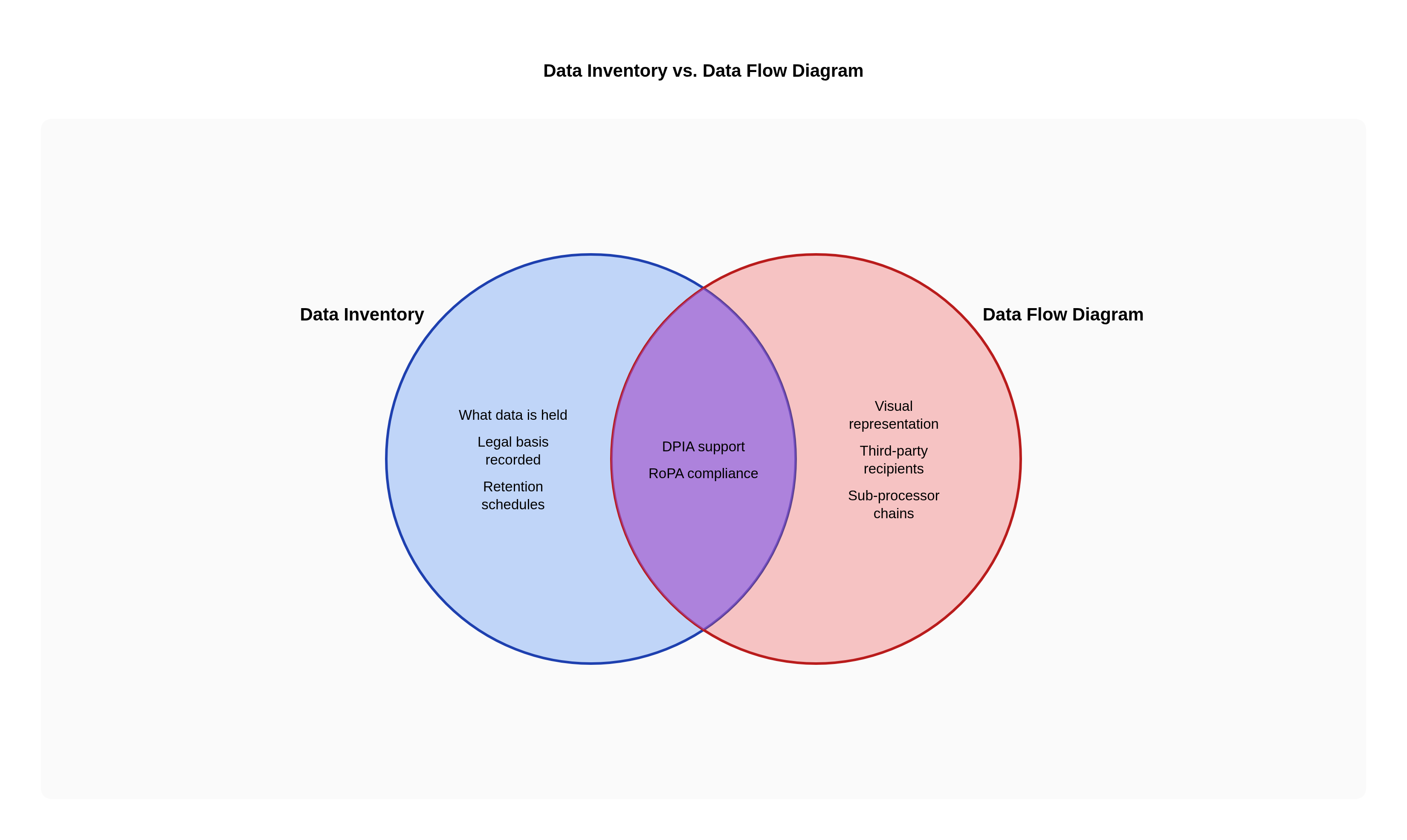
Start with the outputs, because people conflate them constantly. A data map produces two distinct artifacts. The first is a data inventory: a structured catalogue recording what personal data the organization collects, where it resides, who processes it, how long it is retained, and under what legal basis it is held. The second is a data flow diagram: a visual representation showing how that data moves through internal systems and out to external parties. The inventory tells you what you have. The diagram tells you where it goes. Both are necessary; neither alone is sufficient.
The questions a complete map answers are not complicated to state. What personal data is collected? Where does it live? Who touches it? How does it move between systems, departments, and third parties? When is it deleted? The difficulty is not conceptual. Answering those questions accurately across an entire organization requires coordinated input from legal, compliance, marketing, HR, and information security, because the data flows that matter are purely technical only in part. Marketing onboards a new ad platform. HR integrates a benefits vendor. Operations signs a contract with a logistics partner. None of those decisions necessarily routes through IT, but all of them create personal data flows that need to appear somewhere in the map.
Different regulatory frameworks label the same underlying exercise differently. GDPR calls it a Record of Processing Activities, a RoPA. Minnesota's 2024 law calls it a data inventory. CCPA frames it as a PII disclosure exercise. The nomenclature varies; the intellectual work is identical.
What distinguishes a data map from an audit is design intent. An audit produces a snapshot accurate to one moment in time. A map is designed to be a living document, updated as data flows change. But what if organizations simply never update them? That is not a hypothetical failure mode — it is the one regulators document most frequently. The difference between a compliance program that holds up under scrutiny and one that collapses the moment a regulator asks a follow-up question often comes down to whether the map was kept current.
How Privacy Regulations Convert Data Mapping from Best Practice into Operational Necessity
GDPR never uses the phrase "data map." It does not require one by name. What it does instead is require five distinct outputs, each of which is only producible if mapping work has already been done.
Article 30 requires a RoPA listing all processing activities. Article 6 requires that each processing activity have a documented lawful basis. Article 25 requires privacy by design, which presupposes you understand what you are building and how personal data moves through it. Article 28 requires oversight of third-party processors. Article 35 requires Data Protection Impact Assessments for high-risk processing, and those assessments require you to understand collection points, storage locations, recipients, and retention periods before you can evaluate risk at all. You cannot satisfy those five articles from separate, disconnected documents maintained on different schedules by different teams. You need one coherent picture of your data landscape.
CCPA is structurally similar. It does not mandate a mapping exercise. What it does is create rights: a consumer's right to know what data is held about them, the right to have it deleted, the right to opt out of its sale or sharing. Fulfilling any of those requests is impossible if you cannot identify which systems hold the relevant data and which third parties it has been shared with. The right to deletion in particular requires triggering deletion not just in your primary database but in every downstream system. A map is the only mechanism that ensures that chain is complete.
Minnesota's 2024 law went further than any other U.S. state and explicitly required controllers to maintain a data inventory as part of their data security obligations. That is a legislative acknowledgment, not a subtle one, that the inventory is not a compliance team artifact. It is the foundation of defensible data governance.
The DOJ Bulk Data Transfer Rule, effective 2025, requires organizations to analyze cross-border data flows to countries of concern, with civil penalties reaching over $368,000 per violation and criminal exposure for willful violations. The mechanism that makes that analysis possible is a map granular enough to show not just what data goes to third parties but where those parties and their sub-processors are located. Without that granularity, the analysis is speculation wearing compliance language.
Every major framework, in its own idiom, demands that organizations demonstrate they know what personal data they hold, why they hold it, and where it goes. A data map is not one way to provide that demonstration.
How Fast the Regulatory Surface Is Expanding and What That Means for Mapping Scope
When CCPA passed in 2018, it was the only comprehensive state privacy statute in the United States. By the end of 2024, more than 25 states had enacted laws, seven taking effect in 2023, seven more in 2024, with additional statutes active or scheduled in early 2025.
The temptation is to treat these laws as minor variations on a common template and build one map that satisfies them all. Resist it. Maryland's "strictly necessary" standard for processing sensitive data is unlike any other state requirement currently on the books. Iowa carves out data protection assessments entirely. The jurisdictional wrinkles are real, and they are resolvable only through a map built with sufficient field granularity.
A map built to GDPR or CCPA specifications will also miss critical detail if it does not capture processing purpose, data sensitivity classification, and recipient location with enough granularity for multi-jurisdictional analysis. A map that records data type and system name but omits processing purpose cannot tell you whether a given activity clears Maryland's minimization threshold. The fields chosen at build time determine what questions the map can answer later — a design decision that feels inconsequential in the moment and costs a great deal to fix.
Cross-border complexity compounds this. The DOJ rule and continued GDPR Article 46 enforcement mean the map must track not just which third parties receive data but where their infrastructure sits and which sub-processors they use. Vendors change infrastructure providers. Cloud services migrate regions. A map that captures a vendor relationship accurately in January will misrepresent the actual transfer picture by March, through no one's fault and without any notification to the controller.
The practical implication is stark: a data map is the only organizational asset capable of absorbing a new jurisdiction's requirements without triggering a full re-inventory from scratch, but only if it was built with sufficient granularity from the beginning. Retrofitting a thin map is almost always harder than building a rigorous one initially, and it almost always happens under pressure, after the notice of inquiry has already arrived.
What Enforcement Actually Penalizes When Data Governance Fails
Numbers provide context. The GDPR enforcement tracker, as of early 2026, records over 2,600 fines totaling more than €6 billion. The DLA Piper 2025 survey recorded €1.2 billion in fines issued across Europe in 2024 alone.
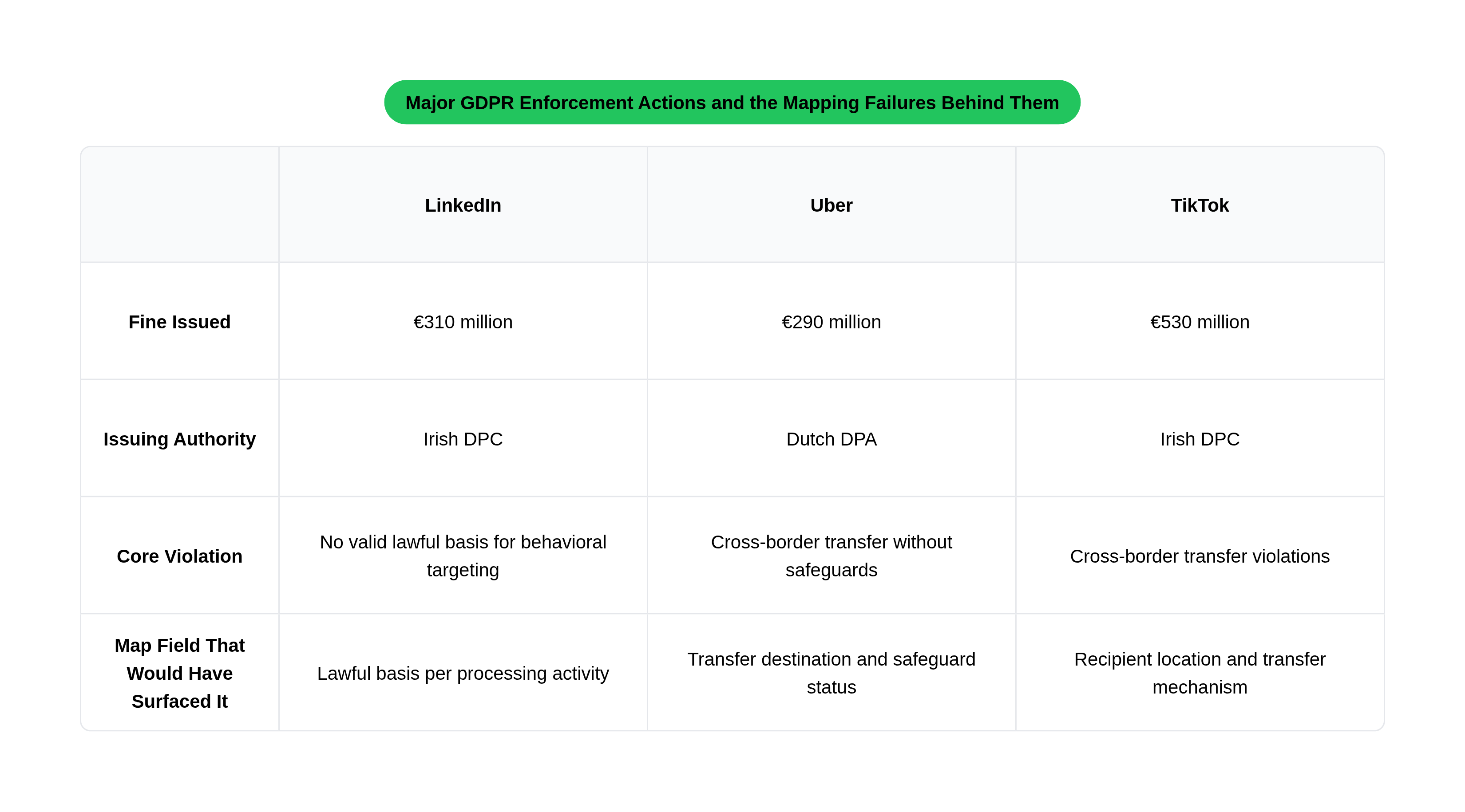
The largest individual penalties name specific failures, and the specificity is instructive. LinkedIn received a €310 million fine from the Irish Data Protection Commission in late 2024 for behavioral analysis and targeted advertising conducted without a valid lawful basis under Article 6. Uber received a €290 million fine from the Dutch DPA for transferring driver data to the United States without adequate safeguards. TikTok received a €530 million fine from the Irish DPC in 2025 for cross-border transfer violations. In each case, the violation that drew the fine was precisely the category of processing a functioning data map, with lawful basis and transfer destination fields populated and current, is designed to surface. The map was either absent or stale.
Five of the ten largest GDPR fines to date involve violations of core data processing principles: processing without lawful basis, transferring data without adequate safeguards, failing to demonstrate that the organization understood what it was doing with personal data and why. These are not technical footnotes. They are foundational failures, and they are legible as such in hindsight.
The CNIL sanction pattern in France during 2024 and 2025 is particularly clarifying. Two failure modes account for the majority of cases. First, RoPA gaps: processing activities like newly added marketing and analytics tools that never appeared in the records. Second, inadequate vendor oversight: DPAs signed but sub-processors added without notification or audit. Both are direct consequences of treating the data map as a completed document. The map was accurate once. Then something changed. Nobody updated it.
U.S. enforcement is accelerating. Texas secured a settlement exceeding $1 billion with a major technology company. Connecticut's attorney general settled with a ticket vendor for $85,000 under the CTDPA in 2025. The range from enterprise to mid-market matters here: the assumption that enforcement only threatens the largest organizations no longer holds.
How a Data Map Is Built and Why Its Structure Determines What It Can Do Later
The build process moves through four phases, and the sequencing matters.
First, information gathering: stakeholder interviews, process questionnaires, system analysis. This is the phase most organizations underinvest in, because it requires coordinating people who do not normally sit in the same meetings. Marketing knows what the email platform does with subscriber data. HR knows what the benefits administrator receives. Procurement knows what the logistics vendor accesses. No single team holds the full picture, and this is a coordination problem that technology cannot substitute for.
Second, documentation of data elements: types of personal data held, storage systems, retention schedules. Third, flow visualization: tracing data from collection through storage, internal use, and sharing to external parties, with enough specificity to identify sub-processor chains. Fourth, risk assessment: identifying compliance gaps, cross-border transfers requiring scrutiny, and data minimization opportunities.
The field architecture chosen during build is the decision that most constrains future utility. A map that captures only data type and system name is adequate for a basic inventory and little else. It cannot support a DPIA, because a DPIA requires understanding processing purpose, recipients, and retention. It cannot support a lawful basis audit, because that requires a purpose field. It cannot support multi-state jurisdictional analysis, because that requires sensitivity classification and recipient location. These fields must be built in from the start. Adding them retroactively, after a regulator's inquiry has already arrived, is a difficult and expensive problem to solve under time pressure.
Ownership structure matters in ways that only surface when something goes wrong. The DPO or senior privacy lead must supervise the map. IT alone cannot produce an accurate one, because IT sees infrastructure but not business process. The HR team that sends employee performance data to a coaching vendor does not necessarily tell IT. The marketing team that connects a new analytics tool does not necessarily file a ticket. Those flows appear in the map only if the people who created them are part of the mapping process.
The living-document requirement is not aspirational language. Quarterly updates are the recommended minimum cadence, and in fast-moving environments even that is barely sufficient. A map left unchanged after a new SaaS tool is onboarded immediately creates the RoPA gaps that regulators are actively sanctioning.
The Compliance Work That Becomes Possible Once a Map Exists
An accurate Article 30 RoPA is essentially a direct output of a well-structured map. The fields translate into the record. Without a current map, the RoPA is either incomplete or maintained as a separate document that diverges from operational reality the moment a new system is onboarded.
Privacy notice accuracy depends on the map in a way that is often underappreciated. Notices can only accurately describe data collection and processing purposes if the underlying map reflects the actual current state of processing. Stale notices are a recurring enforcement target, and the reason they go stale is that they were written against a map that was never kept current. The notice and the map need to be updated together, or neither is trustworthy.
Responding to data subject rights requests, whether access, deletion, or portability, requires knowing which systems hold the relevant data. Without a map, teams either over-disclose, under-disclose, or miss systems entirely. Over-disclosure violates data minimization principles. Under-disclosure frustrates the right. Missing systems means deletion requests are incomplete, and incomplete deletion is exactly what regulators find when they investigate.
Vendor and sub-processor oversight cannot be maintained rigorously without a map that tracks which processors hold personal data, under what agreement, and whether sub-processors have been properly notified. Signing a DPA and filing it is insufficient. The question regulators ask is whether you knew, at any given point in time, which sub-processors your vendors were using. That is a harder question to answer than it sounds.
DPIAs require understanding collection point, storage location, recipients, and retention period before risk can be evaluated. The map supplies all four inputs. Organizations that lack a map spend the first phase of every DPIA reconstructing information that should already be documented, which is both inefficient and revealing about the state of the underlying program.
Lawful basis assignment under Article 6 requires a complete list of processing activities. A sufficiently diligent team can, in theory, maintain that list separately from the map, but the moment the list and the map diverge, neither can be trusted in isolation. Every Article 6 determination depends on the same underlying data. One document or the other becomes the source of truth, and the question is which one anyone checks when it matters.
Where Manual Mapping Breaks Down as Data Environments Scale
Spreadsheet-based mapping was a reasonable approach when data environments were smaller and more stable. That describes fewer and fewer organizations. Modern enterprises operate dozens to hundreds of SaaS applications, many onboarded by individual departments without formal IT procurement review. Shadow IT is not a failure of individual judgment. It is a structural feature of how software is acquired now.
The failure modes compound. Data silos mean no single team can see the full picture. Shadow IT adds data flows between formal review cycles. Third-party and sub-processor chains change without notifying the controller. Inconsistent field definitions across business units produce maps that cannot be aggregated into a coherent organizational view. You end up with several partial maps that collectively fail to cover the territory, and you often do not discover this until a regulator's inquiry forces you to reconcile them.
The CNIL enforcement pattern confirms this: marketing and analytics tools added without privacy review are the most common sanction trigger. That category is also the one most likely to slip through a manual update cycle, because the people onboarding those tools are thinking about campaign performance, not the RoPA. That is not a criticism of those people. It is a structural observation about where the gap appears.
Cross-border complexity multiplies the problem further. Tracking not just which vendors receive data but the location of their infrastructure, and the location of their sub-processors' infrastructure, requires continuous monitoring that quarterly manual surveys cannot provide. A vendor's cloud provider migrates a region. A sub-processor is acquired by a company in a different jurisdiction. Neither event generates a notification to the controller. They simply happen, and the map falls silently out of date.
Resource constraint here is structural, not a matter of organizational discipline. As the number of U.S. state laws with distinct requirements continues to grow, the manual effort required to maintain a map queryable against multiple jurisdictions grows proportionally. Most privacy teams are already past the point where the arithmetic favors the manual approach.
How Automated Discovery and AI-Assisted Tools Change What Continuous Mapping Looks Like in Practice
The shift that automated discovery tools represent is not primarily about efficiency. It is about closing the latency gap between when something changes and when the map reflects that change. But how does this affect our original promise of keeping the map current? That is precisely the question the tooling is designed to answer.
AI-powered discovery engines can continuously scan infrastructure to identify personal data across systems, document flows between applications and databases, and maintain real-time processing inventories. What that replaces is the quarterly manual survey cycle, which is always, by design, looking backward. A map updated quarterly is accurate to three months ago in the best case. Three months is a long time when vendors are migrating infrastructure and marketing teams are onboarding tools without filing tickets.
Automated generation of Article 30 RoPA records and visual flow diagrams reduces the time between a change in data flows and its appearance in compliance documentation. That reduction matters operationally: the RoPA gap that generates sanctions is most often a failure to document promptly after a change, rather than a failure to document at all. Tooling that compresses that interval addresses the actual failure mode, not a hypothetical one.
Integrating consent management with mapping represents a genuine capability shift. When a user withdraws consent for a specific processing purpose, that withdrawal needs to propagate to every system acting on that consent. A map integrated with consent records can execute that propagation. The map stops being a descriptive document and becomes operative, which is a meaningfully different thing.
Tooling discussions tend to oversell, so a few things are worth naming plainly. Automated discovery requires cross-functional input at setup to accurately classify what it finds. Legal judgment is still required for lawful basis assignments; a tool can surface a processing activity and flag that it needs a basis assigned, but it cannot make that determination. When new processing purposes are introduced, human review is necessary. What automation compresses is the maintenance burden between those human decision points, not the decision points themselves.
When evaluating tooling, the selection criteria should follow directly from compliance requirements. The tool needs to capture purpose and legal basis fields, not just data type and system. It needs to support multi-jurisdictional tagging. It needs vendor and sub-processor tracking with location data. It needs integration with consent records. A tool that inventories data assets without mapping flows, or that maps flows without capturing purpose and legal basis, leaves the compliance gap open. The inventory and the flow diagram are both required outputs; a tool that produces one but not the other is an incomplete solution, and discovering that incompleteness during an investigation is the worst possible time.
An organization that maps continuously can demonstrate to regulators, at any point in time, that it knows what personal data it holds, why it holds it, and where it goes. That is precisely what enforcement actions from the LinkedIn fine to Connecticut's CTDPA settlement show regulators demanding. The map is not the compliance program. Without it, though, there is no foundation, and regulators have become quite skilled at finding that out.