Data Governance Roles and Responsibilities
Why organizations with governance programs still suffer from accountability gaps Having a governance program is not the same as having governance. In 2024, 71% of organizations…

Why organizations with governance programs still suffer from accountability gaps
Having a governance program is not the same as having governance. In 2024, 71% of organizations reported having a data governance program. Gartner projects that 80% of data and analytics governance initiatives will fail by 2027. Sit with those two figures together for a moment. Adoption is climbing. The failure rate is not.
So what is actually going wrong?
The instinctive answers are technology and process. The real answer is simpler to name and considerably harder to fix: nobody knows who is actually responsible for what. Not in practice. Not when a data pipeline breaks at 11 p.m. on a Tuesday, not when an auditor asks who authorized a particular access policy, not when a customer dataset turns out to have been quietly degrading for six months and three different teams assumed someone else was watching it.
I've sat in those post-incident rooms. The governance charter exists. The program has a name. Nobody can tell you who owned the decision that let the problem happen.
Ambiguity about ownership is not a soft organizational problem. Poor data quality costs organizations an estimated $12.9 million annually, per Gartner. The global average cost of a data breach reached $4.88 million in 2024, per IBM. That money doesn't evaporate because a charter exists somewhere on the intranet. It evaporates because nobody was specifically accountable when the moment came.
What follows is an attempt to map who does what, why the distinctions between roles matter operationally, and where things predictably collapse when those distinctions are treated as semantic rather than structural.
What data governance actually requires before roles can be assigned
Before you can assign accountability, you need clarity on what you're governing. Data governance, stripped of consulting language, is the system of policies, processes, and roles that ensures data assets are accurate, accessible, secure, and compliant. The scope covers quality management, security controls, regulatory compliance, lifecycle decisions, access control, and standardization. That is a wide surface area. Wide enough that, without careful definition, everyone feels responsible and no one is.
I've encountered a governance philosophy at multiple organizations that goes something like: "Everyone who touches data is responsible for it." The sentiment is right. The implementation, without further specificity, is a disaster. When responsibility belongs to everyone equally, it belongs to no one specifically. That vacuum is exactly where risk accumulates and stays invisible until something breaks.
There's a reasonable counterargument here. Distributed ownership sounds democratizing, more agile, less bureaucratic. And for certain decisions, that's true. But for the decisions that carry real consequence, access authorization, quality thresholds, compliance sign-off, diffuse accountability is indistinguishable from no accountability. The goal isn't to argue for any single organizational design. It's to examine how the roles that make governance functional are distinguished from one another, and why those distinctions matter in practice rather than on an org chart slide.
How the governance hierarchy is structured from the top down
A functional governance structure has two distinct layers. Conflating them is one of the more reliable ways organizations undermine their own programs before they begin.
The strategic layer includes the Data Governance Council, the Chief Data Officer, and an executive sponsor. The operational layer includes directors and managers who translate strategic direction, data owners, data stewards, and data custodians. Both layers are necessary. Neither substitutes for the other.
The governance council
At the apex sits the Data Governance Council: senior leaders including the CDO, CTO, and heads of key business units. Their mandate is to set policy, approve standards, and allocate resources. They are not involved in day-to-day operations, and they shouldn't be. Quarterly or biannual meetings. Five to seven members, maximum. Larger groups don't produce timely decisions; they produce committees, which is a different thing entirely.
The council's symbolic function matters as much as its formal one. Visible executive commitment signals to the rest of the organization that governance is a business priority, not an IT project. That signal travels. When teams see senior leadership meaningfully engaged, they treat governance obligations differently than when governance is perceived as something the data team does in a corner while everyone else ships product.
The layers below the council translate strategic direction into operational reality. That translation is precisely where most governance programs fracture.
What the Chief Data Officer owns and where the role is heading
In 2012, 12% of organizations had appointed a CDO. In 2025, that figure is 84.3%, per the Data and AI Leadership Exchange survey. That's not incremental growth; it reflects a structural shift in how organizations conceptualize data leadership.
The core CDO remit covers defining data strategy, overseeing governance frameworks, ensuring regulatory compliance, and promoting data-driven decision-making across the enterprise. Data governance sits at the top of the CDO priority list for 2025, cited by 51% of CDOs, per Deloitte research. In lower-maturity organizations, that figure climbs to 63%. This tells you something important: for a significant portion of the market, governance is still remedial work. The foundational structures haven't been built, and the CDO is being asked to build them while simultaneously delivering analytics value.
Here's the structural problem that undermines continuity: more than half of CDOs serve fewer than three years, and nearly a quarter last fewer than two. Leadership churn at that frequency is corrosive. When the person who holds the governance vision turns over that quickly, frameworks built around an individual's priorities rarely survive the transition intact. This is why institutionalization matters more than personalization. The framework must outlast the individual — policies, processes, and defined roles must be codified so that a successor inherits structure, not just intent.
The CDO's mandate is also being contested from a new direction. The rise of dedicated Chief AI Officers is blurring the boundary between data governance and AI governance at the executive level. Nearly half of FTSE 100 companies now have a CAIO, most of them appointed within the last two years. Where AI strategy ends and data strategy begins is not always obvious, and in many organizations the answer hasn't been formally decided. That ambiguity at the top cascades downward into every governance role beneath it.
The three operational roles most organizations confuse: owner, steward, custodian
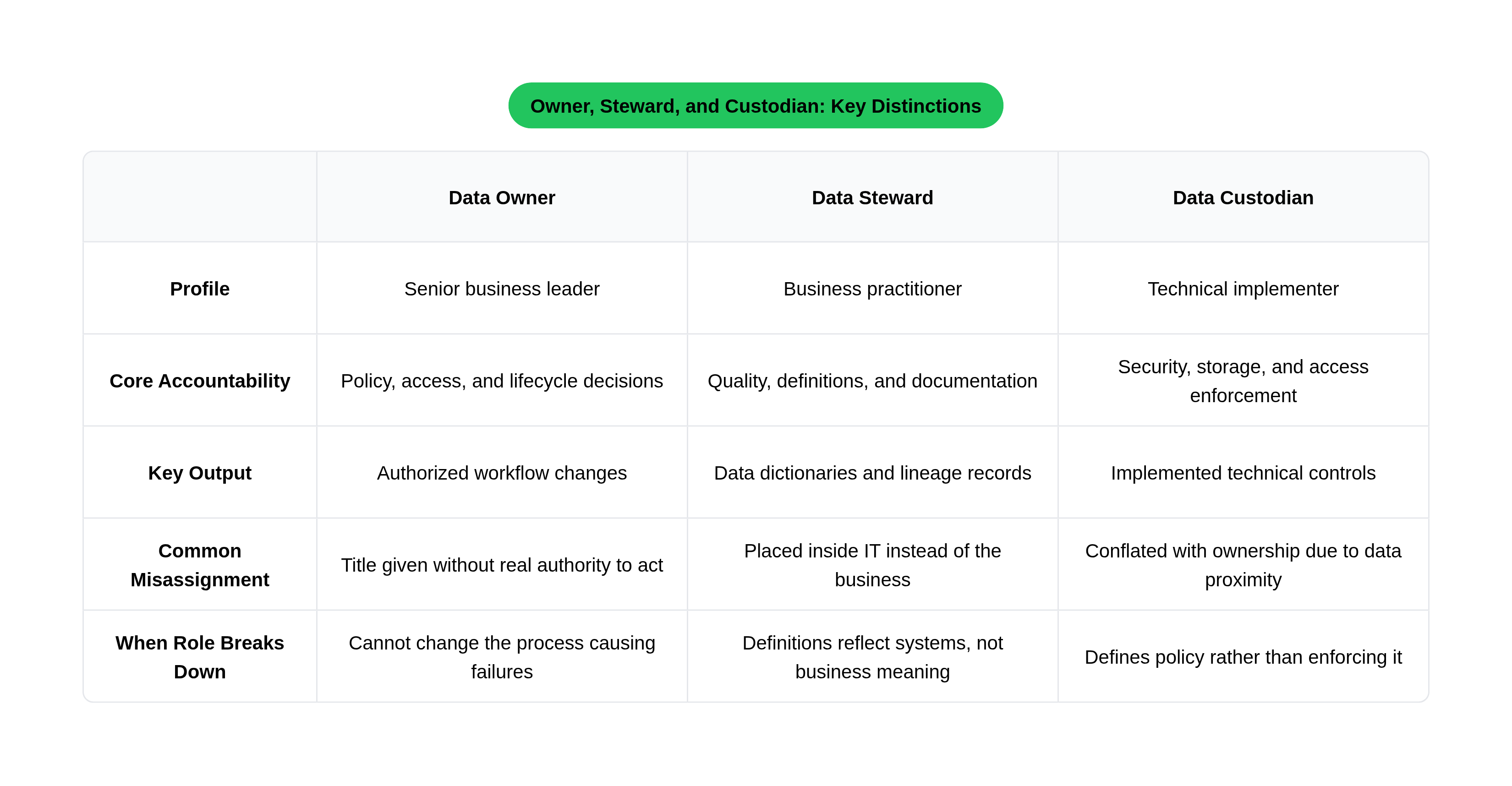
The confusion between these three roles is not a naming problem. It is a structural failure with real consequences. Assign the wrong person, and governance breaks down. The breakdown stays invisible until a quality failure or a compliance audit surfaces it.
The data owner
The data owner is a senior business leader accountable for a specific data domain. Accountable, not merely responsible. This distinction carries weight. Owners approve policy, control budget, hold ultimate authority over access decisions and lifecycle management, and, critically, have the authority to change workflows when data quality fails. That last point is where ownership becomes meaningful or decorative. If the person designated as owner cannot actually change the processes producing bad data, the title is ceremonial.
The data steward
The data steward is a business practitioner, not an IT role, responsible for day-to-day quality, definitions, and documentation within a domain. Stewards maintain data dictionaries, manage metadata, track data lineage, and serve as the bridge between technical systems and business users. When a business analyst asks what a particular field means or where a data point originated, the steward is who they turn to.
The most consequential misassignment I've seen repeated across organizations is placing the data steward inside IT. If that person is primarily managing systems rather than business definitions, they are a custodian, not a steward. When stewardship lives inside IT, business consumers stop trusting that data definitions reflect business reality, because they're right not to. The definitions start reflecting what the system does rather than what the business means. It's a subtle drift, and by the time someone notices, the damage to trust in the data is already extensive.
The data custodian
The data custodian is the technical role: the engineer, database administrator, or infrastructure professional who implements controls, manages access, handles storage, maintains security, and responds to incidents. Custodians enforce policy. They do not define it. That distinction is essential and routinely collapsed.
A common misconception conflates custodianship with ownership because custodians physically handle the data. They manage the vault; they don't set the policy for what goes in it or who gets access. Handling data is not the same as owning accountability for it.
For smaller organizations, a single individual may carry both owner and steward responsibilities across a domain. That's workable. The custodian role, though, remains distinct even in lean structures, because the separation of policy definition from technical implementation is a control requirement, not just an organizational preference.
How these three roles interact across a real governance workflow
Walk through a specific scenario. This is where the structural distinctions stop being theoretical.
A data quality anomaly surfaces in a customer dataset. Fields that should be populated are blank; values that should fall within known ranges don't. Someone notices. Now what?
The steward detects the anomaly and documents it: the nature of the issue, its scope, and which downstream reports or processes it affects. The steward escalates to the data owner with that documentation attached. The owner evaluates severity, determines whether the quality threshold has been breached in a way that requires a workflow change, and makes the call. The custodian implements whatever technical fix the owner authorizes: adjusting access controls, modifying storage logic, patching an ingestion process.
Where that chain breaks is instructive. If the owner lacks the authority to change the workflow that caused the problem, the issue gets escalated into organizational paralysis and the quality failure recurs. If the steward is embedded in IT rather than the business, the escalation path skips the business domain entirely; the fix addresses the symptom, not the cause, and the next audit finds the same problem. I have watched that exact cycle repeat at organizations that genuinely believed they had a functioning governance program. The charter was fine. The role assignments were wrong.
When these roles are well-defined and the interactions between them are understood, Gartner research puts the quality score improvement at 30% higher than organizations without defined roles, with 35% fewer compliance incidents. The steward's documentation function, particularly the maintenance of data dictionaries and lineage records, is what makes the owner's decisions auditable. Without lineage records, compliance audit preparation drags across weeks. With them, the timeline compresses considerably.
The supporting roles that make the core structure work
The owner, steward, and custodian are the core of operational governance. But they don't function in isolation.
The executive sponsor— typically the CDO or CIO — champions the program at the board level. This is distinct from the CDO's operational mandate. The sponsor role is about political cover and budget, ensuring that governance initiatives survive the organizational pressures that consistently deprioritize infrastructure work in favor of visible product delivery. Every governance program I've seen lose momentum lost it because this sponsorship went quiet, not because the framework was wrong.
The Chief Compliance Officer translates regulatory obligations into governance requirements. In financial services, healthcare, or any sector under GDPR or comparable regimes, the CCO tells the governance program what it must legally enforce, not just what constitutes good practice.
The Chief Risk Officer owns the risk calculus around data handling. In high-stakes industries where data incidents carry both regulatory and reputational consequences, the CRO's involvement ensures that risk exposure informs governance decisions, not just legal thresholds.
The data architect designs the models, schemas, and storage systems that custodians maintain and stewards document. Governance without architecture is policy without infrastructure — the architect is what makes the system governable.
Data quality analysts and engineers are the operational instrumentation layer: they track quality metrics, identify errors, and surface issues to stewards. They're not making policy decisions, but without them, the steward is working blind.
Data users sit at the base of this structure, producing and consuming data daily. Governance is only as functional as users' understanding of what they're permitted to do and why. This is where governance connects directly to trust, the point at which internal structure becomes something a customer actually experiences.
Where AI is creating new governance roles and leaving existing ones exposed
AI is producing a set of governance problems that existing role structures weren't designed to handle. In 2024, 62% of organizations identified data governance as the greatest impediment to AI advancement, citing concerns around lineage, quality, privacy, and security. That's a notable inversion: AI adoption is being slowed not by the models themselves, but by the ungoverned data those models depend on.
A new role is emerging in response: the AI and ML Governance Officer, responsible for model governance, fairness, explainability, and ethical AI practices. For organizations deploying large language model-powered applications, this role addresses questions that traditional data governance frameworks don't touch. How was the training data selected? How do you audit a model's outputs for bias? Who is accountable when the model produces a consequential error? As of a 2024 IAPP Governance Survey, only 28% of organizations have formally defined oversight roles for AI governance. Most distribute AI governance tasks across compliance, IT, and legal without a unified structure — meaning the same accountability vacuum that afflicts traditional data governance is being replicated in AI, at accelerated speed and higher stakes.
The Data Ethics Officer is a related but distinct emerging function. The CCO tells you what you must do legally. The Data Ethics Officer asks what you should do — sometimes a considerably harder question. As data collection practices become more sophisticated and less visible to the people they affect, the distinction between those two roles will matter more, not less.
The Data Product Owner is emerging as a hybrid role that bridges traditional owner and steward responsibilities with product management discipline. It reflects a broader shift: treating data as a product with an accountable owner who cares about usability, not just accuracy. Data that is accurate but incomprehensible to its intended consumers isn't well-governed; it's just stored.
The CDO and CAIO boundary problem noted earlier is the executive expression of this same underlying issue. AI governance has no natural home in most organizational charts yet. Until that changes, the gaps between roles will be exploited, usually not maliciously, but structurally.
Why role clarity directly reduces compliance exposure and builds user trust
The cost of undefined roles scales, and it is not abstract. Non-compliance with data regulations costs businesses an estimated $15 million annually. Enforcement actions against organizations with demonstrably poor data accountability have produced penalties measured in the hundreds of millions. Organizations that formalize their governance structures, with owners who can act, stewards who document, and custodians who enforce, see measurable reductions in data quality issues within the first year and significantly compressed compliance audit timelines.
But compliance is a floor. An organization that governs its data primarily to avoid fines is underusing the structure it's building. The same framework that satisfies a regulator also enables something more commercially significant: user trust. First-party data collected with transparent, enforced, auditable policies is more valuable than data collected ambiguously, because it can be used with confidence and defended under scrutiny.
The role structure described in this piece is how that transparency gets operationalized. Owners set policy and hold accountability. Stewards ensure the data reflects that policy in practice and make it legible to the people who need to use it. Custodians enforce the technical controls. Users operate within a framework they understand well enough to make informed decisions about what they share and why.
Accountability doesn't emerge from a governance program document. It emerges from people who know what they're responsible for and have the authority to act on it. The document is the starting point; the roles are where it either becomes real or remains aspirational.