Enforcing Role-Based Access Policies Across a Multi-Server MCP Environment
A shared gateway, audience-bound tokens, and per-tool checks enforce access across MCP servers.
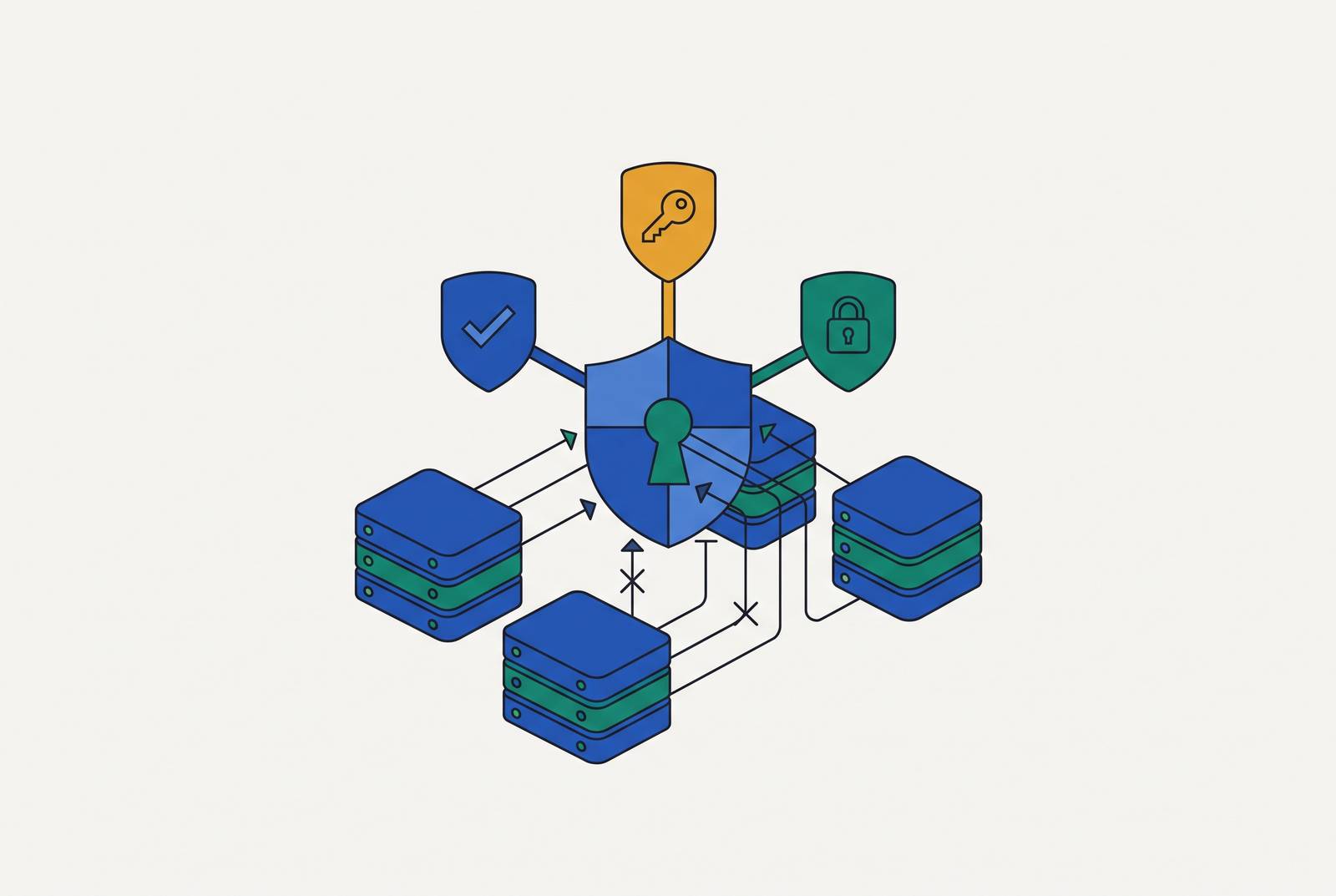
Enforcing role-based access policies across a multi-server MCP environment requires a shared enforcement architecture. Enterprises need centrally assigned agent roles, a gateway that checks every tool call, and audience-bound tokens at each trust boundary. Real-time observability must be part of that same enforcement layer so teams can see whether access stays within policy.
Why MCP ships without an access control model — and what that means at scale
MCP was designed as a universal interface connecting AI agents to external tools and data sources. It was not designed as an enterprise access control framework. That distinction is a fixed design boundary for individual deployments. The NSA's MCP Security Design Considerations document states that MCP components, including clients, servers, proxies, and hosts, can be configured to access or process data without required access control measures. Authentication is optional, and many production implementations omit it.
Even where authentication exists, the enterprise still needs to connect each request to a verifiable identity and its permissions. The July 2026 spec revision shifted the protocol away from sessions, but it did not supply an enterprise role model. Without an RBAC layer, the effective policy is whatever the service account behind a tool permits. That makes the account's reach, rather than the agent's intended job, the practical access boundary. Centralized governance tools, including MCP Manager, fill this gap by controlling and auditing AI access across servers, so each deployment does not have to build its own framework.
How a single-server access problem becomes an architectural one when servers multiply
A single-server pilot can make broad permissions look manageable because the set of reachable tools is small. But when there is more than one server, a shared client passes information between them. Credentials, context, or permissions intended for one server can bleed into interactions with another through normal protocol operation. A boundary that looks sound in one server's configuration may therefore fail across the workflow. The question changes from whether an agent can connect to a server to how far its authority can travel.
The Asana cross-tenant exposure illustrates the cost of a broken access boundary. A logic bug in its MCP server feature made tasks, project metadata, comments, and files from one organization visible to others. Roughly 1,000 customers may have been exposed between May 1 and June 4, 2025, even though there was no intrusion. The GitHub MCP prompt injection in 2025 showed another way to gain too much access, through a personal access token that allowed too much.
Unreviewed server additions make these boundaries harder to account for. Developers and non-developers add servers to Claude Code, Cursor, VS Code, and Claude Desktop configurations, creating a shadow MCP problem. MCPSecBench tested Claude Desktop, OpenAI, and Cursor and found that every attack surface it identified compromised at least one platform, and that core protocol and host-side vulnerabilities affected all three. Teams therefore need to see what happens across the environment as well as within a known server. MCP Manager's monitoring and auditing track how AI accesses data across servers, helping teams spot when permission meant for one server spills into interactions with another that policy does not allow.
The real-world authentication baseline that makes multi-server RBAC urgent
Fudan University and Central South University's authentication measurement study found that 40.55% of identified remote MCP servers expose tools without authentication. That finding gives the access-control gap an empirical baseline. The finding means an enterprise cannot assume that a remote MCP connection comes with an identity check, while unauthenticated servers may differ in the data they expose and the risk they carry. A role policy has little value if the system receiving a request does not establish who is making it.
The problem also reaches the tooling around MCP servers. CVE-2025-49596 involved unauthenticated remote code execution in the MCP Inspector proxy server, the official Model Context Protocol developer tool. CVE-2025-6514 affected the widely used mcp-remote proxy package and carried a CVSS score of 9.6. MCPSecBench includes that vulnerable client in its test framework. A server or proxy can hold several forms of trust at once because it acts as an API gateway, a service account, and business logic in the same access path.
Authenticating a connection does not establish whether its credentials belong at the next destination or whether its requested action is allowed. Centralized governance platforms address that gap by enforcing identity and access policy at the gateway before requests reach individual servers. Enforcement must therefore sit above the servers, and each server must still check that the requests it accepts are valid.
Why server-level access controls are necessary but not sufficient
A server boundary is too coarse to express many ordinary business permissions. A customer support agent may need access to a CRM server for read operations but must not delete records. A finance agent may query payment records but must not start outbound transfers. Server authentication establishes a starting point for more granular access decisions.
Static role rules can also allow too much when teams give extra access to keep workflows from failing. Aembit's analysis of context-based access control identifies three weaknesses in static ACLs, namely poor adaptation to runtime context, blind spots between agents, and forced overprovisioning. A diagnostic AI agent, for example, may keep the same identity even as a request starts to carry PHI. An identity-only rule cannot distinguish that request from a routine diagnostic query. The policy must consider both the action and the sensitivity of the context it carries.
This shifts the unit of enforcement from a server connection to a tool invocation. The July 2026 MCP spec revision supports that shift through required headers on Streamable HTTP requests. Mcp-Method names the operation, and Mcp-Name names the target for tool, resource, and prompt calls. A gateway or policy engine can use those headers to enforce operation-and-target rules without parsing the JSON body. That makes tool-level enforcement practical, while content-sensitive decisions still depend on the context the policy evaluates.
How do enterprises enforce RBAC across servers with a three-layer architecture?
A cross-server enforcement model needs three interdependent layers, which are a centralized gateway, OAuth 2.1 with audience-bound tokens, and authorization for every tool invocation. The gateway provides a common enforcement point, tokens constrain where credentials belong, and invocation checks decide what an agent may do. Omitting any layer leaves a gap the other two do not close.
At the gateway layer, agents send all MCP protocol traffic through a shared control plane. That gives monitoring and policy enforcement a common point of intervention. MCP Manager is one option for this role, centralizing access control across connected MCP servers and providing cross-server observability. The important distinction is between a gateway that merely routes traffic and one that enforces access policy and records activity. Separate server configurations cannot provide the same organization-wide view.
At the credential layer, every remote MCP server should require OAuth 2.1 with PKCE and validate token audience and claims through a recognized authorization server. An upstream token must not become a general-purpose credential for downstream tools. CoSAI recommends token exchange under RFC 8693 instead of passing through user-provided OAuth tokens. The exchange produces a new token scoped to the specific operation and an auditable exchange record. Servers should accept only tokens issued for them.
Issuer validation strengthens that boundary. The July 2026 MCP spec revision requires clients to validate the authorization server's issuer and removes the Mcp-Session-Id mechanism. Issuer validation addresses OAuth mix-up attacks, while audience-bound tokens help prevent credentials from reaching unintended systems. These controls also address confused deputy attacks, in which an MCP server acting as an OAuth proxy is manipulated into using another user's credentials. A gateway does not remove the need for those checks at each trust boundary.
At the tool layer, authorization must be evaluated anew for every invocation. CSA Labs' Agentic MCP Security Best Practices Guide calls for checks against the requesting agent's current permissions, accounting for context, user identity, and session state. High-privilege operations should require explicit just-in-time re-authorization. Context also changes the decision, so a finance agent can get different authorization when it handles customer financial data than when it processes anonymized analytics. Approved environments provide another constraint, preventing a development agent from reaching production tools regardless of its identity credentials.
Assigning and propagating roles consistently across servers — the design decisions that determine whether the architecture holds
The architecture only holds if the same role means the same thing everywhere it is used. Roles should be assigned centrally to agents and the human or system principals behind them, then propagated to servers. When roles are defined on each server on its own, what they allow can drift even if their names match. CoSAI recommends treating agent identity as a first-class concept. The gateway or policy engine must check which agent is asking for access before it checks the agent's tool call.
The default should be no access unless a policy explicitly grants it. Per-tool allowlists should define the permitted operation, including read, write, or delete, and the contextual conditions under which it is allowed. This avoids turning a legitimate need for one action into authority over a whole server. CoSAI recommends explicit per-tool allowlists and schemas. The Mcp-Method and Mcp-Name headers make the operation-and-target portion of those rules enforceable at the gateway without parsing the JSON body.
A central registry supplies the inventory those policies depend on. It should record every server, its tools, its current version, and the roles authorized to invoke each tool. A server missing from that registry leaves enforcement working from an incomplete picture. The Postmark MCP incident in September 2025 illustrates why tracking server identity alone is not enough, because behavior changed in a later version after the original passed review. Runtime re-verification must therefore cover tool descriptions and server versions.
Registration itself is also part of the access lifecycle. In response to its June 2025 incident, Asana deprecated its V1 MCP server and rebuilt V2 with pre-registered MCP apps that require a client_id and client_secret. It removed support for OAuth Dynamic Client Registration to tighten the registration boundary. That response shows why governance must cover both how servers and clients enter the environment and what they do once connected.
As work moves between agents, role propagation must also keep track of how sensitive the context is. If an upstream agent processes PHI, that classification should constrain the tools a downstream agent can invoke with the same context. Otherwise, agents that each passed authentication can still pass sensitive data to components that are not allowed to receive it. Aembit's risk-based authorization model similarly reduces access when agents process unverified input. User-supplied data entering a workflow should bring heightened scrutiny to subsequent tool access, rather than losing that constraint at the next handoff.
What real-time observability adds to enforcement — and why audit logs after the fact are not enough
Enforcement needs a current record of which agent touched which data through which tool. Without that visibility, a policy failure can remain silent until someone reconstructs it after an incident. CoSAI identifies insufficient logging, monitoring, and auditability as MCP-T12 and treats logging as a required control beside access control. The gateway can produce this record where it makes the authorization decision. Every tool call, token exchange, and escalation request is logged at the enforcement point, so its record does not have to be pieced together from the logs of each server.
The stateless July 2026 MCP revision makes per-request logging structurally natural. Mcp-Method and Mcp-Name identify the operation and target, giving the gateway a clear invocation record without parsing JSON bodies. But a record is useful for detection only when teams can see activity while it is happening. The Asana exposure went undetected from May 1 until June 4, 2025, and the feature remained offline from June 5 to June 17 during remediation. Real-time visibility into cross-tenant access patterns would create a materially different detection window, though it would not itself guarantee prevention.
Coverage matters as much as timing. Unregistered shadow MCP servers can generate tool calls that never enter a policy-aware log, leaving traffic without a governance record. MCPSecBench found that current protection mechanisms stopped only a minority of the attack types it tested, reinforcing the need for detection as well as prevention. A gateway with built-in RBAC and observability brings those responsibilities together across the governed environment. Enterprises that build this visibility into enforcement from the start are not trading speed for safety, but creating the conditions to expand MCP deployments confidently because they can see what their agents are doing.