First-Party Data vs Third-Party Data Strategic Tradeoffs
How the cookie deprecation saga changed the environment these data types operate in. Google's April 2025 announcement that Chrome …

How the cookie deprecation saga changed the environment these data types operate in
Google's April 2025 announcement that Chrome would keep third-party cookies enabled by default landed in marketing circles like a small exhale. The deadline everyone had been quietly dreading did not arrive. Business as usual, it seemed, could continue.
I think that reading missed what had already happened.
Safari and Firefox had been blocking third-party cookies by default for years before Google said a word. By the time the announcement landed, roughly 35% of US browsers were already blocking third-party cookies, according to EMARKETER analyst Evelyn Mitchell-Wolf. Nearly half the open internet was already unaddressable through traditional cookie-based tracking, with no fanfare, no single date anyone could circle on a calendar.
Cookie deprecation didn't arrive as one clean event. It arrived as fragmented, cumulative signal erosion: consent banners dismissed without reading, ad blockers running silently in the background, browser-level prevention that announces itself to no one. Google's non-deprecation announcement didn't restore pre-2020 conditions. It froze a system that had already quietly deteriorated.
The organizations that treated the original deadline as a forcing function, that used the urgency to actually build first-party infrastructure before the moment resolved itself, are structurally ahead right now. The ones that waited for a definitive signal spent those years absorbing quiet attrition instead. That gap does not close on its own because it was never really about the cookies. It was about the relationship with the customer that the cookies had been papering over.
Where first-party data wins: accuracy, personalization, and commercial returns
The accuracy gap between first-party and third-party data is not subtle. Third-party demographic attribute accuracy, depending on which research you consult, can fall below 50%. First-party data removes the intermediary by design. You are working with what your customers actually did, not an estimate derived from panel modeling and probabilistic inference. Every layer of inference between you and your customer is a layer of compounding error, and most organizations are making high-stakes decisions several layers deep.
The commercial evidence is consistent. A Google and BCG study found businesses using first-party data for key marketing functions achieved up to 2.9x revenue uplift and 1.5x cost savings. That study is from 2020, which ages it somewhat. But Forrester Consulting's 2024 findings point in the same direction: first-party behavioral data correlated with 83% improvement in customer acquisition costs, 73% improvement in conversion, 72% improvement in ROI. Large numbers. Worth pressure-testing. The more meaningful observation is that multiple independent research streams point toward the same directional finding, which is harder to dismiss than any single data point.
Personalization is where the structural advantage sharpens into something decisive. Third-party data's accuracy problem makes it a coarse instrument for anything requiring individual-level relevance. You can use it to locate audiences. You cannot use it to know them. Seventy-one percent of consumers now expect personalized interactions, and that expectation is either met or failed at the individual level, not the segment level. Segments are approximations; the customer is specific.
There is also a competitive dimension that goes underappreciated. Third-party audience segments are purchasable by any buyer, including your direct competitors. Your customers' transaction history, your loyalty program depth, your email engagement patterns: none of that is available for purchase anywhere. It cannot be replicated because it emerged from your specific relationship with your specific customers. That makes it a structurally different category of asset than anything you can license from a data broker, and it should be treated accordingly.
Where third-party data still holds real value and why the market hasn't collapsed
First-party data only covers people who already have some relationship with your brand. That is not a deficiency in the data; it is simply what the data is. And it means a pure first-party strategy cannot help you find people who have never encountered you. So if first-party data is so clearly superior on accuracy and compliance grounds, why hasn't third-party data buckled?
Because it solves a problem first-party data structurally cannot.
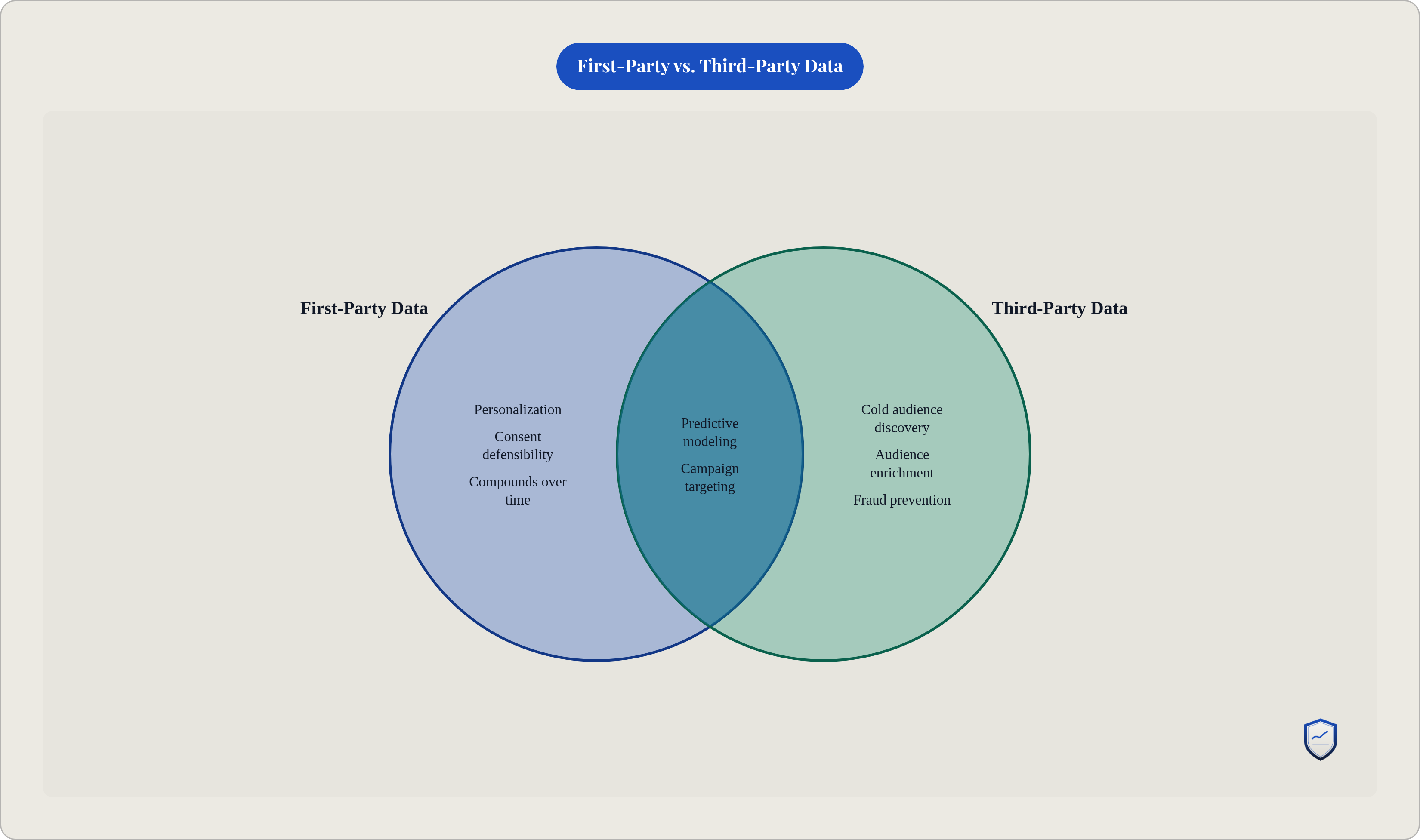
Top-of-funnel prospecting at real scale requires reach into unknown audiences. Third-party data is still the primary mechanism for that. Audience enrichment, appending intent signals or interest categories to existing first-party records, fills gaps your own data cannot close by definition. Predictive models for purchase intent, churn risk, and lifetime value need diverse, high-volume training data; most organizations' first-party datasets are insufficient to train those models alone.
Fraud prevention is a durable use case that rarely appears in these marketing-focused conversations. Retailers rely increasingly on third-party behavioral signals to detect transaction anomalies in real time. That demand exists independently of advertising, and it sustains the market.
The numbers reflect continued appetite rather than a market in freefall. The third-party data platform market was valued at approximately $6.3 billion in 2024. Experian reported 8% year-over-year revenue growth in fiscal 2024. TransUnion achieved 12% organic constant-currency expansion in Q3 of the same year. Roughly 32% of in-house marketers and 31% of agency marketers still rely heavily on third-party cookies, per a 2024 global survey. The transition is real. It is not complete.
The more precise framing is that third-party data is contracting in relative importance, not disappearing. The providers that endure will be those focused on enrichment and prospecting, not those competing with first-party data on personalization accuracy and measurement fidelity. That is a competition third-party data cannot win, and the smarter providers know it.
The real costs and limitations of building on first-party data alone
First-party data is not a free lunch, and the consultants and vendors selling the pivot to first-party strategy tend to move past this quickly.
Scale is the first constraint, and it is not a minor one. Your first-party data is bounded by your existing customer base. Full stop. It cannot support top-of-funnel acquisition at the volume most growth strategies require without supplementation. If your addressable universe is only the people who already know you, you are optimizing for retention while leaving acquisition largely unaddressed.
Infrastructure is more operationally punishing than organizations typically anticipate going in. Roughly half of marketers report lacking the tools to unify first-party data sources. About 72% of marketers now use Customer Data Platforms, per Salesforce research, but most are still consolidating data rather than activating it. Those are different problems. You can build the warehouse and still be unable to act on what's in it, which is its own kind of failure.
Organizational silos compound every technical obstacle. CRM, loyalty, and analytics teams frequently operate in isolation from the media planning teams that actually need the data to run. The data exists inside internal platforms but never reaches the campaign tooling. That is a people and process failure; additional technology investment does not resolve it. I have watched organizations spend seven figures on a CDP and then continue making campaign decisions from spreadsheets because the integration work never happened.
The talent gap is real and consistently underestimated. Forty-five percent of marketers report lacking skilled staff for data analysis. You can have the data, have the platform, and still be unable to extract value because no one on the team knows how to. The infrastructure problem and the capability problem require different solutions, and they are often confused for each other.
Consumer consent is a substantive barrier, not a legal formality to be managed around. More than 60% of consumers cite privacy concerns as limiting their willingness to share personal data. Building the trust necessary to close that gap is slow, ongoing work. Organizations that treat consent as a checkbox will find their first-party data coverage degrading quietly over time, showing up in match rates long before it shows up anywhere in their reports.
And concentrating valuable customer data concentrates risk. The average cost of a data breach reached $4.88 million in 2024. First-party strategy requires serious security investment running in parallel with data collection investment. They are frequently not budgeted together.
The compliance exposure third-party data carries that first-party data reduces
Third-party data's compliance problem is not incidental; it is structural. Users typically have no awareness their data is being collected, aggregated, and resold. Consent to the original collection does not survive the brokerage chain intact. The further removed you are from the moment a user agreed to something, the less defensible your legal position under virtually any major privacy regime.
European regulators issued €1.2 billion in GDPR penalties in 2025 alone, a 22% year-over-year increase in breach notifications. Total documented fines have now surpassed €6 billion. These penalties fall disproportionately on organizations that cannot fully document data provenance at the transactional level. That describes most third-party-dependent data stacks, because the chain of custody is simply not traceable at scale.
The UK Competition and Markets Authority published findings in June 2025 showing that per-impression publisher revenue ran roughly 30% lower under Privacy Sandbox tools versus normal cookies. The privacy-compliant path carries real monetization costs. Organizations that do not model for those costs encounter them anyway.
First-party data collected with transparency and documented consent is more defensible for a straightforward reason: the consent relationship is direct and auditable. You can show exactly when, how, and under what disclosure the data was collected. That auditability is practically impossible for most third-party data at scale, and regulators in multiple jurisdictions are now asking for it explicitly.
Only about 15% of global marketers felt fully prepared for a cookieless environment, per a March 2025 Deloitte survey. That is not a future preparedness problem. It is a present one, and the calendar is not moving in a favorable direction.
How the combination strategy actually works in practice, and where it breaks down
The model that has emerged across the most sophisticated organizations looks roughly like this: first-party data anchoring retention, personalization, and measurement; second-party partnerships extending reach through trusted relationships; third-party data used deliberately for prospecting and enrichment where first-party coverage is insufficient and the use case justifies the compliance overhead.
Retail media networks are the clearest illustration of this working at real scale. First-party data-powered retail media added approximately $45 billion globally in 2025, per eMarketer estimates. Retailers with rich transaction data are licensing access to brands that need audience precision. It is second-party data functioning as a monetization engine, growing because it solves a real problem for both parties simultaneously.
About 75% of brands plan to reduce or fully eliminate third-party data dependency by 2026. The direction is clear even where execution remains uneven.
What holds this combination together is disciplined data classification: knowing what came from where, what consent covers it, and who owns the boundary between sources. When organizations blend third-party data into a first-party-anchored decisioning system without documenting that boundary, they inherit the provenance problems they were trying to escape. The compliance risk of the weakest source propagates through the whole system.
Where the strategy breaks down is when organizations begin treating third-party enrichment as a substitute for consent-based first-party collection rather than a deliberate, bounded complement. When third-party data quietly becomes authoritative for decisions that should be anchored in the direct customer relationship, you are building your most consequential choices on your least reliable foundation. That drift happens not because of a decision, but because no one actively prevents it.
The practical question has never been which data type wins in the abstract. It is which data type should be authoritative for each specific decision. Personalization and measurement belong to first-party data because they require accuracy and consent defensibility. Cold audience discovery can use third-party data, with governance guardrails in place. Conflating those two roles, or allowing organizational inertia to let third-party data migrate into decisions where its accuracy and compliance weaknesses are consequential, is where the strategy quietly fails.
First-party data, collected transparently, compounds. It grows more valuable as the customer relationship deepens. Third-party data is a commodity, and it erodes as signal quality degrades and regulatory pressure builds. The combination works when you treat those two categories according to that difference, not as interchangeable inputs into the same decisions.