Zero-Party Data Collection and Its Role in Personalization
Why This Data Type Is Drawing Serious Attention Right Now. Google announced full third-party cookie deprecation, then reversed …

Why This Data Type Is Drawing Serious Attention Right Now
Google announced full third-party cookie deprecation, then reversed course in July 2024, pivoting instead toward user-controlled preferences in Chrome. A lot of people read that reversal as the crisis passing. It didn't. Safari and Firefox already block third-party cookies by default, and when users are actually prompted for consent in any browser, fewer than 10% agree to tracking. The practical effect is near-disappearance of third-party data regardless of what Chrome does next. Google bought time. The structural problem remained exactly where it was.
Meanwhile, data protection laws now cover 79% of the global population across 144 countries with active privacy frameworks, and 42% of US states had passed their own legislation as of early 2025, according to Usercentrics. Five years ago this was a GDPR conversation happening mostly in European compliance meetings. Now it's an operational reality for almost any brand with a national footprint, let alone a global one.
And consumer anxiety isn't a stable background hum anymore. The share of consumers worried about data privacy jumped from 60% to 70% in a single year, per Deloitte's 2025 Connected Consumer Survey. That's not drift. That's acceleration, and it's happening in the middle of an already tightening environment.
What makes this particularly interesting to me, having watched these pressures compound over several years, is how they interact with each other. Tighter consent requirements reduce trackable behavior. Reduced behavioral data weakens inference-based personalization. Consumers, increasingly aware of how their data has historically been handled, are less willing to extend good faith to brands asking for more. The market for observed data is shrinking on three sides simultaneously. Which makes an Adtaxi 2024 finding all the more striking: a third of respondents still have no cookie-replacement strategy at all. Awareness of the pressure is running far ahead of any organized response to it.
The Gap Between Recognizing Zero-Party Data's Value and Actually Using It
Forrester Consulting, working with SheerID, found that 85% of marketers say zero-party data is necessary for effective personalization. The Supermetrics 2025 Marketing Data Report found that only 16% are actively collecting and using it. That gap is worth sitting with, because it's easy to assume the problem is skepticism. The data says otherwise.
82% of marketers report having access to zero-party data. 42% admit they don't know how to use it effectively. So the conviction is there; the data exists in some form. It's the capability that's missing. That's a different diagnosis than reluctance, and it points toward a different kind of problem to solve.
Meanwhile, 58% of marketers still rely primarily on third-party data, the exact strategy being compressed by every pressure described above. And in the 2025 Braze Global Customer Engagement Review, 99% of marketing executives said personalization plans had been affected by data privacy concerns. Near-universal pain, with a response that isn't commensurate to it.
Search interest in zero-party data jumped 250% year over year. People are researching this but have yet to execute on it. I've seen this pattern before in adjacent spaces: the barrier isn't persuasion. It's that no one has handed the practitioner a concrete blueprint for what to actually build.
What Customers Actually Share, and in What Form
There are roughly five categories of information customers will voluntarily disclose when the context earns it: product preferences (style, size, color, category, flavor); communication preferences (channel, frequency, message type); personal context and interests (hobbies, goals, lifestyle); purchase intentions (what they're looking for, by when, what problem they're solving); and profile information (skin type, fitness level, gifting context, experience level).
What unifies all five is that zero-party data is inherently forward-looking. It describes what someone wants, not what they've already done.
A purchase history tells you what someone bought. Stated preferences tell you what they're trying to accomplish. Those are meaningfully different signals. Behavioral first-party data validates; zero-party data contextualizes. A click on a product page tells you someone looked. A user who tells you they're shopping for a wedding gift for a specific person, within a budget, before a specific date, has handed you something no click history can manufacture: the reasoning behind the action. That's not a subtle distinction. That's the whole ballgame.
The Collection Methods That Produce Reliable Zero-Party Data Without Alienating Users
Interactive formats — quizzes, product finders, skin assessments, style diagnostics — produce the highest-quality zero-party data, and the reason is structural rather than cosmetic. They work because they offer something concrete in return. Disclosure feels like an exchange rather than extraction.
Sephora's beauty quiz is the example that comes up constantly in this space, and having watched a lot of collection experiments succeed and fail, I think it's instructive for a precise reason: skin type, color preferences, and beauty goals — all collected in a format users actively seek out because the output is useful to them. The brand gets the data; the user gets a recommendation calibrated to what they just said. That alignment is what makes the collection work. Remove the alignment and you just have a form with extra steps.
Preference centers operate on the same principle but serve a different function. They give users an explicit interface to state communication preferences, content interests, and product categories, and to update those choices over time. This is consent as a persistent architecture rather than a one-time acknowledgment buried in onboarding.
Progressive profiling addresses something Forrester has documented directly: if a form asks for too much at once, users will fabricate answers just to finish it. The profile looks complete and is functionally worthless. Spreading collection across multiple touchpoints, a few accurate signals per interaction, produces a profile that's actually usable.
Loyalty enrollment is a natural collection moment many brands squander. Birthday, interests, shopping habits, product preferences: users provide accurate information at enrollment because they're expecting something concrete in return. The expectation is clear, the exchange is explicit, and that clarity is precisely what produces reliable data. Short surveys with proportionate incentives — discounts, early access, loyalty points — work for the same reason. The value exchange is legible and fair.
The common thread across all of these isn't a UX pattern. It's transparent collection, explicit exchange, and real user control. Strip those out and you don't just get worse data. You get data that looks usable but isn't.
Why Explicitly Volunteered Data Produces Better Personalization Than Inferred Data
The fundamental problem with inferred data is that behavioral signals require interpretation, and interpretation is where things quietly go wrong. Someone bought a children's book. Were they shopping for their kid, buying a gift, picking something up for a school fundraiser? The behavioral signal is identical across all three cases. The meaning is entirely different. Behavioral data captures the action; it cannot capture the reasoning behind it, and personalization built on that ambiguity inherits the ambiguity and scales it.
Zero-party and first-party data do different jobs. Zero-party surfaces intent and preference. First-party validates through actual behavior. They're more powerful together than either is alone, but zero-party provides the context that makes behavioral data interpretable in the first place. Without it, you're pattern-matching on a signal you don't fully understand, and occasionally you're pattern-matching confidently on something that's completely wrong.
The practical payoff is accuracy. A user who tells you they prefer minimalist styles in neutral colors has given a brand more actionable information than a browsing history that reflects gifting, research, or distraction. Explicitly stated preferences eliminate interpretive ambiguity. Inference preserves it.
That matters more now that AI is involved. Real-time activation of zero-party data through AI-driven systems can produce personalization at a scale no human editorial process can match. But the output is only as good as the input. Inaccurate inferred data fed into an AI system produces bad recommendations at volume, consistently, across every touchpoint. The amplification cuts both ways. Accenture's 2025 research found that 91% of consumers are more likely to shop with brands offering relevant recommendations based on stated preferences. Consumers can feel the difference between a brand that knows what they said and a brand that guessed, even if they can't always articulate why.
A Customer Data Platform can unify zero-party data with behavioral first-party data, enabling compliant segmentation across touchpoints. But the platform is infrastructure. What flows through it depends entirely on the quality of what you're putting in.
What Measurable Outcomes Look Like When Zero-Party Data Drives Personalization
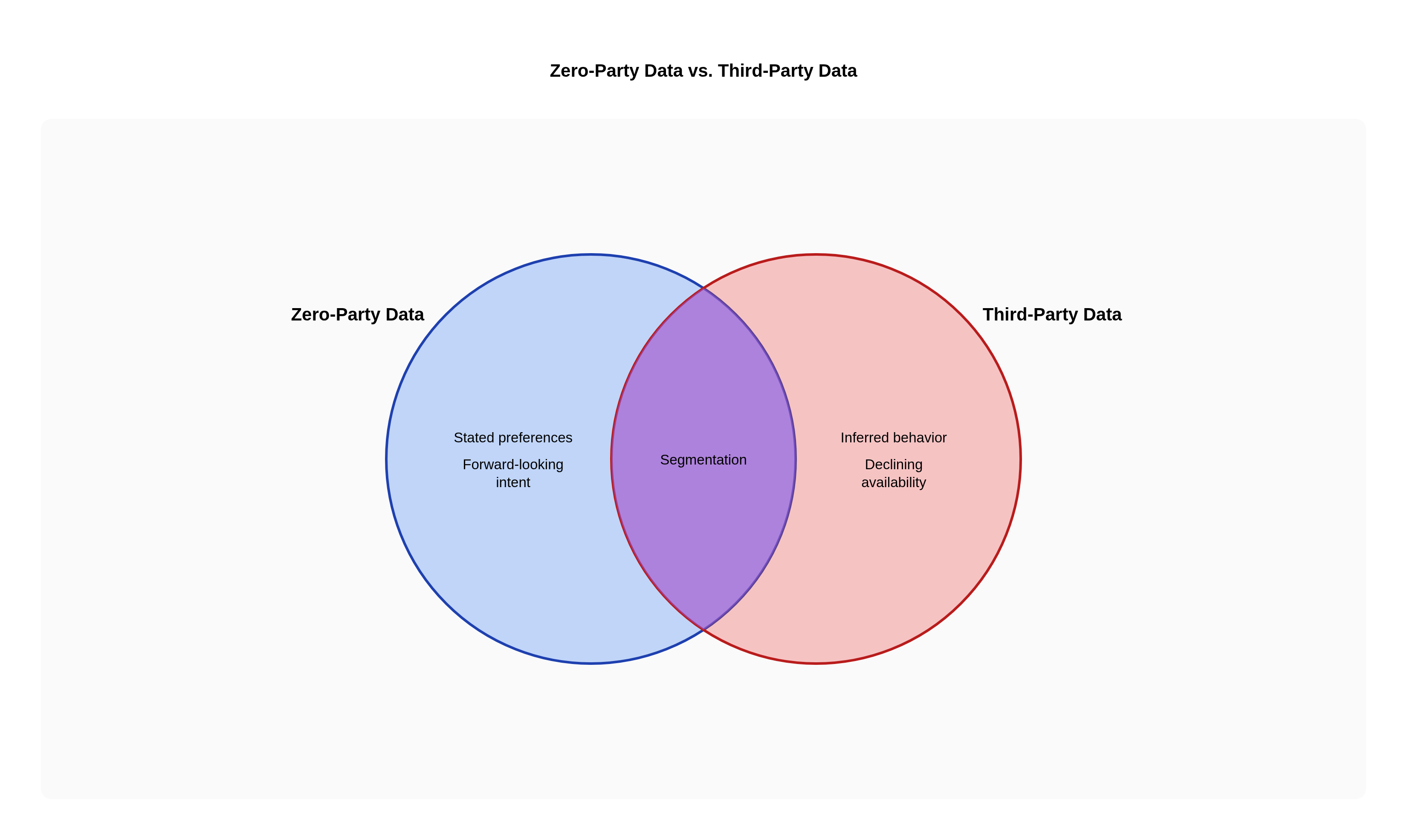
Single Grain's 2025 analysis found that zero-party data outperforms third-party data by 217% in engagement metrics. That figure is large enough to warrant real scrutiny before accepting it. A 217% lift isn't a marginal improvement in the same category; it suggests zero-party data isn't just doing the same job better but doing a fundamentally different job than the thing it's replacing.
Email is where the evidence is most consistent. Fashion retailers using preference data report 40% higher click-through rates compared to generic campaigns, and open rates running 22 to 28 percentage points higher. Those aren't small deltas on a noisy metric.
The returns figure is the one that reframes the conversation, at least in my experience of where these arguments tend to stall. The same retailers report a 60% reduction in returns when recommendations align with explicitly stated preferences. Returns are a supply chain problem, a customer experience failure, a margin issue. They almost never enter the marketing conversation about data strategy, and they should. A recommendation engine that knows what someone actually wants doesn't just drive conversion; it drives the right conversion.
Unsubscribe rates drop 35% on preference-matched communications. When what you send matches what someone said they wanted, they stay subscribed. Stated plainly, that isn't surprising. But confirmed at scale across actual retail data, it reframes relevance as channel protection rather than campaign optimization.
Most of these figures come from retail and fashion contexts, where preferences are concrete and the feedback loop between recommendation and purchase is tight. The principle holds across industries, but how cleanly it translates depends on how legible preferences are in a given category and how well the collection and activation infrastructure is actually built. The numbers are real; the generalizability requires honest evaluation against your specific context.
Why Treating Consent as Infrastructure, Not a Form, Is What Makes Zero-Party Data Sustainable
The collection methods above only keep delivering if users continue sharing accurately. And that requires the brand to hold up its end: using the data as it was presented, being transparent about what's collected, giving users genuine control over what they've disclosed. Without that, the data degrades. Users who feel their disclosure was used in ways they didn't expect stop sharing accurately. The pipeline quietly corrodes, and you often won't see it happening until the signal has already lost most of its value.
This is the real difference between a quiz that builds a useful profile and one that extracts data under a value pretense. Brands that treat collection as a tactic and consent as a legal formality will find that the accuracy advantage disappears. Users learn, and they adjust accordingly.
Preference centers, built properly, aren't a one-time disclosure form. They're the ongoing interface through which users update their relationship with the brand. The user who preferred email over SMS in 2023 now wants push notifications. A living consent layer captures that evolution. A static sign-up form doesn't. Zero-party data collected once and never refreshed is just a decaying snapshot.
With 70% of consumers now worried about data privacy, per Deloitte's 2025 figures, brands that make consent visible and meaningful are positioned to capture the accuracy that anxious, low-trust consumers simply won't extend to brands they're uncertain about. That anxiety isn't irrational. It's a rational response to a long history of opaque collection and quiet misuse. Brands that treat consent as a strategic asset have better data, not just a cleaner compliance posture, because trust is what keeps people telling you the truth about what they want.
Here is the reframing that I keep coming back to when this conversation comes up internally: transparency isn't a compliance cost imposed on personalization. It's the condition under which the most accurate personalization data becomes available at all. The brands still treating consent as a checkbox are optimizing for a version of the problem that's already becoming obsolete. Per eConsultancy's Future of Marketing research, 55% of marketers expect zero-party data to become more important over the next two years. The direction is clear. The harder question is whether organizations build that infrastructure before they discover their existing data isn't accurate enough to act on.