IT-Approved MCP Server Catalogs That Keep Developers Out of the Shadows
Governed catalogs let IT say yes to MCP adoption instead of enforcing risky bans.
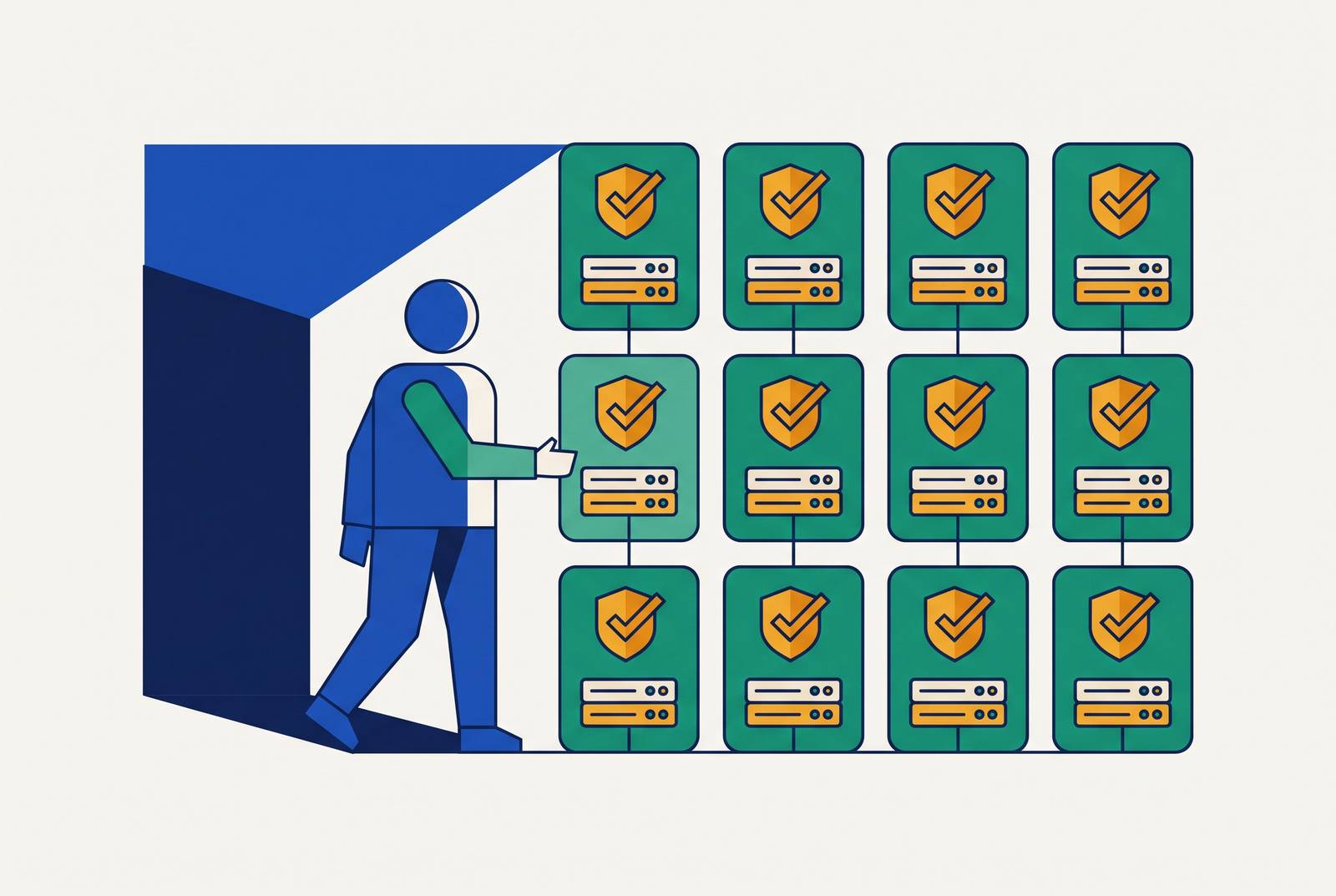
MCP servers spread faster than IT can track them because the protocol removes every friction point that once gave governance a head start. No purchase order, no vendor review, no network exception. A developer installs a server locally, points it at an internal system with whatever credential is closest, and the work is done. The fix is not a ban. It is a governed catalog developers actually want to use.
Why MCP servers spread faster than IT can track them
Any developer can write an MCP server. The standard is open, the barrier is an afternoon, and the only requirement is a credential. That is not a flaw. It is the reason MCP took off so fast. But it is also why security teams keep discovering servers they never approved.
The gap is structural, not behavioral. Classic shadow IT leaves traces: a login page, an expense line, a cloud access security broker alert. A shadow MCP server leaves none of those. The first time IT learns about it is usually during an audit, or after something goes wrong.
Discovery does not help either. Public registries index tens of thousands of servers. A developer looking for a Jira or GitHub integration finds multiple options before IT has written a policy. The ecosystem simply moves faster than an approval queue.
The stakes are higher than shadow SaaS. Shadow SaaS is a data transfer problem. A shadow MCP server is an action problem: file modification, code execution, production API calls. The exposure is frequently broader than the task.
What the ungoverned MCP landscape actually looks like inside an enterprise
Security assessors see the same pattern across large organizations: many MCP server configurations on developer machines that IT has no record of, with a meaningful share carrying production credentials. A large portion of these unofficial servers come from unknown authors. No vendor behind them, no audit trail, no owner to trace.
The compliance exposure is invisible until it is not. A shadow server touching cardholder data under PCI DSS, health records under HIPAA, or personal data under GDPR creates a gap the organization does not discover until an audit or an incident. That is the worst time to find out.
Even official servers can be exploited. Invariant Labs disclosed a prompt injection against the official GitHub MCP server in May 2025 that exfiltrated private repository data through a public issue. Cross-server tool shadowing was demonstrated against a whatsapp-mcp server the same year: a malicious server running alongside the legitimate one used poisoned tool descriptions to make a shared AI agent silently exfiltrate entire chat histories.
Then there was CVE-2025-6514. A critical OAuth vulnerability in a widely used MCP component gave attackers remote code execution on over 437,000 developer environments. Official servers carry real risk. Unofficial ones compound it by definition.
Why banning MCP servers does not solve the problem and usually makes it worse
A block policy is tempting. It is also the wrong tool. A ban removes the governed path and leaves the ungoverned one fully intact.
The framing matters here. They are not being malicious. A policy that ignores why they reached for the tool in the first place pushes adoption underground rather than eliminating it.
Teams that give developers an easy, governed path reduce shadow AI more reliably than teams that ban it. The friction in the approved path, not the absence of a rule, is the primary driver of shadow adoption. When the legitimate option takes a week of approvals and the unofficial one takes ten minutes, the outcome is predictable. That is the point MCP Manager's centralized governance layer is built around: by enforcing which servers can connect to internal systems and monitoring every access attempt in real time, it gives IT a way to say yes to legitimate MCP adoption without requiring developers to route around the approval process. Organizations that centralize and enforce MCP access policies proactively ship agentic AI faster than teams that defer security, because the guardrails are what enable the yes to production.
What distinguishes a governed enterprise catalog from a public MCP registry
A public registry is a discovery layer. An enterprise catalog is a governance layer. The two are not substitutes. The official MCP Registry, PulseMCP, and Smithery help a developer find a server to try. Most do not support private servers or enforce approval state at all.
The blind spot is visible in the listings themselves. The MCP ecosystem tracker notes that fourteen servers from the original Anthropic reference repo moved to an archived location with no security guarantees, yet continue to appear in listings without that flag. A catalog can make it impossible to miss.
The deepest distinction is architectural. Most registry tools are discovery-only. An agent can still connect to a server that is not in the catalog. Full governance requires pairing the catalog with a runtime gateway that enforces the allow-list. Without a gateway, the catalog is advisory, not enforceable.
What an effective IT-approved catalog must include to earn developer trust
A catalog that is harder to use than going rogue will not get used. Developer trust is a design requirement, not a soft consideration. The search experience must be as good as the public directories developers already know. If it takes three clicks to see whether a server covers a use case, a developer will take one click to find an unapproved one.
That means six questions must be answered for every catalog entry before a server is allowed into a production agent workflow. The first is maintainer. A vendor-maintained server tracks the vendor's API, inherits its permission model, and has an owner who ships security fixes. Community servers from unknown authors require elevated scrutiny.
The second is identity. The regulated enterprise developer guidance flags that 88% of MCP servers require credentials, and 53% rely on long-lived static secrets, with a majority of those credential configurations considered insecure. Catalog policy should require OAuth 2.1 or equivalent for any server with write or mutation access.
The third is mutation. Read access, write access, and production mutation are distinct risk tiers, and they should be approved and audited differently. The fourth is logging. If an agent uses a server to retrieve context, change an issue, call an API, or update a record, there must be a known, accessible log destination. Regulated teams need evidence.
The fifth is data boundary. Servers exposing local files, SaaS data, or regulated records require different approval thresholds and data-handling rules. The sixth is maintenance status. Archived or unmaintained servers should be blocked at catalog entry, and that status must be tracked continuously, not checked once at onboarding.
How production enterprise catalogs are built and maintained in practice
Several platforms have operationalized the governed catalog pattern in 2026. Each takes a different architectural approach, and the choice depends on what a team is already running. MCP Manager, by Usercentrics, is the control layer purpose-built for enterprise MCP governance. It operates as a gateway and registry together: a private, governed catalog backed by runtime enforcement, so an unapproved server has no sanctioned path into production. The catalog is not advisory. The governance infrastructure is what enables the yes to production, not what delays it. Docker Custom Catalogs and Profiles reached general availability on May 15, 2026. Organizations publish and distribute catalogs defining approved servers, and developers discover trusted MCP servers within organizational boundaries instead of searching the open internet.
JFrog Universal MCP Registry reached general availability on March 18, 2026. It carries a caution worth taking seriously. The result of CVE-2026-82329, with a CVSS score of 9.8, exploited authentication flaws in self-hosted Artifactory instances. The lesson is not about JFrog specifically. It is that the registry itself becomes the highest-value target in the supply chain and must be hardened accordingly.
ServiceNow's MCP Registry is built on the open MCP Registry API specification and described as the first enterprise private MCP registry on that open standard. Amazon's Kiro IDE registry, released in 2026, lets administrators allowlist approved MCP servers and define which models developers can use. Enforcement is deterministic across both the IDE and the CLI.
At scale, a GitOps workflow is more reliable than manual catalog management. Human judgment sits at the gate. Automation handles everything after it.
Keeping every approved server accountable from registration through runtime
Approval at registration is necessary but not sufficient. A server's risk profile changes after it enters the catalog, and the catalog must track those changes in real time. An MCP attack surface discovered after deployment is a governance failure, not a security surprise. The vulnerability existed the moment the server went ungoverned or unmonitored. Every new MCP server added without a registry entry is an identity the organization cannot account for, and an unaccounted identity is the one that gets exploited.
Visibility into what an agent touched is only operationally useful if it is available as the action happens. An audit log read after an incident is a postmortem, not a safety net. RBAC at the tool level, not just the server level, ensures that what AI can do is a decision the organization made on purpose, not a default inherited from the broadest capability a server offers.
That is the loop MCP Manager's architecture closes: governed catalog, runtime gateway, real-time observability. The observability layer makes every agent action accountable without waiting for an incident to review logs. Organizations implementing a consent-governance platform's AI oversight capabilities gain immediate visibility into shadow configurations by auditing what data and systems each agent has actually accessed, converting the invisible compliance gap into a concrete inventory of servers to assess and either approve or retire.
A shortlist of vendor-maintained MCP servers worth including in a first enterprise catalog
The most defensible first catalog draws from vendor-maintained servers that inherit the identity and permission model of the systems they expose. Approval is easier because the governance model is already established. These are options with different fit profiles depending on the systems a team uses, not a ranking.
The GitHub MCP Server is maintained by GitHub and authenticates through OAuth or a personal access token. Enterprise controls include toolsets that enable only the tools a use case needs, a read-only mode that removes write tools entirely, and support for GitHub Enterprise Cloud with data residency. Write tools are present by default, so the read-only flag should be the first configuration step for most enterprise approvals.
The Azure MCP Server is maintained by Microsoft. It authenticates via Entra ID through the Azure Identity library, and tool availability follows the caller's Azure RBAC permissions. Mutation risk covers Azure resource operations, constrained by the caller's RBAC role.
The Microsoft Learn MCP Server is the lowest risk tier: a remote endpoint over Streamable HTTP, no authentication required, exposing only public Microsoft documentation. Read-only, no credentials, no internal data. It is a strong first approval for teams new to MCP governance.
Work IQ MCP for Microsoft 365 is maintained by Microsoft, runs remote, and authenticates via Entra ID. It exposes mail, calendar, Teams, files, and people data through eleven generic tools acting on resource paths. Fine-grained access is enforced per path, method, and tenant policy rather than broad OAuth scopes.
The Atlassian Rovo MCP Server runs remote and uses OAuth 2.1. It acts within the signed-in user's Jira, Confluence, and Compass permissions. Rovo broadly supports HIPAA use as of July 2026, but the Rovo MCP Server specifically is excluded from HIPAA scope. The Slack MCP Server runs remote at mcp.slack.com/mcp with confidential OAuth through a registered Slack app. Admins approve each MCP client, and audit logs record MCP activity, so the logging destination is well defined. AWS MCP Servers come from AWS Labs as open source, with a hosted AWS MCP Server maintained by AWS that reached general availability on May 6, 2026. The hosted server uses IAM-based authentication and CloudTrail logging, which gives regulated teams a familiar evidence trail. Google Managed MCP Servers are remote and run by Google, with Google Cloud IAM authentication. They cover BigQuery, Maps, Compute Engine, and GKE, with tool use audit-logged through Google Cloud.
Playwright MCP handles browser automation and UI testing. The approval note from regulated enterprise guidance is direct: unsafe direct-code tools should be disabled unless the client is explicitly trusted. That is a catalog-level configuration requirement, not a post-deployment fix.
The common thread is simple. Every server on this shortlist has a named maintainer, an identity model, and a logging story. That is what collapses shadow adoption. Not a ban. An alternative that works.