Generative AI vs Agentic AI in MCP Tool Orchestration
MCP standardizes tool connections differently for generative and agentic AI workloads.
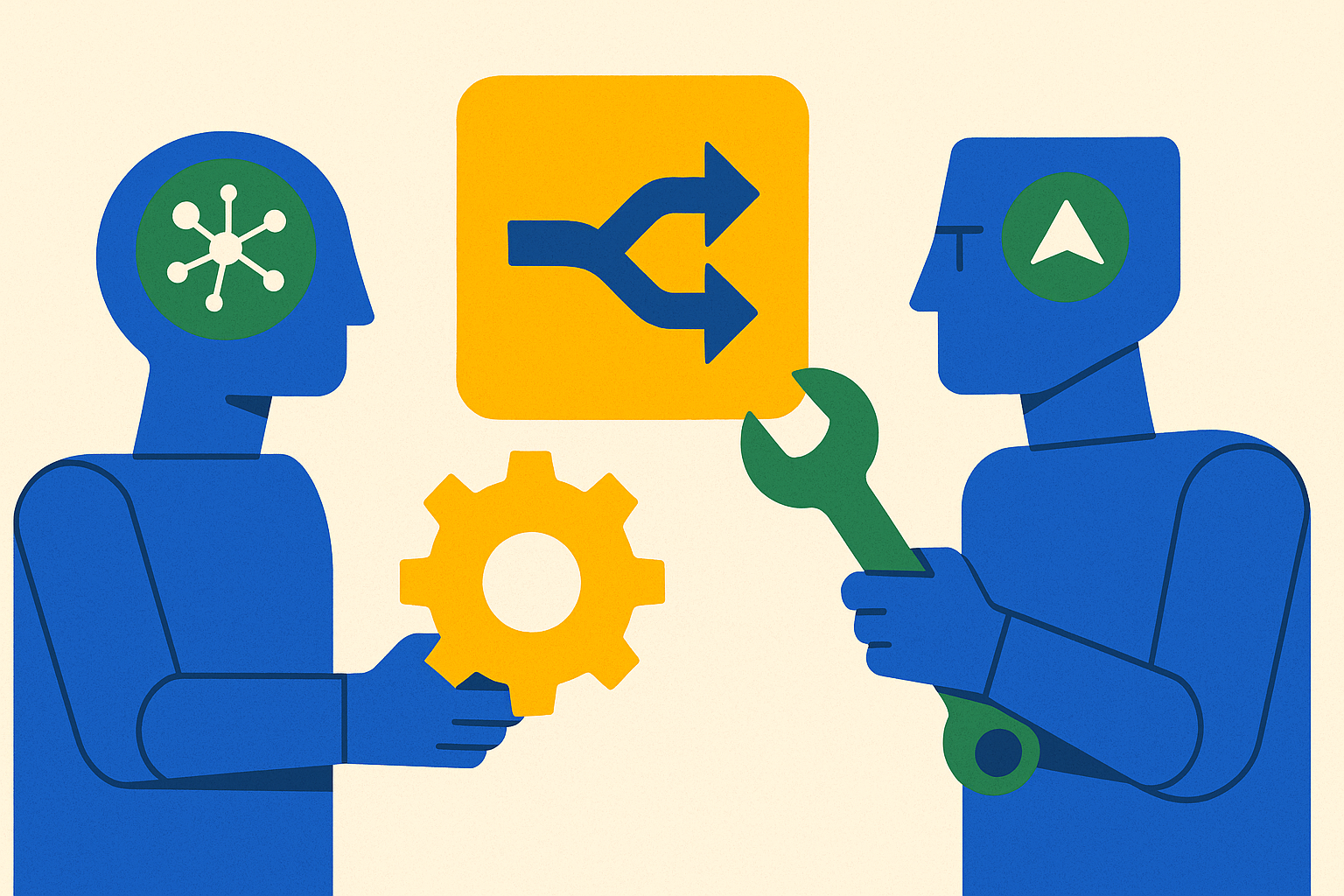
Generative AI and agentic AI ask for completely different things from the plumbing that connects them to tools. One needs a prompt interface: text in, text out, maybe a document pulled in along the way. The other needs governed, multi-step access to live systems, the kind where an agent runs on its own for hours without anyone checking in. Model Context Protocol, or MCP, sits underneath both, and I've watched enterprises treat these two modes as interchangeable right up until orchestration breaks the first time it hits real production traffic.
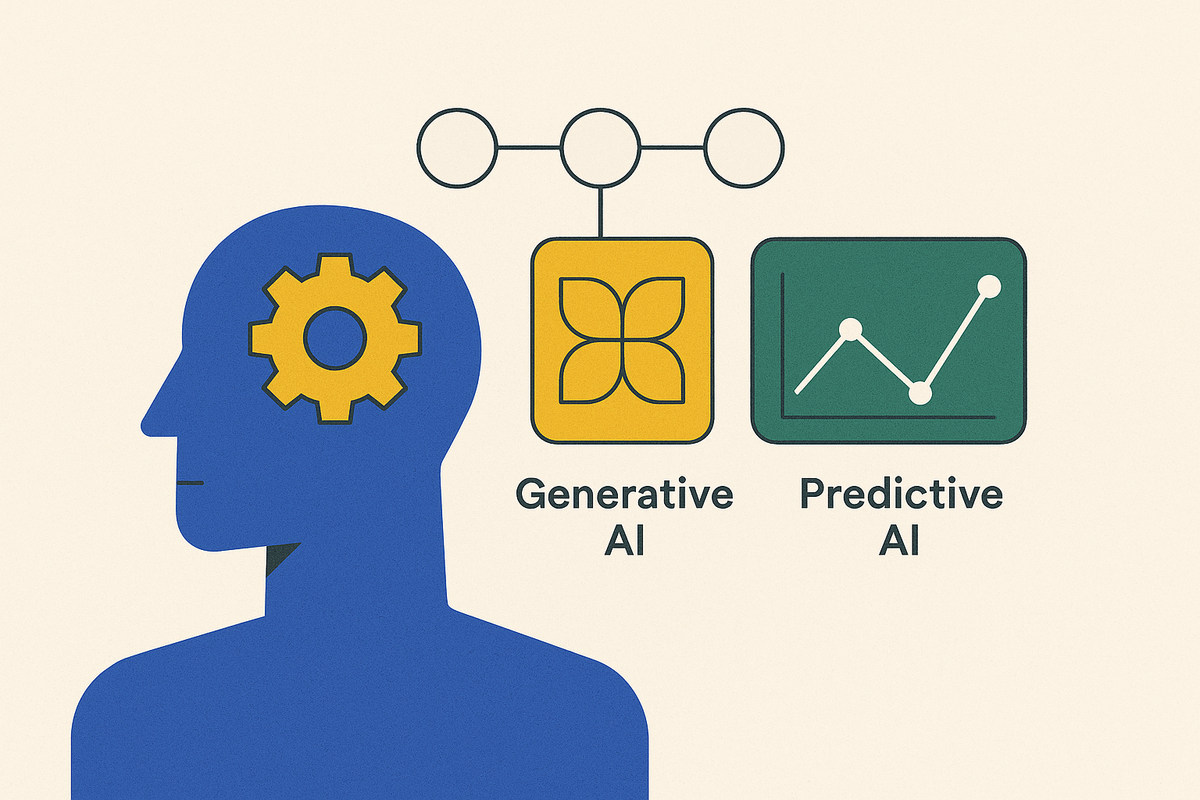
Generative AI is reactive. You give it a prompt, it hands back a draft, a summary, a block of code, and that output changes how someone approaches the next step of their work. Agentic AI is goal-directed: you give it an objective, and it plans steps, calls tools, adjusts when conditions shift, then hands back a finished result with nobody signing off on each move. There's a middle category too, agents that add tool use and some autonomy to a generative model but stop short of the sustained, multi-system reasoning that defines agentic AI proper. Generative AI makes artifacts, and agentic AI takes actions. Once you look at what each one asks of MCP, that difference stops being academic pretty fast.
What MCP actually is and the structural problem it was built to solve
Before MCP, connecting AI systems to tools was an N times M problem, and anyone who's built integrations knows exactly how ugly that gets. Ten tools (say Slack, GitHub, a database, a CRM) and five model front-ends that all need to reach them, and you're writing custom glue code for every pairing. Fifty combinations means fifty bespoke integrations, and adding one more tool or model doesn't just add one connection; it adds a whole new row or column to the grid.
MCP fixes this with an open standard built on JSON-RPC. Any AI application can discover tools, prompts, and resources from a remote MCP server through one stateful session, and fifty integrations collapse into a protocol both sides already speak.
Anthropic published MCP in November 2024. By December 2025 it had been handed to the Agentic AI Foundation under the Linux Foundation, co-founded by Anthropic, Block, and OpenAI, with Google, Microsoft, AWS, Cloudflare, and Bloomberg backing it. Governance sits with a multi-vendor foundation now instead of one company's product roadmap, and I think that shift gets underrated, honestly, because a protocol this load-bearing shouldn't answer to a single vendor's incentives.
Three pieces make up the architecture. The MCP host is the application layer: Claude Desktop, an IDE, an agent platform, whatever coordinates everything and holds the state. The MCP client fetches tool metadata (name, description, input schema) on the agent's behalf. The MCP server exposes the actual capabilities, and the host decides when to call them.
That tool description carries more weight than it looks like it should. It's the main semantic bridge between the model and the world, and it shapes which tool the model reaches for, how it fills in parameters, how it chains calls across a longer task. Get the description wrong and the model picks the wrong tool, or feeds it garbage, and it does that every single time, not once in a while.
MCP launched with roughly 50 public servers, and by Q2 2026, estimates put that number between 8,000 and 12,000. SDK downloads grew roughly 970 times from launch in November 2024 to more than 97 million a month by March 2026, and I've stopped being surprised by big adoption curves in this industry, but that one still made me sit up. Adoption at that speed tends to outrun whatever governance was built to handle it, every time, in every protocol I've watched grow this fast.
How generative AI uses MCP: a prompt interface, not a control plane
For a generative model, MCP mostly does one job: enrich context. Pull in a document, grab a resource, fetch a snippet the model didn't already have, then generate a response. The session is short, the state is shallow, and a human almost always sits between the output and whatever happens next.
None of this is new. OpenAI shipped function calling back in June 2023, letting a model decide when to invoke a predefined function while the application handled execution. It worked, but it scaled badly, since every new tool needed its own schema, schemas varied across providers, and any project touching more than a couple of tools meant rewriting nearly identical plumbing over and over — exactly as tedious as it sounds.
MCP standardizes what sits around function calling: discovery, invocation, response handling, all made consistent across models and providers. Function calling picks the tool and fills in the parameters; MCP handles the actual invocation, so a developer doesn't have to hardcode tool-specific logic into the app. Swap the model, or add a new tool, and the core agent code stays put.
None of this stresses the orchestration layer much in generative mode, given one or two tools, one inference step, one output, and a session that ends the moment someone reads the answer. MCP running here sits comfortably inside its original design intent.
How agentic AI uses MCP: governed, multi-step access to live systems
Agentic AI reshapes the whole problem. The agent gets a goal, not a task. It picks its own tools, sequences its own calls, and holds state across many inference steps in a row, without a human signing off between any of them.
In MCP terms: the client fetches tool metadata, the model plans a path toward the goal and formulates a tool call, the agent executes it, the response feeds back in, and the model decides whether to answer or call another tool and keep going. No handoff to a person anywhere in that loop, which is exactly what makes it powerful and exactly what makes it nerve-wracking.
Block's Goose shows what this looks like at real scale. It's an open-source, MCP-compatible agent that Block rolled out to employees across the organization, connected to internal tools and systems. Employees report time savings of 50 to 75%, with work that used to take days now finishing in hours. That's agentic MCP access as ordinary day-to-day infrastructure, not a demo running in someone's sandbox somewhere.
Multi-agent setups push this further. Gartner reported a 1,445% jump in inquiries about multi-agent systems between Q1 2024 and Q2 2025, a number I had to double-check the first time I saw it. The pattern that keeps showing up is a "puppeteer" orchestrator coordinating specialist agents underneath it: a researcher, a coder, an analyst, each scoped to its own job. Managing state between those agents, resolving what happens when two of them disagree, running the orchestration logic itself, none of that was much of an engineering problem in single-agent systems, and now it's the central one.
The protocol is catching up. The November 2025 MCP spec added concurrent tool execution, letting a single research server spawn multiple internal agents, coordinate them, and hand back one coherent result using standard MCP primitives instead of some custom workaround somebody duct-taped together last year. Underneath it all, the infrastructure is shifting too, with remote MCP server deployment growing 400% since May 2025, moving away from local developer tooling toward cloud-hosted servers built for many agents to hit at once.
Where the token and latency trade-offs actually bite in agentic pipelines
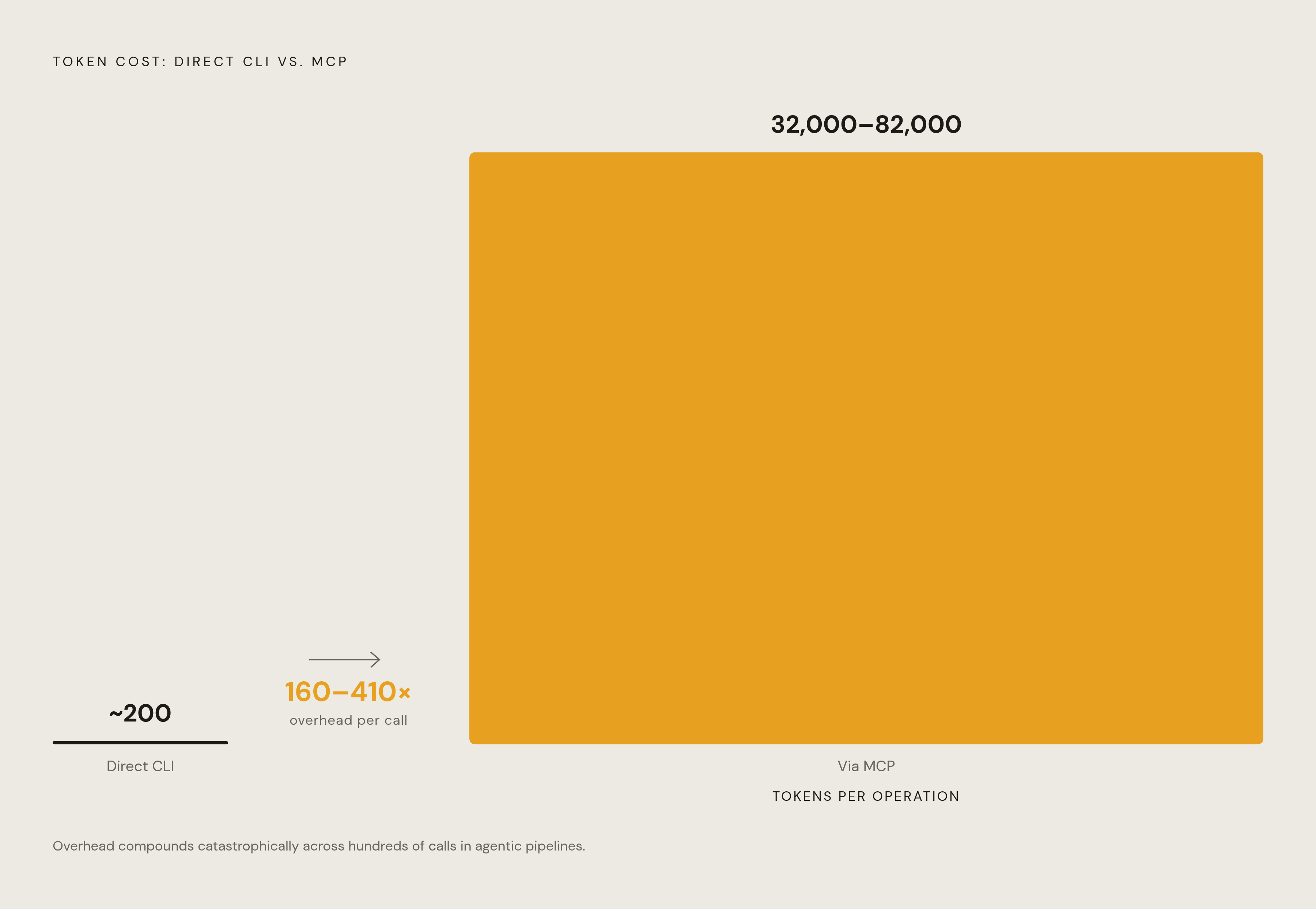
There's a cost here that's invisible when a person is waiting on one answer and very visible once a machine runs the pipeline unattended. Setup, schema loading, session context: all of it costs tokens, at every step of a multi-step workflow, not just the first.
A CLI command averages around 200 tokens. The same operation through MCP runs 32,000 to 82,000 tokens, somewhere around 160 to 410 times more — the kind of number that looks like a typo until you check it twice. Nobody notices this on a one-off query, but a batch job running hundreds of tool calls compounds that overhead into something dramatically slower than a direct API call would ever be.
So here's the rule of thumb I use: a person waiting on one answer barely notices MCP's overhead, while a machine processing at volume in an automated pipeline feels every bit of it. That's a design constraint you plan around, not something you discover after a job times out at 2 a.m. and you're the one getting paged.
Teams that get agentic pipelines into production weigh where MCP's overhead is worth paying, for the governance and modularity it buys, against where a direct integration just makes more sense for the task at hand. Plenty of tasks are better served without MCP at all, and anyone telling you otherwise is probably selling something.
Why agentic MCP access creates a structurally larger attack surface than generative AI ever did
In generative AI, the human in the loop doubles as a security checkpoint. The model proposes, a person reads it, a person acts, and that review step is a control, even when nobody bothers calling it that out loud.
Agentic AI removes the checkpoint entirely. The agent acts on its own, and the attack surface grows with every server it can reach and every step it takes without a person looking first.
Three risks show up specifically at MCP's production scale. Silent tool redefinition, sometimes called a rug pull, is the first: a tool's description changes after a user already approved it. Day one it looks safe, and day seven it's quietly rerouting API keys somewhere they shouldn't go. Second is prompt injection through tool responses, where a malicious server slips instructions into what looks like ordinary output and redirects the agent's behavior across every other server it's connected to. Third is cross-server privilege escalation: once an agent talks to multiple servers at once, a compromised one can override or intercept calls meant for a trusted one.
Two incidents make this concrete instead of hypothetical, and I keep coming back to both when people ask me why this matters. In May 2025, researchers demonstrated an exploit in GitHub's MCP server where a malicious issue filed in a public repository directed the agent to expose private repository data inside a generated pull request. The agent had access to both repos and just followed the injected instructions, no detection, no flag raised, nothing. Then in November 2025, Anthropic's own official Git MCP server turned up path validation bypass, argument injection, and unsafe repository initialization flaws. Chained with a filesystem MCP server, those could be used for remote code execution triggered by prompt injection, which is about as bad as it sounds.
That's an ecosystem that scaled faster than the security tooling meant to watch it, and honestly, I don't think that gap closes on its own.
None of this exposure shows up as a surprise after deployment; it's there the moment a server gets connected without governance wrapped around it. The vulnerability is the absence of oversight itself, full stop, which is the problem tools for auditing AI data access via MCP are built to address.
What production-grade MCP orchestration requires that experimental use does not
The line between playing with MCP and running it in production comes down to control. Stacklok's December 2025 survey of 300 senior technical leaders found only 41 to 45% reporting even limited production use of MCP. Most of what's happening with MCP inside enterprises right now is still pre-production, still people kicking the tires before they buy the car. The teams that cross that line treat governance as infrastructure from day one, not as something bolted on after an incident forces the question.
A server registry has to come first. Every MCP server an organization runs needs an identity attached to it; an unregistered server is an identity nobody's accounting for, and those are exactly the ones that get exploited. Role-based access control for agents matters just as much. What an agent can touch should be a decision someone made on purpose, not whatever scope the tool happened to expose by default.
Real-time observability comes next, and it demands more than a log file. A log read after something went wrong makes a fine postmortem, but visibility into what an agent is doing right now has to be live, while it's happening, not reconstructed after the fact from whatever breadcrumbs survived. Tool description integrity matters just as much, since descriptions drive model behavior directly, they need active monitoring for mutation. Silent redefinition is an attack vector, not a maintenance chore to get to eventually when someone has a spare afternoon.
Gateway enforcement ties it together: a centralized point that intercepts and enforces policy at the MCP layer is what separates governed agentic access from shadow AI running loose outside any control plane. Platforms built for this layer bring the registry, the access control, the observability, and the gateway controls into one place instead of scattered tooling nobody checks consistently.
The organizations moving fastest into agentic AI in production are the ones whose guardrails made it safe to say yes at each step along the way. Most of the friction teams blame on security traces back to a missing gateway. Competing orchestration protocols (MCP, A2A, ACP, ANP) will keep evolving and jostling for position, and I don't think anyone can honestly tell you which one wins that fight in three years. Build for the protocol you're using today, and worry about lock-in when it actually costs you something.