AI Governance as Enterprise Competitive Advantage
Companies hiding AI use from leadership face 670k more in breach costs than those with governance.

Most enterprises can't count how much AI actually touches their business. The number leadership reports and the number employees really use are two different figures, and the gap between them is where the exposure sits. Closing that gap, not shipping AI faster, is what separates the companies pulling ahead from the ones still cleaning up messes.
Why most enterprises are running more ungoverned AI than they realize
Ask a company leader how many AI tools run through their operation, and the answer will be wrong. Not slightly off, either. Wrong in a way that points to a structural blind spot, because the tools people actually use at their desks rarely show up in any official inventory.
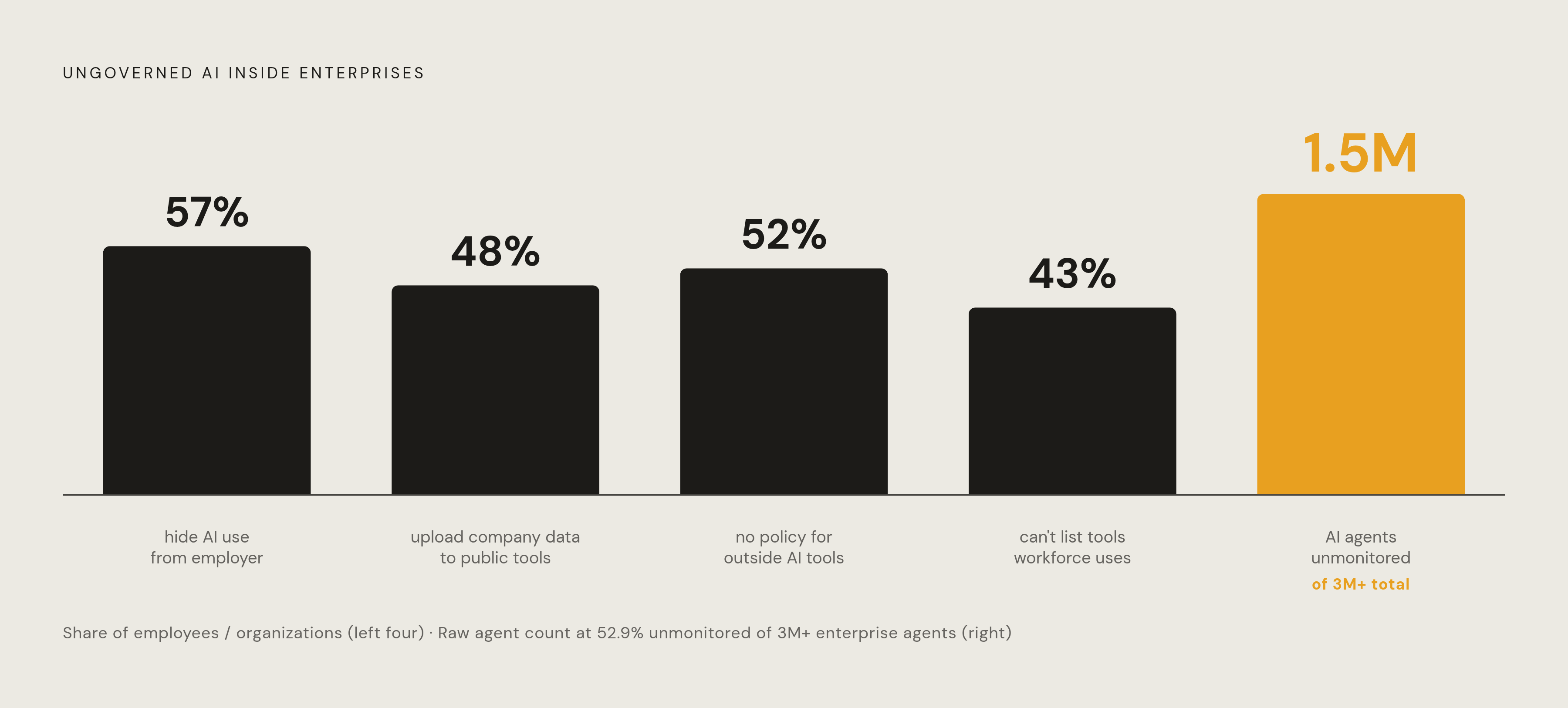
The University of Melbourne and KPMG ran the largest global study of workplace AI use to date, surveying 48,340 workers across 47 countries. The findings should worry anyone who thinks a written policy equals control: 57% of employees hide their AI use from their employer, and 48% have uploaded company information to public AI tools. Separate work from KPMG found 52% of organizations have no formal policy governing employee use of outside AI tools, and 43% can't even list which tools their own workforce is using.
Blocking access doesn't fix any of this. It just pushes the behavior somewhere leadership can't see it. Microsoft's 2024 Work Trend Index found 78% of AI users bring their own AI tools to work, approved or not. Give people a sanctioned path to the tools they already want, and shadow use drops. Ban the tools outright, and adoption moves underground, where nobody's watching.
The scale gets stranger once agents enter the picture. Gravitee's 2026 research counted more than 3 million AI agents already running inside corporations, with only 47.1% actively monitored or secured. Do the subtraction: roughly 1.5 million agents are running loose right now, touching sensitive data, wired into critical systems, with no audit trail behind any of it.
None of this comes free. IBM's 2025 Cost of a Data Breach Report found organizations with high levels of shadow AI paid $670,000 more per breach on average. Shadow AI has become a significant driver of security incidents, and organizations lacking governance controls consistently account for a disproportionate share of AI-related breaches, each carrying costs that rival or exceed the average enterprise breach.
None of this argues for slowing AI down. It argues for admitting that ungoverned AI is already the default state inside most companies, and that finding out about it after a breach costs far more than governing it beforehand.
What governance-first organizations actually do differently in deployment
Governance-first companies don't run five separate initiatives bolted onto each other. They build five habits into how AI actually ships, and each one answers a question that ungoverned deployments leave hanging.
Who owns it when something breaks? Accountability spanning Security, Risk, Compliance, Legal, and Technology answers that before an incident happens, not during the scramble after.
Can anyone explain why the model did what it did? Documenting how a system reaches a decision, what data feeds it, and where its limits sit is what lets the people inside a company trust the thing enough to keep using it.
Does every use case deserve the same scrutiny? It shouldn't. A chatbot answering FAQ questions needs a much lighter touch than a system approving credit or screening job applicants. Risk-based governance sorts that out up front, instead of applying one blanket rule to everything a company builds.
Are compliance requirements built in from the start, or bolted on later? Building them in during development beats retrofitting them after an incident, mostly because retrofits are slow, expensive, and nobody budgets for them ahead of time.
Is the governance model static, or does someone keep it alive? AI capabilities shift fast, and a framework written once and never revisited goes stale within a year, sometimes faster.
Agentic AI raises the stakes on all five questions at once. Research consistently shows that adoption of agentic AI is accelerating well ahead of the governance maturity needed to handle it safely. Agents act on their own, chaining actions across systems without a human checking each step along the way. The access controls and audit logs built for human-operated tools fall short here: reading a log after an agent has already acted is a postmortem, not a control.
Deloitte's State of AI in the Enterprise found worker access to AI rose 50% in 2025, and the number of companies with substantial AI projects in production is growing rapidly. Companies with governance infrastructure already in place absorb that velocity. Companies without it just pile up more exposure, faster than before.
The measurable returns that governance-mature organizations are already compounding
Research consistently finds that only a small share of organizations see significant financial returns from AI. What separates the ones that do is something other than budget size. It's how they operate. Ambition paired with governance discipline is the combination that shows up again and again: companies with strong AI strategies scale further and hit enterprise-level EBIT impact more often than companies without one.
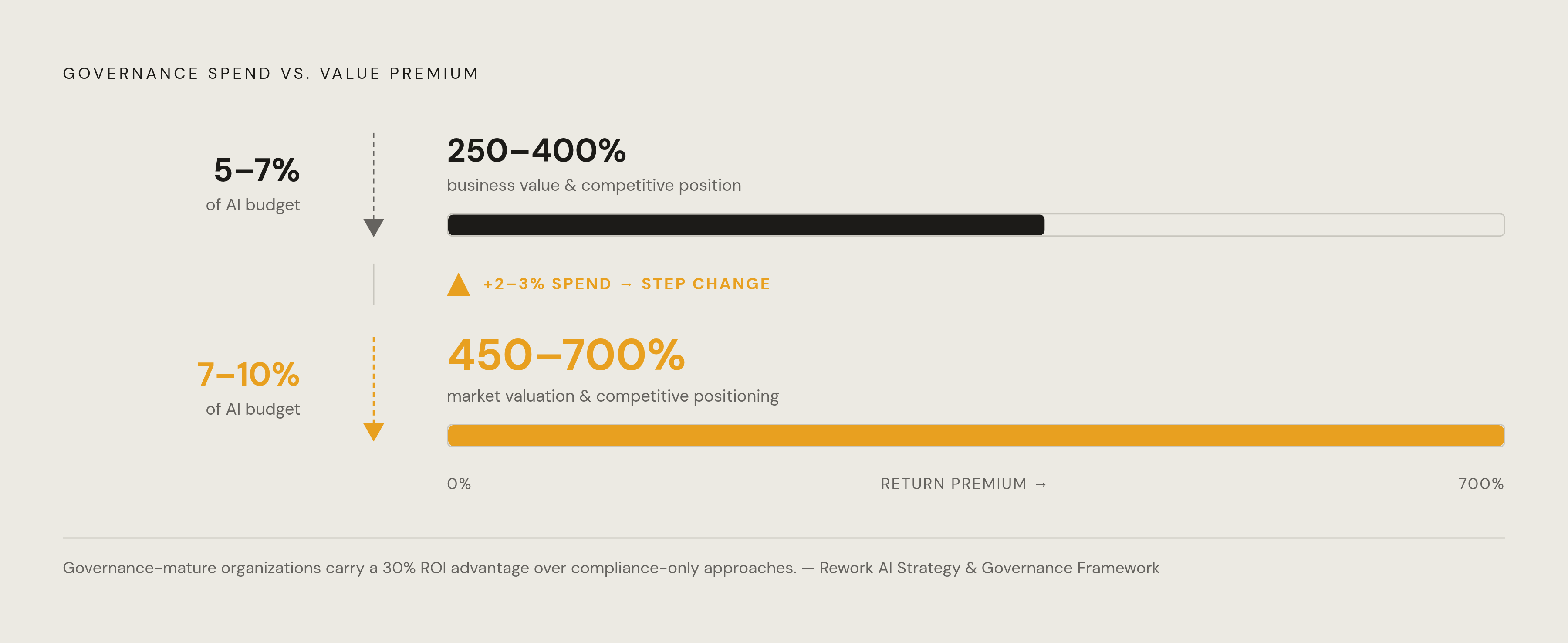
Organizations that treat governance as a strategic capability see a 30% ROI advantage over organizations that treat it as a compliance chore bolted on at the end. Rework's AI Strategy & Governance framework puts a number on the investment tier: companies spending 5 to 7% of AI budgets on operating models and governance capability see a 250 to 400% improvement in business value and competitive position. Push that spend to 7 to 10%, and the premium climbs to 450 to 700% in market valuation and competitive positioning.
The mechanism isn't complicated, even if the numbers look dramatic. Governance-first organizations pay the setup cost once, and every new use case after that inherits the framework instead of starting a risk review from scratch.
PwC's 2025 Responsible AI Survey found 60% of executives say responsible AI practice boosts ROI and efficiency, and 55% report better customer experience and more innovation. Nearly half still say turning those principles into daily operating process remains hard.
The counter-evidence matters just as much as the wins. Only 39% of organizations report enterprise-level EBIT impact from AI, and roughly 30% of AI projects were abandoned by 2025, killed by bad data quality, weak risk controls, ballooning costs, and unclear business value. The ROI figures above don't come from AI spending alone. They come from the gap between governed deployments and ungoverned ones. PwC found 61% of organizations sit at the strategic or embedded stage, where responsible AI is actually built into daily operations. Everyone else is still figuring out how to turn governance into a return instead of a line-item cost.
How regulatory requirements became a procurement sorting mechanism
The EU AI Act set a clock, and that clock now decides who wins contracts. Prohibited AI practices and AI literacy obligations took effect February 2, 2025. General-purpose AI model rules followed on August 2, 2025. The big compliance wave, covering high-risk systems in hiring, credit, education, and law enforcement, was set for August 2, 2026, before the Digital Omnibus on AI (Regulation (EU) 2026/1744), enacted July 27, 2026, pushed standalone high-risk obligations to December 2, 2027, and product-embedded high-risk systems to August 2, 2028. Prudent compliance planning still treats August 2026 as the deadline that matters, not the extension nobody should bank on. Penalties for violations are substantial, reaching into the tens of millions of euros or a percentage of global annual turnover, whichever is larger.
ISO/IEC 42001 has quietly become table stakes in procurement. Enterprise buyers increasingly treat ISO/IEC 42001 certification, or an equivalent third-party audit of an AI management system, as a preferred or required vendor qualification. Show up without it, and diligence cycles stretch out, audit costs pile on, and in a competitive bid, the deal just vanishes. The cost extends past the lost deal, too: it's the management hours spent proving governance ad hoc, work a certified competitor skips entirely by handing over one document.
Vendors have lost real public-sector contracts when evaluators concluded their AI platforms posed unacceptable risks to data security and sovereignty. Those are governance failures, not product failures, and they cost real deals.
The US federal market tells a similar story. OMB M-25-21, issued in April 2025, required federal agencies to name Chief AI Officers. OMB M-26-04, from December 2025, added new procurement rules for large language models used by federal agencies, centered on unbiased AI principles. For any company selling into federal agencies, governance stopped being a nice-to-have. It became a contract term, plain and simple.
The regulatory picture isn't settling down, and it won't anytime soon. Companies that treat each new rule as a fire drill fall further behind every cycle. Companies with an existing governance program just absorb the next requirement as an extension of what's already running.
What board-level ownership of AI governance changes about organizational outcomes
Research on AI in the enterprise consistently finds that companies where senior leadership actively shapes AI governance get meaningfully more business value than companies that hand the whole job to technical teams and walk away.
The gap at board level is wide enough to be its own risk factor. Board-level AI expertise remains limited across most organizations, part of why KPMG International, working with the INSEAD Corporate Governance Centre, launched AI Governance Principles for Boards in April 2026. OMB M-25-21's mandate for Chief AI Officers sends the same signal from the federal side: AI governance is becoming a named executive job, not a task quietly distributed across whoever happens to be free.
Investors are paying attention too. The share of S&P 500 companies disclosing AI-related risk to shareholders rose from 12% in 2023 to 83% now. That represents genuine work beyond a regulatory checkbox getting filled in. It's a material concern shaping where capital actually goes.
What changes when the board owns this instead of delegating it downward? Controls get funded before something goes wrong, not after. Risk tolerance for AI gets set on purpose, instead of drifting into place through unmonitored deployment nobody signed off on. AI investment gets tied to business outcomes instead of chasing whatever looks technically interesting that quarter. And when something does go wrong, there's a named person responsible for fixing it, not a room full of people pointing at each other.
Research has found organizations without a formal AI governance framework are significantly more likely to suffer project failures, compliance violations, or reputational damage tied to AI. Treating governance as an asset rather than a burden is what earns trust from regulators and enterprise buyers alike, and that trust matters more with every quarter agentic AI keeps scaling.
Where the governance advantage is won or lost in the agentic AI transition
Agentic AI adoption is accelerating across enterprises, yet only a small fraction have governance models mature enough to handle it safely. That gap is the entire competitive sorting mechanism for the next few years, and it is widening with every quarter.
The money backs up the urgency. Future Market Insights values the AI governance market at $2.20 billion in 2025, projecting growth to $11.05 billion by 2036, a 15.8% compound annual growth rate. That's $8.50 billion of new market opportunity, driven by the shift from voluntary ethics guidelines to mandatory compliance obligations with real penalties attached to them.
Agentic AI is harder to govern than anything that came before it, for a structural reason: agents chain actions across systems on their own, without waiting for a human to sign off on each step. A single ungoverned agent can touch data, make a decision, and trigger a downstream process before anyone even knows it acted. Identity and access management has to stretch to cover the agents themselves, not just human users, because every agent endpoint added without an entry in some registry is an identity nobody can account for. Knowing what an agent accessed after the fact is a postmortem. Real-time visibility into what it's accessing right now is the control most organizations still don't have.
Companies positioned to lead this transition already have a few pieces in place: centralized access policy enforcement, so approving a new agent deployment doesn't mean building a risk review from zero every single time, and audit infrastructure that runs continuously instead of switching on only after something breaks. Add a governed path for employee AI adoption, one that pulls shadow use into the light instead of driving it further underground, and the pattern holds across every company doing this well.
Google Cloud's ROI of AI 2025 report, a global survey of 3,466 senior leaders, found 88% of agentic AI leaders are already seeing returns. The report points to executive sponsorship, data governance, and cross-functional integration as the pattern behind that number. Governance offers a foundation for experimentation, contrary to what most leadership teams still assume. It's the prerequisite for running AI at production scale, and that distinction is what the next few years of competition will actually be built on.
Sources
- Enterprise AI Governance: Complete Implementation Guide (2026) | Liminal
- "AI Strategy & Governance: A Core Business Competency (2026)"
- AI Governance as Competitive Advantage: Why Responsible AI Builds Customer Trust (2026)
- Explore the Global Enterprise AI Governance and Compliance Market— analysis of key trends, regional growth, top players, and a 10-year forecast from 2026 to 2036.
- AI Governance Statistics 2026: Key Data & Insights
- Shadow AI Statistics: Key Data Points Every CISO Needs in 2026 | Airia