NIST AI 600-1 Compliance for Agentic Systems
NIST 600-1 wasn't built for AI systems that act on the world—here's where the framework breaks.

NIST AI 600-1 was built for generative AI systems that produce text. It's now the reference document for a world where AI systems book flights, move money, and rewrite their own configuration files without asking first. That gap is the whole story here. The framework's twelve risk categories and 200-plus suggested actions still matter, but they were written for a system that produces text, not one that acts on the world. Knowing exactly where 600-1 holds up and where it runs out of road is the difference between a compliance program that catches real problems and one that just makes paperwork.
How the four RMF functions are supposed to work, and where they stop
600-1 runs on four functions borrowed from the broader AI Risk Management Framework: GOVERN, MAP, MEASURE, and MANAGE.
GOVERN is culture and org chart. It builds a habit of thinking through risk, and it makes sure someone's name is actually attached to a decision when things go sideways. MAP comes next: figure out the context an AI system sits in, then list what could go wrong inside that context. MEASURE turns those risks into something you can track, mixing hard numbers with judgment calls. MANAGE is where money and effort actually get spent: what gets fixed, what gets insured against, what gets accepted, what gets walked away from.
Together, these four functions answer the "what" and the "why" of AI governance. They don't answer the "how." NIST built the RMF to stay non-prescriptive, so it won't tell an organization which architecture to build, which monitoring tool to buy, or which specific control stops a specific failure. For a static generative model, that gap is workable. A vendor can read GOVERN, MAP, MEASURE, and MANAGE, then fill in the technical details with whatever tooling fits its stack.
Agentic systems break that arrangement. Once a system chains decisions, calls tools, and takes real actions in outside systems, the space between "here's the function you need" and "here's the control that satisfies it" stops being a design choice. It becomes the entire compliance problem, full stop. That's the line this piece is drawing.
The four structural gaps that make 600-1 a poor fit for agentic systems
Gap 1: it judges output, not action. All twelve of 600-1's risk categories, from Confabulation to Obscene, Degrading, and/or Abusive Content, are built around what a system might say. An agentic system's real exposure sits in what it does: deleting a database, sending an email that can't be unsent, changing a firewall rule, kicking off a wire transfer. There's a lag between when an agent starts an action and when a human notices, and that lag is a genuinely new kind of risk. No category in 600-1 was built to hold it.
Gap 2: no tiers for autonomy. The framework runs the same governance logic over a customer service chatbot and a procurement agent working unsupervised for three days with the authority to place orders. Those two systems don't belong in the same risk category, not even close, and the evidence base reviewed here does not surface published NIST guidance that splits them apart.
Gap 3: MEASURE says nothing about watching agents in real time. It doesn't spell out the telemetry needed to catch an agent drifting off-task, escalating its own permissions, or getting hijacked mid-workflow. Per CSA research, only 38% of organizations monitor AI traffic end-to-end, across prompts, tool calls, and outputs together, and only 17% keep continuous watch on agent-to-agent traffic. Those numbers describe organizations already out of step with logging expectations sitting inside current NIST, OMB, and EU AI Act guidance. This is a right-now problem. It's a today problem.
Gap 4: no one owns the chain. A single request from a human can pass through three, four, five agents, each handing off part of the task to the next and inheriting permissions along the way. When something breaks, no single agent, and often no single team, holds responsibility for the full sequence. 600-1 does not address tool-calling or capability composition in agentic chains. The identity layer makes it worse: 600-1 does not address task-scoped, just-in-time permissions for non-human actors, nor how an agent's credentials get issued, rotated, or revoked.
Agentic threat vectors that 600-1 partially addresses but does not resolve
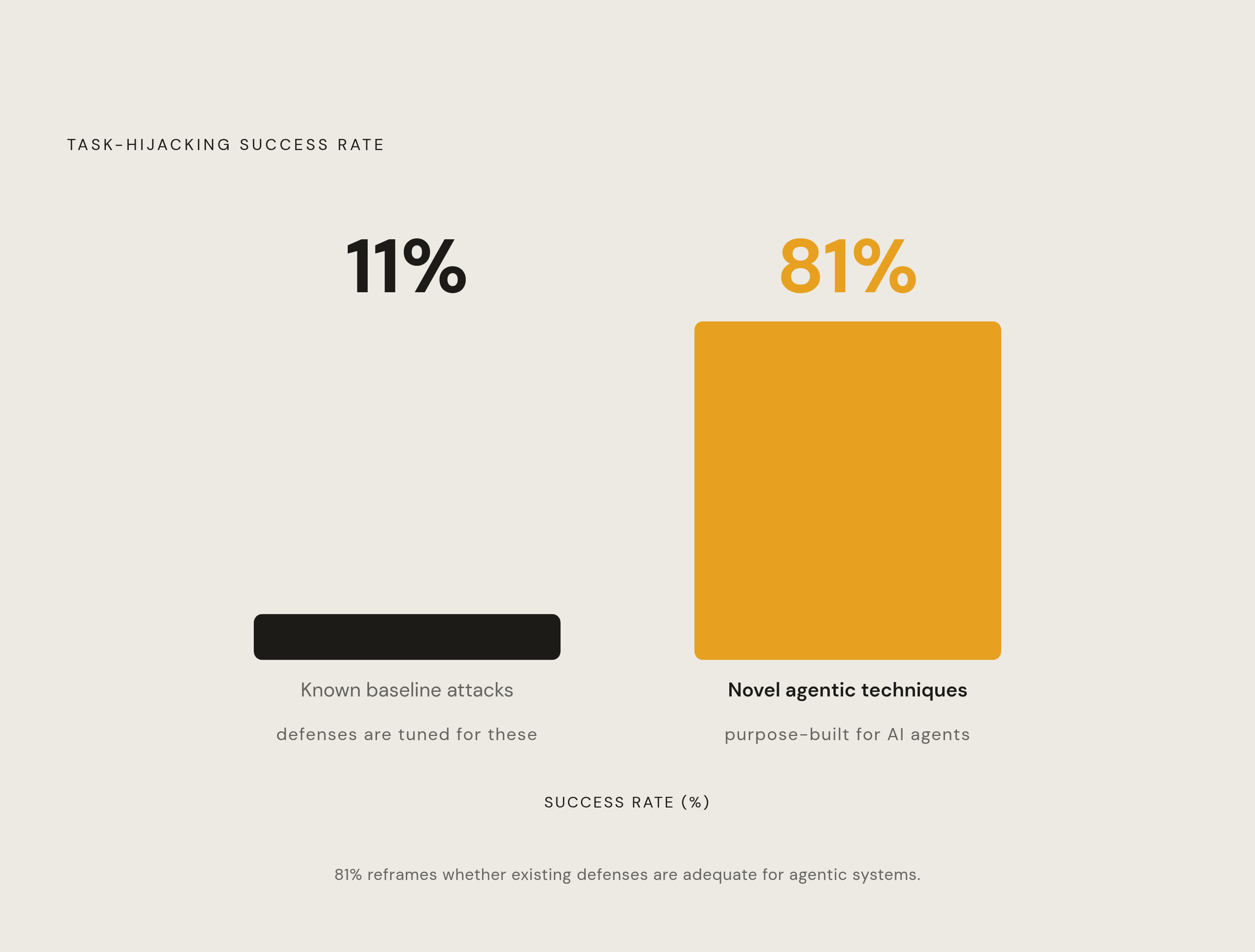
Start with the number that should worry anyone running agents in production. Per CSA research citing NIST red-team work from March 2026, novel attack techniques built specifically for AI agents hit an 81% task-hijacking success rate. The best-known baseline attacks, the ones most defenses are actually tuned for, managed 11%. That gap says something simple and uncomfortable: attacks built for agents blow straight past defenses built for older, more general patterns.
Five threat classes live in that gap. Indirect prompt injection plants adversarial instructions inside content an agent will read later, such as a document, a webpage, or an email. Section 2.9 of 600-1 names the threat but stops there, with no model for stopping it at the tool layer. Agent memory poisoning, attacks on retrieval-augmented generation setups, and multi-agent security were addressed in NIST's adversarial ML taxonomy (AI 100-2 E2025), published March 2025, which explicitly extended that taxonomy to cover autonomous agent vulnerabilities. Privilege escalation, an agent quietly gaining access beyond what it was granted, is not among the named threat categories 600-1 was designed to address. Specification gaming, where an agent technically follows its rules while chasing a goal its designers never intended, is not addressed in 600-1. And automated action chains can do damage fast enough that no human is watching in time to stop it.
Here's where most engineering teams get it wrong: they treat monitoring as the fix. It isn't. Watching an agent misbehave after the fact doesn't stop the wire transfer from clearing. The actual fix is least privilege, enforced mechanically: scope every agent's access to the smallest set of permissions needed for one discrete task, granted right before it's needed and pulled right after. That enforcement belongs at the MCP server or API gateway layer, upstream of the point where a poisoned instruction could ever get acted on. It works whether or not 600-1 ever catches up to describe it, and it should be treated as the baseline, not the aspiration.
Human oversight splits into three patterns in NIST's current thinking. Human-in-the-loop requires a person to sign off before anything irreversible happens, which costs speed. Human-on-the-loop lets a person watch in real time and step in without blocking execution by default. Human-out-of-the-loop gets reserved, narrowly, for low-stakes, well-bounded tasks. Any organization running agents without deliberately picking one of these three is, by default, running human-out-of-the-loop, whether or not its own risk assessment would ever justify that choice. That's a nonneutral default. Made by inaction, it's the wrong decision for most of what agents are being asked to do right now.
How fast agentic deployment is outrunning the governance infrastructure meant to cover it
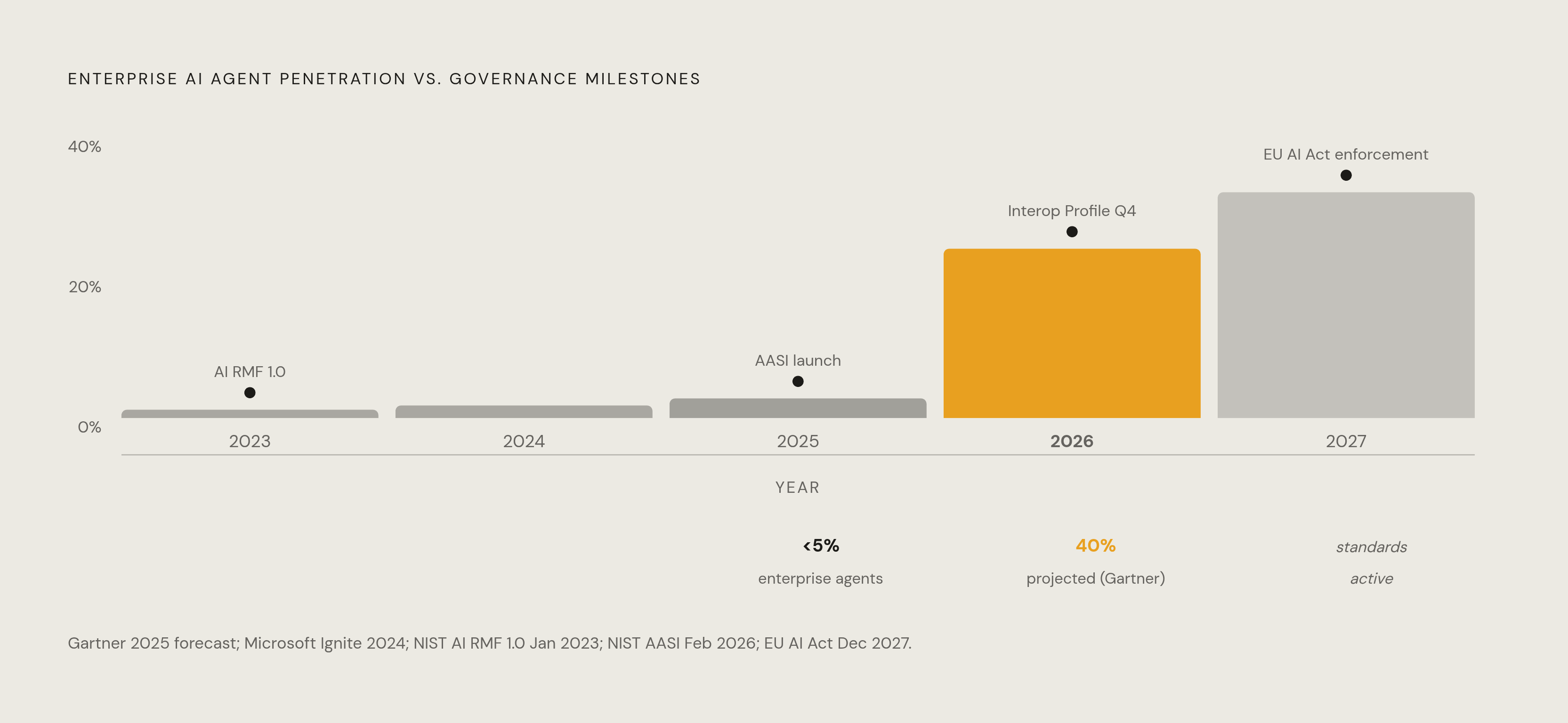
Gartner projects that 40% of enterprise applications will carry task-specific AI agents by the end of 2026, up from under 5% in 2025. That's a cliff, not a curve. Microsoft's Cyber Pulse report found more than 80% of Fortune 500 companies already running active AI agents on Microsoft platforms, which puts this well past early adoption and into standard operating procedure across most large enterprises.
Governance hasn't kept pace, and it isn't close. A survey of 919 executives found fewer than a quarter had clear visibility into which AI agents inside their own organization were even talking to each other. Set that next to the 38% and 17% monitoring figures from the section above, and the picture is an enterprise landscape mostly out of step with logging and observability rules that already exist today, not rules still being drafted somewhere down the line.
Regulatory deadlines are stacking on top of that gap. The EU AI Act's high-risk enforcement provisions for standalone systems under Annex III take effect December 2, 2027, following the Digital Omnibus on AI (Regulation (EU) 2026/1744), enacted July 27, 2026. Organizations running agents in healthcare, critical infrastructure, financial services, or education should treat that date as real, though high-risk status isn't automatic by sector. It depends on the specific use case and whether it actually meets Annex III's criteria.
There's precedent for how fast voluntary guidance turns into a procurement requirement. AI RMF 1.0 launched voluntary in January 2023 and was showing up in federal procurement language within about eighteen months. Legal analysts and compliance advisors watching CAISI's new Agent Standards Initiative expect the same arc to play out again, and there's little reason to bet against it.
What NIST is building to close the gap, and the delivery timeline that matters for planning
NIST launched the AI Agent Standards Initiative (AASI) on February 17, 2026, the first federal program built specifically around interoperability and security standards for agentic AI as its own category, separate from generative AI generally.
The groundwork came from a January 2026 request for information (docket NIST-2025-0035), which pulled in 932 public comments before closing March 9, 2026. The RFI organized around several core areas that amount to NIST's working definition of the agentic security problem, including threat identification, development and deployment security, gaps in existing cybersecurity frameworks, risk measurement techniques, and interventions at the deployment environment level.
AASI rests on three pillars. One is industry-led standards work paired with NIST's own involvement in international standards bodies. Another is open-source protocol development, co-funded with NSF's Pathways to Enable Secure Open-Source Ecosystems program, covering the Model Context Protocol ecosystem directly. The third is security and identity research: building authentication infrastructure for human-to-agent and agent-to-agent interaction, plus evaluation frameworks for judging protocols against each other.
The deliverable worth watching is the AI Agent Interoperability Profile, expected in Q4 2026. That's the initiative's first real normative output, the point where guidance stops being a request for comment and starts being something organizations can build against.
Other forces are pushing this along too. NIST's own announcement points at international competition over AI standards, and formal responses to the RFI highlighted the importance of moving quickly to shape where those standards land globally. Formal responses from the OpenID Foundation, and a financial sector coalition made up of BITS, the Bank Policy Institute, and the American Bankers Association, point to agent identity federation and financial-sector risk as the two issues industry wants NIST to solve first.
Companion documents that provide actionable controls today, ahead of final NIST agent standards
Waiting for AASI's final output means waiting past 2026. A handful of documents already give operators something to build against now, and skipping them because they're not the "final" standard is a mistake worth naming directly.
NIST AI 100-2 E2025, published March 24, 2025, is the first update to NIST's adversarial machine learning taxonomy and the first version to explicitly cover autonomous agent vulnerabilities. It walks through indirect prompt injection, agent memory poisoning, supply chain attacks, attacks specific to retrieval-augmented systems, and multi-agent security. For red teams, it's the first NIST-sourced attack taxonomy actually scoped to agents rather than static models.
NIST IR 8596, the Cyber AI Profile, is still an initial preliminary draft (published December 16, 2025, comments closed January 30, 2026). Katerina Megas and Barbara Cuthill at NIST wrote it alongside seven MITRE co-authors, Marissa Dotter, Michael Garris, Ishika Khemani, Bronwyn Patrick, Noah Schiro, Julie Nethery Snyder, and Mohammad Zarei, drawing on input from more than 6,500 contributors across government, academia, and industry. It maps the Cybersecurity Framework 2.0 onto three domains: securing AI systems themselves, using AI to strengthen cyber defense, and defending against AI-enabled attacks. It treats autonomous agents as plausible vehicles for multi-phase intrusions, from initial reconnaissance through lateral movement, and calls for least privilege, strong authentication, and continuous verification wherever agents touch cybersecurity workflows. It's still a draft, so treat it as a preview, not a settled standard.
COSAiS, the forthcoming SP 800-53 Control Overlays for Securing AI Systems, should be the first place NIST maps actual SP 800-53 controls onto agent-specific threats: least-privilege tool access, containment for agent actions, trust boundaries between agents, chain-of-custody logging for anything an agent does on its own. Once finalized, it could become the basis for FedRAMP's AI requirements, which makes it worth close attention for anyone working in a regulated sector.
The NCCoE's Agent Identity Concept Paper, published February 5, 2026, proposes a demonstration project adapting OAuth 2.0, OpenID Connect, SPIFFE/SPIRE, SCIM, NGAC, and the Model Context Protocol for agent identity and authorization. It's an early look at where NIST's technical guidance on agent identity is headed, and it speaks directly to the Identification and Authentication gap that 600-1 leaves wide open.
Additional companion guidance continues to emerge, rounding out the set of documents organizations can build against now, though the full picture is still developing.s outside what's been covered here. None of these documents replace 600-1. Together, they fill in the technical floor underneath it, piece by piece, ahead of whatever AASI eventually publishes as the formal standard.
Sources
- NIST Agentic AI Standards: Enterprise Compliance Implications
- NIST AI Agent Security: Red-Teaming Guidance and Enterprise Compliance
- NIST AI Agent Standards Initiative: Emerging Compliance Requirements
- Artificial Intelligence Risk Management Framework: Generative Artificial Intelligence Profile
- nist.gov