Enterprise AI use and compliance
Most enterprises spend billions on AI without governance, leaving compliance to chance or crisis.
The final paragraph reads as a vendor pitch rather than earned insight. Here's the edited version with that passage revised to reflect genuine deliberation rather than promotional framing:
78% of organizations now use AI in at least one function, up from 55% two years ago, according to McKinsey. That's the headline, but here's the part that doesn't make the slide deck: most of those companies never built governance to match, and that gap doesn't stay open forever. It closes one of two ways, either a company closes it on purpose, or a regulator, an auditor, or a breach closes it for them.
Where AI investments are landing and what they're actually returning
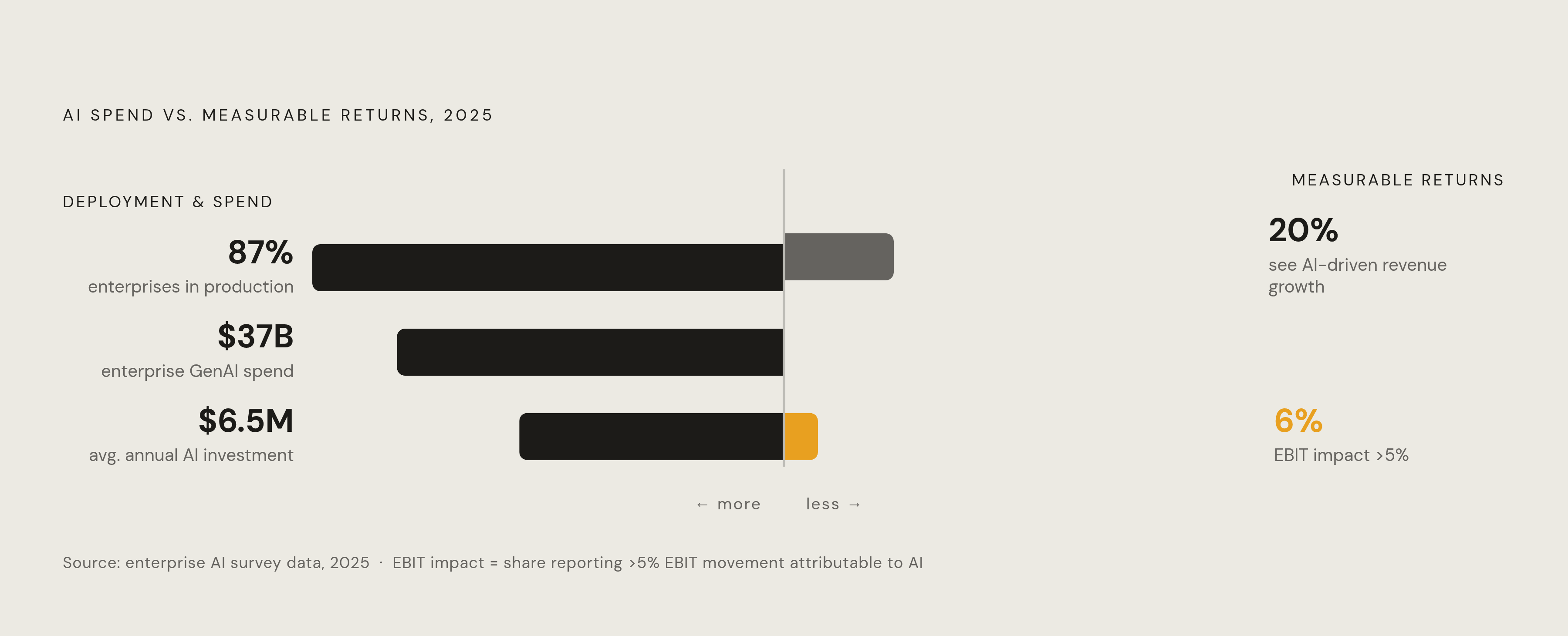
The money moved fast, faster than most budgeting cycles can usually stomach. Enterprise generative AI spend hit $37 billion in 2025, up from $11.5 billion the year before. US enterprise AI spend is projected to hit $407 billion in 2026. Large enterprises now average $6.5 million a year in AI investment, and 87% of them already have some system running in production.
Returns are lagging, the way they usually do in cycles like this one. Deloitte's 2026 survey of over 3,000 leaders found 66% report productivity gains, but only 20% see AI-driven revenue growth from any of it. PwC found just 12% of companies, what it calls the "vanguard," hit both revenue growth and cost reduction in the past year. MIT's NANDA research is blunter still: only 6% of companies say AI moves EBIT by more than 5%.
So spending is way out ahead of proof. Companies plan to roughly double AI investment as a share of revenue by 2026, and agentic AI, systems that act on their own instead of just assisting someone, has surged as a leading priority across enterprise technology roadmaps. Ship first, prove value later sounds fine in theory, but governance keeps getting pushed to whenever there's time left over, and there's rarely time left over. Weak governance and ROI-chasing travel together, and I'd argue weak governance is one of the actual reasons the ROI doesn't show up.
Why shadow AI is the real compliance problem at enterprise scale
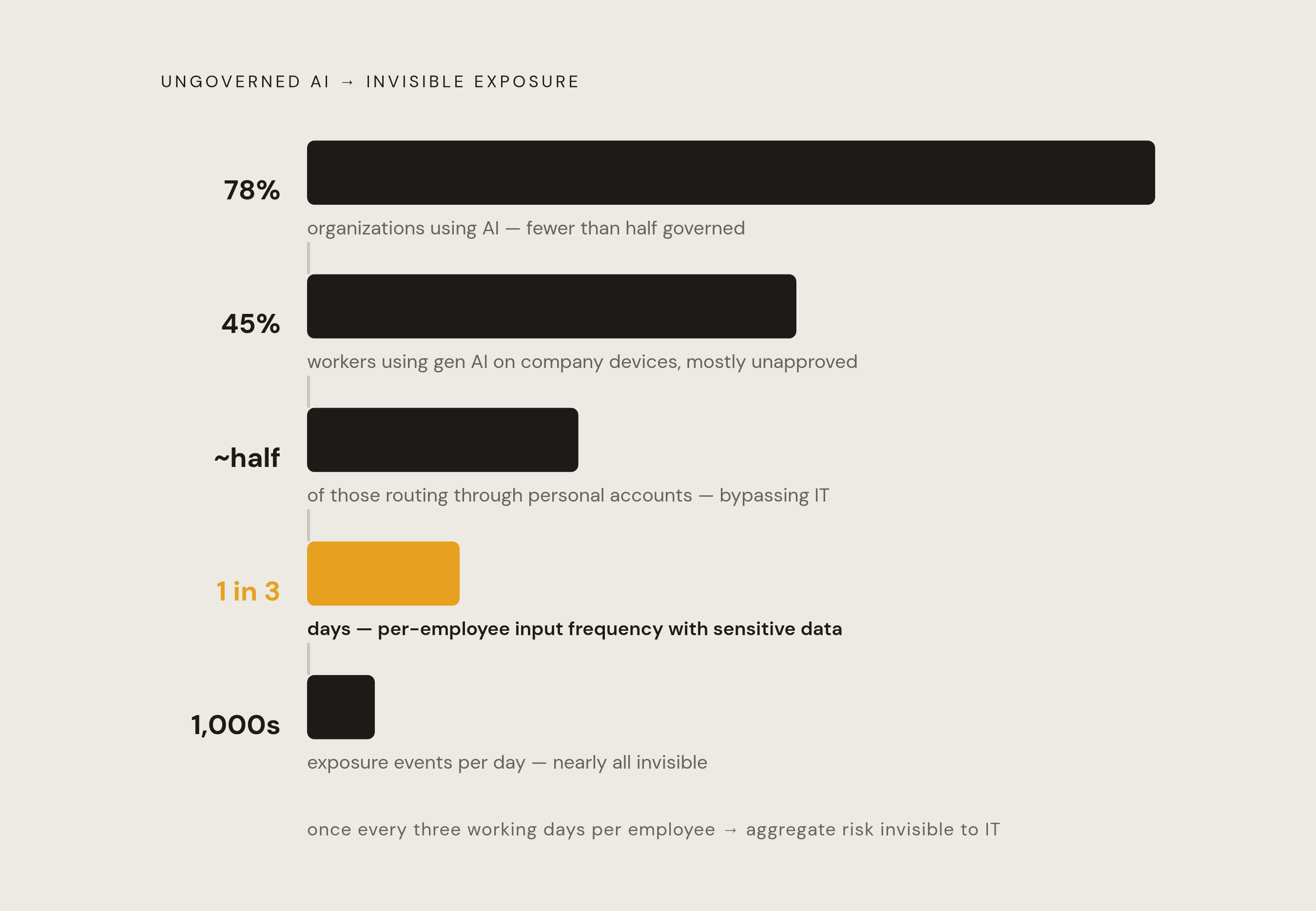
Only a minority of organizations have an AI governance policy in place, per IBM, compared to the 78% already using AI somewhere in the business. That forty-point gap is where shadow AI lives, and it isn't shrinking.
Most leadership teams underestimate how deep this runs. Verizon's 2026 Data Breach Investigations Report found around 45% of workers use generative AI regularly on company devices, most of it neither approved nor watched by anyone. Nearly half of generative AI users go through personal accounts, sidestepping whatever controls IT put in place. Only a small slice of organizations have technical controls that could even catch someone pasting confidential data into a chatbot mid-conversation.
Cyberhaven's number is the one I quote most: the average employee inputs sensitive data into an AI tool roughly once every three working days. Multiply that across a few thousand employees and you get thousands of exposure events a day, almost all invisible to whoever's supposed to be watching.
Banning the tools doesn't end the behavior, it just pushes it somewhere darker. A survey of 302 cybersecurity leaders found a large majority of organizations already suspect, or have proof, that employees use prohibited generative AI tools. The trajectory of shadow AI exposure suggests a growing share of enterprises face a security or compliance incident tied directly to ungoverned AI use. The companies with the lowest shadow AI rates share one habit: they gave people a sanctioned way to get the tool they wanted, instead of saying no and hoping that holds.
What existing regulations already cover — before AI-specific law applies
Here's what a lot of teams miss: the channel is new, but the violation almost never is. GDPR, HIPAA, CCPA/CPRA, PCI DSS, all of it attaches the moment sensitive data lands in a prompt. Someone pastes a customer list into a consumer chatbot, and that's a GDPR and CCPA exposure event today, whatever AI-specific law eventually says.
Most of the compliance risk sitting on companies right now traces back to privacy and sector rules that predate AI by years, sometimes decades. Waiting for AI-specific legislation before building real governance is a bet that's already lost. The financials back this up: Research tracked by adaptivesecurity.com puts average annual insider incident costs in the tens of millions, up 20% in two years, with shadow AI accelerating that curve. IBM found average costs from AI-model breaches in financial services top several million dollars.
The reporting math alone should worry people. One AI-related incident can trigger multiple separate notification clocks at once, each running under a different regulatory framework with its own deadline. An organization without real-time visibility into what its AI systems actually touched can't hit those windows. A log pulled after the fact just documents what already went wrong, long past the point anyone could've stopped it.
What the EU AI Act actually requires and when enforcement starts
The EU AI Act, Regulation EU 2024/1689, represents a sweeping regulatory framework for AI. It staggers obligations by risk level, with different requirements applying to different categories of AI system. High-risk systems, things like employment decisions, credit scoring, education, and law enforcement, carried earlier compliance deadlines under the Act's risk-tiered structure.
A subsequent legislative adjustment pushed some of those deadlines back. Systems used in biometrics, critical infrastructure, education, employment, migration and asylum, and border control received extended timelines under the revised schedule. Physical products with AI built in, robotics and industrial machinery among them, received the longest lead time under the phased approach.
Some obligations didn't move at all, though. Certain obligations, including enforcement powers over General Purpose AI and the penalty regime, were not subject to the same delays and took effect on their original schedule. The delay is narrower than most organizations think, and treating it as a blanket reprieve is a mistake I'd bet plenty of companies still make.
That 78% adoption figure tells you nothing about whether a company is actually ready for the Act. If anything, the extra runway from the Omnibus delay becomes an excuse to keep putting this off. The Act demands continuous monitoring, plainly put, so the governance infrastructure has to run all the time, not just show up when a regulator knocks. None of this stays inside EU borders, either: the Act reaches any provider or deployer whose systems touch people inside the EU, wherever the company itself is headquartered.
How governance built alongside adoption differs from governance bolted on after
I've watched this play out the same way often enough to call it a pattern. An organization locks AI down at the perimeter, adoption slips underground anyway, and then an audit or a breach surfaces the fact that the logs never covered the tools people were actually using. By the time anyone notices, the exposure has been running for months.
The alternative looks different from day one. Access policies, tool registries, agent identity controls, all built before wide deployment instead of after. That lets a company move into production AI with real confidence instead of crossed fingers, without slowing anything down. The organizations getting actual returns share a few habits: they invest in people and process alongside the technology, they build human oversight into anything high-stakes, and they treat AI access as an identity and access management problem folded into existing security work, rather than some separate "AI policy" living off on its own.
Agentic AI raises the stakes considerably here. Analysts expect task-specific AI agents to expand dramatically across enterprise applications in the near term. Every one of those agents is a new identity with its own reach into systems and data. An unregistered agent is a risk nobody can even name, because it's an identity nobody's accounting for.
Run this through role-based access control and the question changes shape: whether that access reflects a decision someone actually made on purpose, rather than a default nobody checked, matters more than what AI can technically do. Visibility has to run live, too, because an audit log tells you what already happened but can't stop the thing from happening in the first place. Observability treated like paperwork produces documentation after the damage. Observability treated as operational produces governance that heads the damage off before it starts.
What a governance layer that keeps pace with adoption actually looks like in practice
Four pieces matter here, and they need to work as one system or none of them hold.
A centralized registry of every AI tool and agent in use, because you can't watch what isn't registered. Access controls scoped to role and data sensitivity, not a blanket yes or a blanket no. Real-time observability into what agents and tools actually touch, not logs somebody skims in batches once a week. A real path for employees to request new tools, because without one, people route around the rules and adopt things quietly instead.
The Model Context Protocol layer deserves its own mention. As enterprises wire AI agents into internal systems through MCP servers, each server becomes a potential access point. An ungoverned MCP server carries exposure the moment it goes live unregistered, long before anyone formally notices the risk.
A handful of platforms have started building at exactly this layer, bundling a gateway, guardrails, and agent identity management into one place. Some tools in this space offer centralized control over what agents can actually reach across a company's systems. MCPManager, a Usercentrics product, sits in this category, focused on auditing and monitoring AI data access via MCP. Whether tools like this hold up under real enterprise load is still an open question, honestly, since most of them are barely a year old. The direction is worth tracking regardless, because it says something about where the market thinks the problem actually sits: governance as infrastructure, run with the same seriousness as security or identity management, built early instead of bolted on after something breaks.
That distinction matters. Governance at this layer works as an operational floor, running constantly, letting a company grow its AI footprint without its risk footprint growing right alongside it dollar for dollar. Guardrails, in this framing, are what make production deployment possible in the first place. Companies that treat governance as infrastructure tend to ship agentic AI faster as a result.
IBM's CEO study found roughly 25% of AI initiatives deliver the returns leaders expected going in. What separates that quarter from everyone else comes down to clear scope, real oversight, and accountability someone can trace back to an actual decision, more than luck or a bigger budget. A working governance layer is what makes that possible at scale. At this point, the compliance conversation and the ROI conversation aren't really two conversations anymore.